


Average order value: definition, calculation, how to increase it
It's essential to know how to calculate the average order value of your e-commerce site. This allows you to improve your online store's business strategy and increase your profits.
This article will guide you through calculating your average order value. It will also provide tips for increasing the transaction value on your website.
Average Order Value — definition
Average order value is the average amount spent per customer, whether online or in your physical store. It's an important indicator for tracking sales evolution and comparing the profitability of your different sales channels.
By understanding the average order value, you gain valuable insights into your customers' purchasing behavior. For example, the average number of items per cart helps you know how many items are generally bought per transaction, which can shed light on the effectiveness of your upselling strategies.
Moreover, the customer lifetime value shows you how much a customer brings in, on average, as long as they continue to purchase. This indicator is essential for evaluating loyalty and determining if your retention efforts are paying off.
In short, these metrics, when analyzed together, offer a clear and detailed overview of your store's performance, allowing you to adjust your strategies in a more targeted and effective manner.
Your goal will be to increase it as much as possible to improve your business's profitability.
How to Calculate Average Order Value?
Calculating the average order value for your online business is relatively simple. Simply divide your total revenue by the total number of orders placed over a given period. Here's the simple formula:
Total Revenue / Number of Orders
Calculation Example
Imagine your online store made €15,000 in sales this month, with a total of 300 orders placed. The average order value is calculated as follows:
15000 / 300 = 50€
Calculating average order value by product type: Why is it important?
This calculation method helps you discover the most popular products and those often purchased together within the same category. You can then create bundled offers directly on the product page, which immediately increases your sales.
How to calculate the average order value for a product category?
Calculate the average order value for a category by dividing its revenue by the number of orders over a given period.
This approach allows you to precisely understand what contribution each category makes to your overall revenue, and to adjust your sales strategies accordingly.
How you can Increase the Average Order Value of your online store?
Increasing the average order value allows you to boost online sales and your company's profitability.
Preliminary considerations for increasing average order value
Increasing the average order value in your business can be a powerful strategy, but it's crucial to approach it with the right mindset and an awareness of legal parameters. Here's what you should consider before launching promotional activities:
-
Understand legal limits
In many regions, including France, strict laws govern promotional activities. These rules are in place to protect consumers from misleading practices. A key regulation to know is the prohibition of selling products at a loss outside of official sales periods. Violating this rule can lead to heavy penalties. -
Evaluate promotion effectiveness
Before implementing a promotion, evaluate its potential impact. Ask yourself if the increased sales volume will cover reduced prices and ensure profitability. A well-planned strategy should not only attract more customers but also generate a tangible profit. -
Comply with advertising regulations
When advertising promotions, transparency is essential. Clearly communicate details such as the duration of the promotion, original prices, and the quantity of available products. Misleading advertisements can lead to charges of false advertising, which carry severe consequences.
By keeping these considerations in mind, you can effectively plan promotions that increase the average order value while remaining compliant with legal standards. This strategic approach not only protects your business but also strengthens customer trust.
Here are seven simple techniques to encourage your customers to buy more.
1. Cross-selling
Offer additional or improved products when purchasing from your online store. This is called cross-selling and upselling.
For example, if I buy a day cream, you also recommend a night cream to enhance the effectiveness of my skincare. By offering me this product combination, you provide an attractive discount that makes me consider the opportunity to sell complementary products. So, why not?
This technique, called cross-selling, encourages customers to buy more products.
2. Upselling (upgrading)
Upselling involves encouraging customers to purchase a more expensive / higher-end version of the product or service they are considering buying.
For example, if I add a computer with low storage, the site will recommend a slightly more expensive model, but with more storage.
3. Free shipping above a certain amount
Set a minimum order amount to qualify for free shipping. This can encourage consumers to add more items to their cart.
You can include a message in the cart to indicate how much is left to qualify for free shipping. You can also add a free shipping progress bar so the user can better visualize this information!
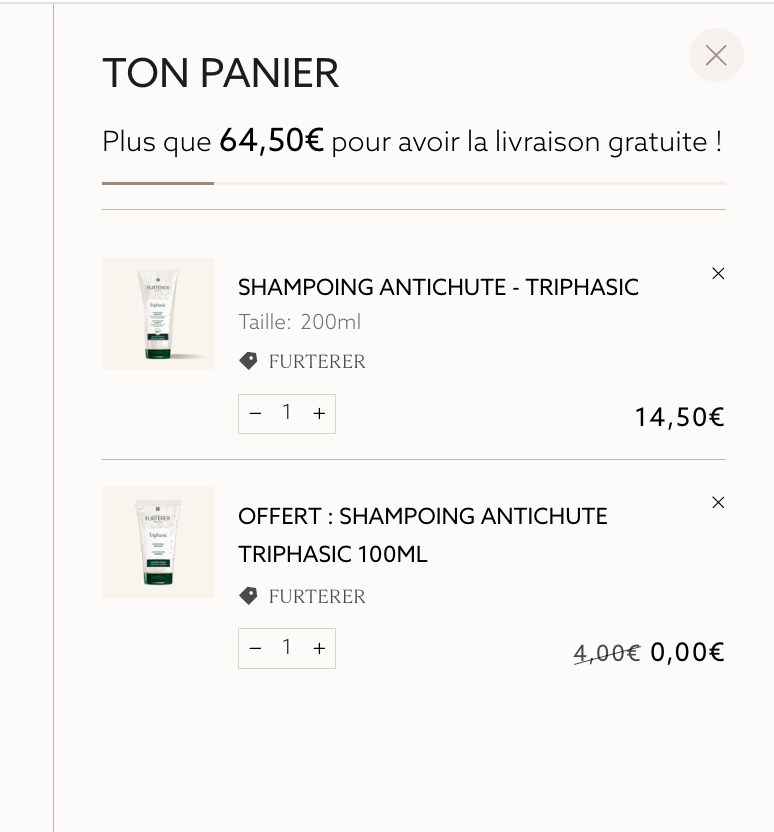
E-commerce cart: An effective method to immediately increase the average order value.
4. Quantity Discounts
Encourage larger purchases by offering discounts on buying multiple similar items.
Understanding tiered pricing strategies
Tiered pricing is a common tactic where the cost of additional items progressively decreases. This approach encourages customers to buy more by offering larger discounts with each additional purchase. For example, a customer might buy a belt for €30. If they buy a second belt, the price drops to 50% of the original price, and a third belt could cost even less, perhaps with a 75% discount.
Impact on average order value
This strategy can significantly increase the average cart size, every retailer's dream. Here's how:
- Increased volume: It motivates customers to buy multiple units, effectively clearing inventory. This is particularly useful for selling old stock or items with higher profit margins.
- Perceived value: Customers feel they are receiving more value as they buy more, thus increasing loyalty and return rates.
- Margin management: While appealing, it is crucial to use this strategy judiciously. Selling at significant discounts too frequently can erode profit margins.
By carefully implementing tiered pricing, businesses can boost sales while intelligently managing inventory. However, it is essential to balance discounts to maintain profitability.
5. A loyalty program
Reward regular customers with points or discounts to use on their next orders. This could encourage customers to include more items in their cart.
5. A loyalty program
A loyalty program can not only retain your customers but also boost their average order value. Here's how:
- Point Accumulation: Offer 1 point for every €10 spent. This system encourages customers to spend more to accumulate more points.
- Attractive Rewards: Offer gifts or vouchers that customers can unlock once they reach a certain number of points. This motivates them to exceed their usual purchase to achieve their reward goals.
- Growth Strategies: If you have a solid customer base, these incentives can transform occasional visits into regular and more substantial purchases.
By integrating these strategies into your loyalty program, you create an environment where every purchase becomes an opportunity for the customer to get more, while contributing to the increase in your average order value.
6. Use Klaviyo, the email marketing solution
To send post-purchase emails such as:
- A thank-you email with a coupon.
- A "we miss you" email for customers who haven't made a purchase in the last 45 days.
And why not try the SMS marketing solution (integrated with Klaviyo)?
7. Offer product bundles
Create a dedicated page for product bundles offered at advantageous prices. For example, propose a "discovery pack" including different miniature products or a "tasting pack" to discover your best-sellers for example. This approach is beneficial: it allows the customer to get several products at a reduced price and increases the overall sales of your store.
Why limited-time promotions increase average order value?
Limited-time promotions are a powerful tool in the marketing arsenal for several compelling reasons. They not only temporarily boost sales but also improve overall purchasing behavior, leading to a higher average cart size. Here's an explanation of their effectiveness:
1. Urgency incites action
Creating a sense of urgency is at the heart of successful limited-time promotions. By setting a deadline, you play on the human instinct to act quickly to avoid missing out. This urgency directly relies on the psychological principle known as "fear of missing out" (FOMO). Buyers feel compelled to finalize their purchase sooner than planned, often buying more than they initially intended.
2. Incentive for larger purchases
When customers perceive a limited-time offer as an exceptional deal, they are more inclined to add additional items to their cart. For example, if a product is reduced from €20 to €15 for a short period, the perceived savings can encourage them to add complementary products to maximize the value of that shopping trip.
3. Create buzz and visibility
Limited-time promotions create buzz, sparking conversations and attracting attention both online and offline. If effectively communicated through various channels, such as email campaigns, social media, or on-site banners, these promotions can attract both new and returning customers, increasing overall traffic and conversion rates.
4. Encourage impulse purchases
A limited-time offer often leads to impulse purchases. When time is short, customers may forgo lengthy deliberations about potential purchases. Instead, they act quickly, leading to an increase in cart size as they seize the opportunity before it disappears.
5. Strategic inventory management
These promotions also help move inventory, freeing up space for new products. Retailers can strategically choose which items to offer at a reduced price for a limited time, often selecting products that pair well with full-priced items. This pairing naturally increases the average order value, as customers are incentivized to buy the promotional item with other full-priced products.
In conclusion, limited-time promotions leverage urgency and appeal to consumer psychology, generating larger transactions and improving overall sales performance. When executed carefully, they not only increase the average order value but also provide a compelling reason for customers to return.
Optimizing the customer journey to increase average basket value
When a customer enters a store, various obstacles can dissuade them from making multiple purchases. They might be in a hurry, decide not to buy, or opt for fewer items. To counter these obstacles and increase the average basket value, it's crucial to strategically design the shopping experience.
1. Design a clear path
First, separate the store entrance from the checkout area. By creating a defined path that naturally guides customers through the store, you increase the likelihood of unplanned purchases. As customers move through the store, they encounter a range of products, finding themselves faced with tempting offers they hadn't initially planned to buy.
2. Establish distinct zones
To make the journey effective, prioritize setting up different zones:
- The transition zone: This zone connects the entrance to the main sections of the store. It's an opportunity to introduce customers to the store layout and highlight special offers or limited-time promotions such as sampling a new product. This initial engagement can pique interest and encourage the first purchase.
- The hot zone: This busy segment of the store captures increased customer attention. It's the ideal place for premium products and impulse buys due to its high foot traffic. Position higher-margin items here to capitalize on spontaneous purchasing decisions.
- The cold zone: While not all stores have this section, it can maintain customer interest towards the end of their shopping journey. Stock it with essential or frequently forgotten items that encourage additional purchases, reminding customers of vital needs.
- The checkout zone: At the conclusion of the journey, this area often seems intimidating due to the impending payment process. Alleviate this tension by creating a friendly atmosphere and offering small, inexpensive items that stimulate impulse buys—think chocolates or small gadgets. These additions, though minor per transaction, can significantly increase your overall sales when accumulated across all transactions.
3. Practical application: Learning from industry leaders
Retail icons like IKEA have mastered this approach by creating an immersive shopping journey that guides customers through various themed displays. This strategic path encourages them to explore and ultimately purchase items as they effortlessly move from one section to another.
By carefully designing each step of the customer journey, businesses can effectively mitigate obstacles to purchase, foster stronger engagement, and increase basket size.
Monitoring and analyzing average order value over time
It is important to regularly check your website's key statistics.
Number of visitors
Visit duration
The most popular product categories.
This data helps evaluate the effectiveness of different actions taken to adjust the strategy accordingly.
With Google Analytics, you can track and analyze average order value and purchase conversion metrics. These tools help understand customer behavior and improve sales performance. For example, the conversion rate, which measures the percentage of buyers compared to the total number of website visitors.
On platforms like Shopify, this information is easily accessible via the dashboard. Online store owners can monitor key indicators. They can make informed decisions to improve their sales.
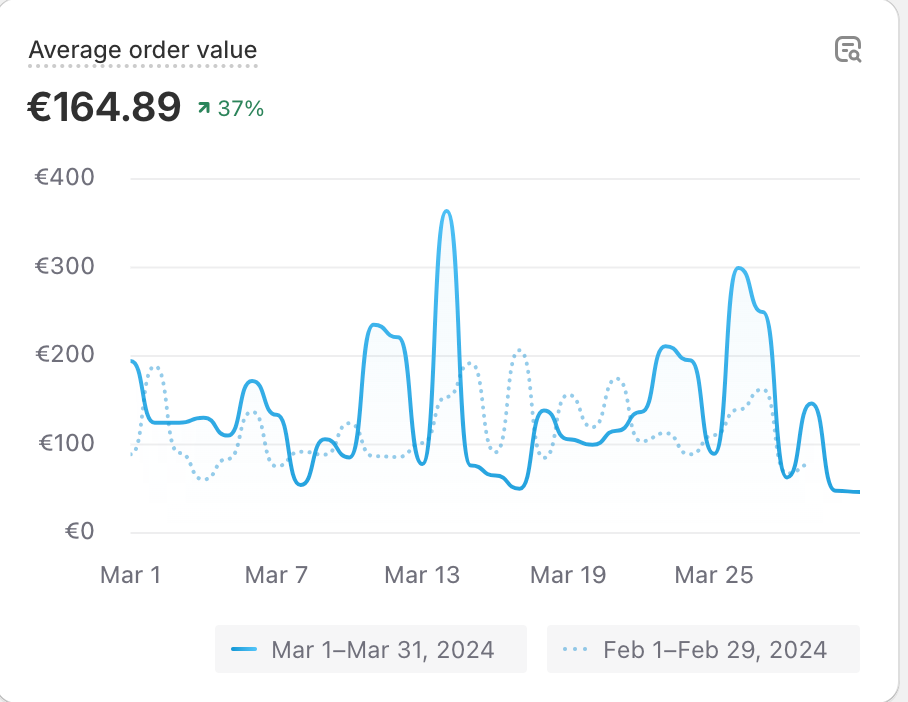
Dashboard - Shopify
FAQ
Why is it important to calculate the average order value?
This allows them to understand their customers' purchasing habits, improve their sales techniques, and increase their profits.
How can the average order value be used to boost online sales?
Brands can implement effective strategies by calculating the average purchase amount. These strategies include cross-selling, bulk purchase discounts, and free shipping.
These strategies encourage customers to spend more, which increases the value of each transaction and boosts overall sales.
What impact do promotions have on the average order value?
Promotions can influence the amount customers spend. They can encourage them to buy more to benefit from an offer or, conversely, reduce the total spent by offering significant discounts. A promotional strategy must be well-balanced to ensure it stimulates consumption without eroding the profit margin.
Legal Considerations for Implementing Promotions
When planning promotions to increase your business's average order value, it is crucial to navigate the legal landscape carefully. Here are some key legal considerations to ensure your promotions comply with the law:
1. Restrictions on Selling at a Loss
In France, outside of designated sales periods, businesses are prohibited from selling products below their purchase price. This restriction is applied to prevent predatory pricing practices. Violating this rule could lead to severe penalties.
2. Evaluating the Impact of the Promotion
Before launching a promotion, it is essential to evaluate its potential impact. Ensure that the promotion is likely to generate a significant sales volume to make it profitable. Without this analysis, the promotion might not deliver the expected financial benefits.
3. Advertising Compliance
Promotional campaigns must comply with advertising regulations. This includes specifying the duration of the promotion, the original prices of the products, and the quantities available. Misleading advertisements are considered deceptive practices and lead to strict legal consequences.
By keeping these guidelines in mind, you can effectively manage your promotional strategies while avoiding legal pitfalls.
What tools can help track and analyze the average order value?
Google Analytics and Shopify dashboards are useful for tracking online sales and other important data. These tools help measure online sales performance.
Why is the average order value low?
If you find that your average order value is low, it's important to understand the reasons.
This could be due to offering free shipping for all orders, regardless of the amount.
It may also be that you haven't sufficiently developed incentive sales strategies for additional products.
Feel free to implement one or more of the strategies we presented in this article.
Conclusion
Understanding how to calculate average order value and optimize it is crucial for maximizing the profitability of your online store.
By using strategies such as cross-selling and targeted marketing, you can increase the value of each sale.
This can lead to an increase in your revenue.
If you have any questions or would like to learn more about how we help our clients increase their average order value and boost sales, feel free to contact us here.
See also
How to increase conversion rate?