

Why Mobile Will Dominate E-commerce Beauty in 2026
Mobile now accounts for between 59% and 79% of traffic in beauty e-commerce, a figure that still surprises many e-commerce managers who believe that desktop remains the preferred channel for purchases. This mobile dominance is radically transforming how consumers discover, evaluate, and buy online cosmetic products. This article explores why mobile is becoming the primary channel in beauty, how purchasing behaviors are evolving, which technologies are amplifying this trend, and, most importantly, how to optimize your store to maximize mobile conversion.
Table of Contents
- Key Takeaways
- Mobile: The Primary Driver of Traffic and Sales in Beauty E-commerce
- Mobile Consumer Behaviors and Expectations in Beauty
- Mobile Technologies Revolutionizing the Beauty Shopping Experience
- Optimizing Mobile Conversion: Bridging the Gap with Desktop
- The Impact of Mobile Social Commerce on the Beauty Sector
- Optimize Your Beauty E-commerce Store for Mobile with Tamara Agency
- Frequently Asked Questions about Mobile in Beauty E-commerce
Key Points
| Point | Details |
|---|---|
| Mobile domination in beauty | Mobile accounts for the majority of traffic and purchases in beauty, requiring optimization of the mobile experience. |
| Instant loading required | 53% of buyers abandon a mobile site that takes more than three seconds to load. |
| One-click payment | Payment should be completed in a maximum of two or three steps to encourage mobile conversions. |
| Immediate personalization | Personalized recommendations and content should be displayed as soon as the user arrives on the site. |
| Social engagement and reviews | The integration of reviews and user-generated content must be quickly accessible to influence mobile purchases. |
Mobile: The Primary Driver of Traffic and Sales in Beauty E-commerce
The beauty sector is experiencing a massive shift towards mobile, far surpassing other industries. Mobile accounts for 78% to 79% of e-commerce traffic in this sector, compared to about 60% for general retail. This dominance is explained by purchasing behaviors specific to the cosmetics world, where visual inspiration, spontaneous discovery, and quick product information searches align perfectly with mobile usage.
Data shows that the majority of beauty purchase journeys begin on smartphones, even when the final transaction occurs on desktop. Consumers use their mobile devices to compare prices, read reviews, check ingredients, and watch tutorials before making a decision. This reality transforms mobile into a priority acquisition and influence channel for any ambitious beauty brand.
Why mobile dominates in beauty:
- Users check their smartphones an average of 96 times a day, creating multiple opportunities for contact with your brand.
- Beauty purchases are highly visual and emotional, perfectly suited for mobile formats rich in images and videos.
- Social networks, primarily consumed on mobile, have become the primary channel for beauty product discovery.
- Voice search and mobile navigation enable impulsive purchases facilitated by ease of access.
- Push notifications and geotargeted marketing create contextualized shopping moments impossible on desktop.
| Channel | Share of beauty traffic | Average conversion rate |
|---|---|---|
| Mobile | 78 to 79% | 1.8 to 2.3% |
| Desktop | 21 to 22% | 3.2 to 4.1% |
| Tablet | 2 to 3% | 2.5 to 3.0% |
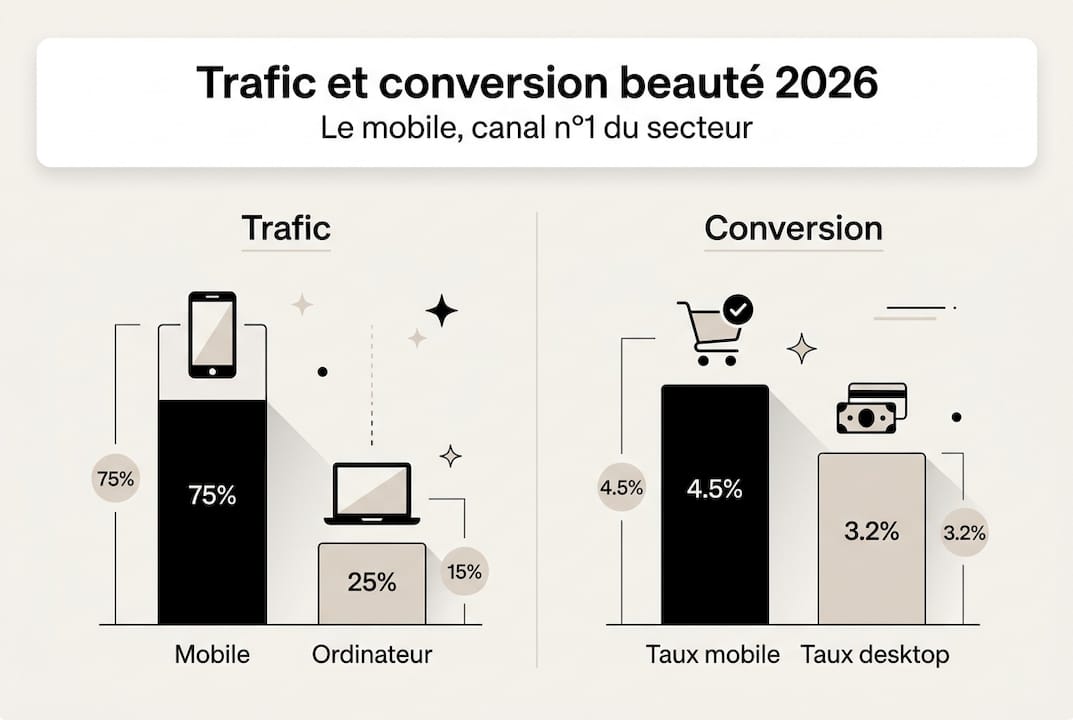
Optimizing your site is therefore essential to convert this massive mobile traffic into concrete revenue. Ignoring this reality means leaving 4 out of 5 visitors with a potentially degraded experience.
Mobile Consumer Behaviors and Expectations in Beauty
Beauty shoppers on mobile exhibit distinct profiles and behaviors that demand a specific approach. Gen Z spends 3.5 hours daily on their smartphones, with 61% of them exclusively using mobile for online purchases. This generation, which represents a growing share of the beauty market, expects a fluid, fast, and socially integrated experience.
Mobile behavior is characterized by short but frequent sessions. Users check your store during micro-moments: on public transport, during lunch breaks, or in the evening before bed. These fragmented moments demand intuitive navigation where key information appears immediately without excessive scrolling. 62% of French e-shoppers now make their purchases via mobile, confirming that the smartphone is no longer just a research tool but a transactional channel in its own right.
Specific expectations of mobile beauty consumers:
- Instant loading: 53% abandon a mobile site that takes more than 3 seconds to load.
- Immediate personalization: recommendations based on history and preferences displayed upon arrival.
- Social integration: direct access to customer reviews, user-generated content, and social proof.
- One-click payment: checkout process reduced to a maximum of 2 or 3 steps.
- Enriched visual support: product videos, multiple photos, and high-resolution zoom adapted for touchscreens.
Pro tip: Identify your key micro-moments by analyzing peak mobile traffic hours. Schedule your marketing campaigns and product launches to coincide with these windows of maximum attention. A beauty brand we work with increased its email open rate by 47% by sending newsletters at 8:30 PM instead of in the morning.
Understanding these behaviors allows you to adapt your Shopify beauty store creation strategy to precisely meet the expectations of your mobile audience. Projects like the Maison Les Pierres Dorées migration illustrate how a mobile-centric redesign transforms user engagement.
Mobile Technologies Revolutionizing the Beauty Shopping Experience
Recent technological innovations are transforming mobile into an ultra-performing beauty shopping platform. 5G, augmented reality, and biometric payments are gradually eliminating the frictions that historically hampered mobile conversion. These technologies are no longer futuristic but are already being deployed by leading brands that are seeing measurable impacts on their sales performance.

Augmented reality represents a major breakthrough for mobile beauty. Virtual try-ons for makeup, hairstyles, or skincare allow consumers to visualize product results on their own faces before purchasing. This feature drastically reduces product returns while increasing purchase confidence. Brands integrating AR see conversion rates 94% higher than classic product pages.
Key technologies boosting mobile beauty commerce:
- 5G and instant loading: connection speed enabling high-definition videos and fluid navigation without latency.
- AR facial recognition: virtual makeup product try-on with realistic colorimetric precision.
- Biometric payment: purchase validation by fingerprint or facial recognition in less than 2 seconds.
- Artificial intelligence: personalized recommendations based on skin type, preferences, and purchase history.
- Progressive Web Apps: app-like experience without installation, combining speed and advanced functionalities.
Beauty brands that integrate virtual AR try-on on mobile see an average increase of 94% in conversion rate and a 25% reduction in product returns, transforming the mobile experience into a decisive competitive advantage.
These technologies no longer require prohibitive investments. Platforms like Shopify now offer AR integrations accessible via third-party apps. A well-designed Shopify store redesign integrates these functionalities natively, providing your customers with a mobile shopping experience that rivals physical retail.
Optimizing Mobile Conversion: Bridging the Gap with Desktop
The conversion gap between mobile and desktop is not inevitable but rather the result of insufficiently optimized user experiences. Data shows that mobile-optimized beauty sites improve their conversion by 34% and reduce cart abandonment by 28%. These substantial gains come from targeted UX adjustments that eliminate frictions specific to the mobile journey.
The average mobile conversion rate in beauty ranges between 1.8% and 2.3%, compared to 3.2% to 4.1% on desktop. This gap is mainly due to unsuitable interfaces, excessive loading times, and overly complex checkout processes. Correcting these weaknesses dramatically transforms your commercial performance without requiring an increase in traffic.
| Metric | Before Optimization | After Optimization | Improvement |
|---|---|---|---|
| Conversion Rate | 1.9% | 2.5% | +34% |
| Cart Abandonment | 78% | 56% | -28% |
| Loading Time | 4.2s | 1.8s | -57% |
| Pages Viewed/Session | 3.1 | 4.7 | +52% |
5 essential practices for optimizing mobile beauty conversion:
1. Fixed "Add to Cart" bar: Keep the CTA button permanently visible, even on long product pages with detailed descriptions.
2. Express checkout: Offer Apple Pay, Google Pay, and Shop Pay for purchase validation in a maximum of 2 clicks.
3. Optimized images: Compress your visuals without losing quality to ensure loading in under 2 seconds.
4. Thumb-friendly navigation: Place clickable elements in the thumb-accessible area (bottom and center of the screen).
5. Minimalist forms: Limit mandatory fields to a maximum of 3 and enable smart auto-completion.
Pro tip: On long product pages with detailed ingredients and usage tips, implement a sticky bar containing the price and the "Add to Cart" button. This simple modification increases the add-to-cart rate by an average of 23%, as users no longer have to scroll back up the page to purchase after reading the information.
Optimizing your Shopify store must prioritize these mobile elements to convert your majority traffic into proportional revenue. Every friction eliminated directly translates into additional sales.
The Impact of Mobile Social Commerce on the Beauty Sector
Social commerce, commerce directly integrated into social platforms, is redefining the beauty purchase journey on mobile. TikTok Shop generated approximately $1 billion in beauty sales in one year, demonstrating the power of this new approach where discovery, inspiration, and purchase merge into a single experience. This convergence eliminates the intermediate steps that traditionally caused potential customers to drop off.
Social commerce works particularly well on mobile because it aligns with users' natural behaviors. 68% of beauty consumers state that social networks directly influence their purchasing decisions. Short video formats, influencer demonstrations, and authentic reviews create immediate trust that traditional product pages struggle to replicate.
Effectively integrating mobile social commerce into your beauty strategy:
- Activate native shopping features on Instagram, TikTok, and Facebook to allow purchases without leaving the app.
- Collaborate with micro-influencers whose audience matches your target for authentic product demonstrations.
- Encourage user-generated content by creating branded hashtags and reposting the best customer posts.
- Use live shopping to showcase new products with real-time interaction and exclusive offers.
- Synchronize your Shopify catalog with your social stores for centralized inventory and order management.
Social commerce doesn't replace your online store but creates additional entry points into your e-commerce ecosystem. An integrated strategy where your social profiles lead to your optimized Shopify site maximizes both discovery and conversion. Our Shopify training precisely covers these social commerce integration strategies for beauty brands.
Optimize Your Beauty E-commerce Store for Mobile with Tamara Agency
Transforming your mobile presence into a conversion machine requires sharp industry expertise and deep technical mastery of Shopify. Since 2018, Tamara Agency has supported ambitious beauty brands in creating mobile-optimized Shopify stores that convert majority traffic into proportional revenue. Our approach combines aesthetic design aligned with your brand's universe and technical optimizations that eliminate every friction point in the mobile journey.

We offer comprehensive solutions tailored to your level of maturity: turnkey store creation for launches, mobile-centric redesign for existing brands, and Shopify training to empower your teams. Each project incorporates current best mobile practices: ultra-fast loading, intuitive navigation, express checkout, and social commerce integration. Our beauty sector expertise guarantees an immediate understanding of your specific challenges and rapid implementation of proven solutions. Discover our Shopify store optimization service to transform your mobile performance today.
Frequently Asked Questions about Mobile in Beauty E-commerce
What percentage of e-commerce traffic in beauty is mobile?
Mobile accounts for between 78% and 79% of e-commerce traffic in the beauty sector, representing nearly 4 out of 5 visitors. This proportion significantly exceeds the average for online retail and continues to grow with the massive adoption of smartphones by younger generations.
How can I improve my store's mobile conversion rate?
Prioritize three areas: loading speed under 2 seconds, simplified checkout with express payments, and thumb-optimized navigation. Data shows that comprehensive optimization improves mobile conversion by an average of 34%. Also, test a fixed "add to cart" bar on your long product pages.
Which mobile technology tools are effective for beauty customers?
Augmented reality for virtual try-ons, biometric payments for instant checkout, and Progressive Web Apps for an app-like experience without installation. AR, in particular, increases conversion by 94% because it reduces purchase uncertainty by allowing customers to visualize product results.
Can social commerce really boost my beauty sales?
Absolutely. TikTok Shop alone generates approximately $1 billion in annual beauty sales, and 68% of beauty consumers are influenced by social media in their purchasing decisions. Integrating shops on Instagram, TikTok, and Facebook creates additional entry points that capture customers where they already spend their time.
How does mobile influence the purchasing behavior of younger generations?
Gen Z spends 3.5 hours daily on mobile, with 61% exclusively using this channel to shop online. They expect an instant, visually rich, and socially integrated experience. Their purchasing journey often starts on social media, moves through mobile searches, and concludes with a one-click purchase via biometric payment.