

8 E-Commerce Website Design Trends to Adopt in 2026
Design is now central to the success of online stores. By 2026, competition will intensify and consumers will become more demanding, making user experience crucial for conversion and loyalty.
Given these challenges, mastering e-commerce site design becomes essential to stand out and meet new usage patterns. This article presents the 8 major trends to adopt to build an innovative, high-performing site aligned with market expectations.
Discover how concrete examples and practical advice will help you transform your customers' experience. Ready to rethink your design strategy and get ahead? Follow this guide to make a difference today.
Why e-commerce site design is evolving in 2026
New purchasing behaviors and consumer expectations
French consumers are adopting new habits, notably a strong growth in mobile purchases, which now exceed 53%. They seek immersive, personalized, and seamless experiences. Speed, simplicity, and trust are becoming essential criteria in choosing an online store. Innovative brands are transforming their approach to meet these demands.
Impact of technological advancements
The rise of artificial intelligence, augmented reality, and dynamic personalization is revolutionizing e-commerce site design. Automated product recommendations and intelligent merchandising facilitate discovery and increase engagement. New technologies also offer unparalleled animations and web interactivity, making the user experience more captivating.
Increased competition and differentiation through design
The e-commerce market is saturated, pushing brands to differentiate themselves through design. An aesthetic and high-performing site becomes a powerful lever for acquisition and loyalty. According to some studies, a visitor forms an opinion in just 50 milliseconds, making e-commerce site design decisive for conversion.
Accessibility and digital inclusion
Accessibility is becoming a priority. Standards are evolving to ensure that every user, including those with disabilities, can navigate without obstacles. Inclusive, universal, and responsive design expands the site's reach, improves satisfaction, and meets regulatory expectations.
Evolution of SEO standards and web performance
SEO requirements are strengthening, particularly with Google's Core Web Vitals, which prioritize speed, visual stability, and interactivity. The link between UX, SEO, and visibility has never been stronger. Optimized e-commerce site design, as detailed in Website Design Optimization, improves positioning and user experience.
Concrete examples of successful redesigns in 2025-2026
Several brands have seen their conversion rates climb thanks to the adoption of new trends. Figures from client cases and industry studies confirm the positive impact of a redesigned e-commerce site, both on engagement and profitability.
Challenges for beauty, fashion, and wellness brands
Sectors with strong visual identity such as beauty, fashion, and wellness require a fine adaptation of design trends. Storytelling, graphic consistency, and the valorization of brand universes become essential to attract and retain demanding customers.
8 E-commerce Site Design Trends to Adopt in 2026
In 2026, success in e-commerce site design requires a deep understanding of the trends shaping user experience and commercial performance. Brands that anticipate these evolutions gain a head start on the competition, attract consumers, and optimize their conversion rates. Discover the 8 essential trends to integrate into your e-commerce site design strategy to ensure innovation, efficiency, and adaptation to new usage patterns.
1. Ultra-optimized mobile experience and Mobile-First
Mobile now dominates e-commerce site design, with over 53% of purchases made on smartphones in France. Adopting a mobile-first approach from the wireframing phase is no longer an option, but a necessity.
Focus on fluid navigation, contextual menus accessible with the thumb, and clearly visible call-to-action buttons. Optimize image and video sizes to ensure fast loading, which is essential for both customer satisfaction and SEO.
Brands like Outdoor Voices or Vogueon (Dribbble) perfectly illustrate this trend with clean and intuitive mobile interfaces. Their e-commerce site design promotes conversion through clarity and speed.
Remember to:
- Systematically test display on different devices.
- Prioritize essential content on the mobile version.
- Use tools like BrowserStack to validate compatibility.
Google now heavily values mobile-friendly sites in its results, confirming the importance of this trend for e-commerce site design. A slow or poorly adapted mobile site risks losing up to 40% of visitors in a few seconds.
2. Dynamic personalization through AI
Artificial intelligence is revolutionizing e-commerce site design by enabling real-time personalization. Product recommendations, content, and even promotional offers adapt to the behavior and profile of each user.
Solutions like Shopify or third-party modules make personalization accessible, even to small businesses. Leaders like Amazon or Sephora leverage AI to increase engagement, average order value, and customer loyalty.
To effectively integrate this trend into your e-commerce site design:
- Analyze customer data to segment your audiences.
- Implement personalized recommendations on the homepage and product pages.
- Favor a discreet UX so as not to overwhelm the user.
Pay attention to data protection and transparency with your customers. Personalization should never harm the fluidity of the journey. A well-thought-out e-commerce site design leverages AI without complicating the experience.
3. Creative use of video and interactive content
Video and interactive content is becoming a pillar of e-commerce site design. Immersive videos on the homepage or product pages, such as demonstrations or storytelling, promote engagement and brand memorization.
Interactive experiences such as quizzes, animations, or dynamic carousels enrich the customer journey. According to Shopify, adding product videos can increase the conversion rate by 30%.
For a high-performing e-commerce site design:
- Favor short, subtitled videos that can be played silently.
- Optimize media weight to ensure fast navigation.
- Draw inspiration from Lunaria Beauty Studio (Dribbble) or fashion brands that broadcast runway clips.
Interactivity stimulates interest and helps differentiate your e-commerce site design in a saturated market. Be sure to maintain a balance between innovation and simplicity.
4. Minimalist design and ultra-clear navigation
Minimalism is a strong trend in e-commerce site design. It promotes understanding, reduces cognitive load, and maximizes conversion. A clean design, short menus, strong visual hierarchy, and ample white space make navigation more intuitive.
Examples like NUMA Beauty, SEESUN Landing Page, or Thesus show how a minimalist e-commerce site design improves display speed and readability. These sites show better Core Web Vitals performance, essential for natural referencing.
To apply this trend:
- Limit the number of interactive elements per page.
- Structure information clearly and progressively.
- Test navigation clarity with tools like heatmaps or user tests.
A minimalist e-commerce site design does not sacrifice brand identity, but highlights it. It also reduces cart abandonment rates by eliminating distractions.
5. Advanced integration of augmented reality (AR) and 3D
Augmented reality and 3D open up new perspectives for e-commerce site design. Consumers can now visualize products from all angles or try them on virtually, whether for clothing, accessories, or makeup.
Platforms like ThreadLab 3D Fashion Platform, or major beauty and fashion brands, leverage this technology to offer an immersive experience. The benefits are numerous: reduced returns, strengthened engagement, marked differentiation of e-commerce site design.
To integrate AR and 3D:
- Use mobile and desktop compatible solutions.
- Ensure not to burden loading speed.
- Offer simple access without third-party applications.
The growth of AR on mobile is spectacular, and customer expectations are evolving rapidly. The main obstacles remain production costs and technical compatibility, but the benefits for e-commerce site design are undeniable.
6. Accessibility and inclusivity at the heart of design
Accessibility is becoming essential in e-commerce site design, both for ethical and regulatory reasons. Complying with WCAG 2.2 standards from conception ensures an inclusive experience for all, including the 15% of the population with disabilities.
Good practices include:
- High contrasts and legible texts.
- Keyboard navigation and alternative descriptions for images.
- Regular testing with tools like Lighthouse, Axe, or Wave.
Pioneering brands integrate accessibility from the design phase, thus expanding their audience and strengthening their legal compliance. An accessible e-commerce site design also improves SEO and brand perception.
Regularly audit your site to identify areas for improvement. Accessibility benefits everyone and is becoming a selection criterion for many consumers.
7. Eco-design and environmental performance
Eco-design is gaining ground in e-commerce site design, in response to consumers' environmental awareness. A sober design, optimized media, green hosting, and limiting scripts reduce the digital carbon footprint.
According to Shopify, 70% of buyers say they are sensitive to the environmental impact of their purchases. Brands that value their eco-responsible approach gain in image and loyalty.
For an ecological e-commerce site design:
- Measure your impact with tools like Website Carbon or GreenIT Analysis.
- Reduce the weight of images and videos.
- Choose technical partners committed to the ecological transition.
Eco-design is becoming a full-fledged CSR criterion, influencing purchasing decisions. An e-commerce site design that performs well in this area combines innovation, efficiency, and respect for the environment.
8. Seamless payment and friction-free checkout experience
Payment is a decisive lever in e-commerce site design. A simplified purchasing funnel, with fewer steps, auto-fill, and integration of wallets (Apple Pay, Google Pay, BNPL), significantly reduces cart abandonment.
Solutions like Shopify Checkout or Amazon One-Click illustrate the importance of a friction-free payment experience. According to the Baymard Institute, 21% of abandonments are due to a process that is too long or complex.
To optimize this key stage of e-commerce site design:
- Clearly display fees and order summary.
- Reassure about security and confidentiality.
- Offer several payment options adapted to your market.
Seamless payment improves conversion and brand image. To go further on the redesign and optimization of your purchase tunnel, discover best practices in this article on Shopify Store Redesign.
Tamara Agency: Shopify expertise for your e-commerce performance
In a context where every detail of your e-commerce site design can make a difference, choosing the right digital partner becomes crucial. Adopting innovative trends is not just a matter of monitoring, but of operational integration, adapted to your ambitions and your sector. To ensure the success of your project, it is essential to rely on a team that masters business challenges, user experience, and e-commerce technologies.
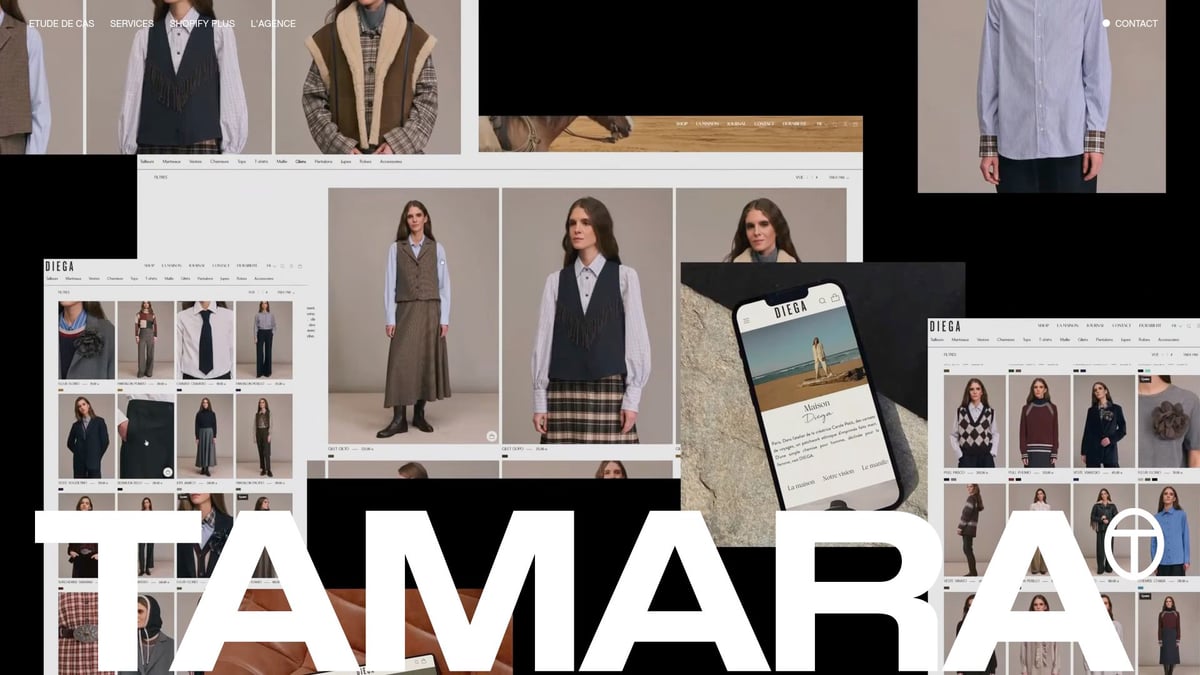
Tamara Agency, a Shopify and Shopify Plus expert since 2018, supports brands that want to place their e-commerce site design at the heart of their growth strategy. With over 400 projects completed in the beauty, fashion, and wellness universes, the agency relies on a proven methodology and a deep understanding of the expectations of these sectors. To discover examples of custom-designed fashion stores, browse the Shopify Fashion Store Creation page. The support offered is comprehensive: strategic consulting, UX/UI design, technical development, migration, continuous optimization, and monitoring of the latest trends.
What distinguishes Tamara Agency is its ability to integrate the latest and most effective e-commerce site design trends: mobile-first approach, augmented reality, accessibility, eco-design. The certified Shopify team favors agility and personalization, to guarantee sites that are both unique, fast, and perfectly aligned with the brand identity. The results speak for themselves: significant increase in conversion rate, streamlined purchasing journeys, innovative redesigns praised by users. Opting for an expert partner means ensuring reactive support, tailor-made management, and sustainable long-term growth.
Practical advice for adopting e-commerce trends in 2026
Adopting e-commerce site design trends in 2026 requires a structured and evolving approach. To remain competitive, each brand must evaluate its needs, plan its evolutions, measure the impact of changes, and arm itself with the right tools. Here is a step-by-step guide to transform your site and ensure its performance in a rapidly changing market.
Evaluate your brand's needs and prioritize trends
Before any evolution, it is essential to conduct an in-depth UX/UI audit. Analyze the customer journey, identify friction points, and measure the current performance of your e-commerce site design. List your objectives: do you want to increase the conversion rate, improve accessibility, or focus on personalization?
Compare your site to those of your direct competitors through a sectoral benchmark. Identify the most relevant trends for your sector: augmented reality for fashion, accessibility for wellness, or immersive video for beauty. Prioritize innovations that meet the expectations of your target audience and your brand identity.
Plan the redesign or evolution of your site
The success of a new e-commerce site design depends on rigorous planning. Draft specifications integrating priority trends, in consultation with marketing, IT, and artistic direction teams. Determine essential functionalities, journeys to simplify, and the integration of innovative solutions such as AI or AR.
Choose a flexible platform, such as Shopify, which facilitates the addition of applications and adaptability to market changes. Plan user testing phases to validate each step of the redesign before final deployment.
Measure the impact of design evolutions
After going live, closely monitor the KPIs related to your e-commerce site design: conversion rate, average order value, cart abandonment rate, and user engagement. Use A/B testing tools to compare different versions of pages or functionalities.
Regularly collect customer feedback via surveys or feedback modules. Analyze data to adjust your choices and ensure continuous progress towards your performance objectives.
Ensure compatibility and technical performance
A high-performing e-commerce site design must offer fast loading times, responsive display, and optimal compatibility across all browsers. Respect SEO standards, accessibility requirements, and security norms. Technical optimization is a pillar of visibility and conversion.
To delve deeper into this point, consult the SEO Tips for E-commerce Sites which detail best practices for combining design, performance, and natural referencing. Remember to regularly update your technologies and plugins to stay at the forefront.
Train teams and surround yourself with experts
The evolution of e-commerce site design implies upskilling your teams. Organize training on UX, AI, augmented reality, or eco-design. Raise awareness about the importance of accessibility and new web standards.
To go further, collaborate with specialized agencies or certified experts, who will be able to support you in implementing trends and ensure alignment with your business objectives.
Examples of digital transformation roadmap
A successful transformation of your e-commerce site design involves a structured roadmap:
- Audit and needs gathering
- Prototyping and user testing
- Technical development
- Testing and correction phase
- Progressive deployment
- Post-launch monitoring and continuous optimization
Generally, a redesign or migration takes between two and six months, depending on the complexity of the project. Success depends on agile management, considering customer feedback, and effective project steering.
Resources and tools to stay ahead of the curve
To keep your e-commerce site design up to date, rely on reliable resources:
- Specialized blogs (Shopify, Dribbble, Webflow)
- Industry newsletters for innovation watch
- Collaborative design tools (Figma, Sketch)
- Behavioral analysis and user testing platforms
- Exchange and inspiration communities (Dribbble, Behance, Shopify Community)
Stay curious, experiment with new tools, and connect with your peers to anticipate market changes and stay one step ahead.