


Shopify beauty store launch workflow
TL;DR:
- A rigorous workflow, from preparation to monitoring, maximizes success from launch.
- Regulatory compliance and an adapted technical architecture are essential for the beauty sector.
- Post-launch optimization, especially speed and mobile experience, significantly increases sales.
Launching a beauty store on Shopify without a structured method is taking the risk of seeing weeks of work yield disappointing results. Too many ambitious brands rush through the steps, neglect regulatory formalities, or publish an unoptimized store that doesn't convert. However, data confirms it: a rigorous workflow, applied from preparation to post-launch monitoring, radically changes the trajectory of an e-commerce project. This guide offers a proven methodology, supported by concrete sectoral benchmarks, to avoid classic pitfalls and maximize your performance from day one.
Table of Contents
- Preparing the Ground: Essential Prerequisites
- Key Steps in the Shopify Workflow for Beauty
- Optimization and Benchmarks: Maximizing Conversions and Sales
- Launching and Monitoring a New Beauty Product: Pre, Launch, Post
- Our Perspective: The True Catalyst for Success in Shopify Beauty
- Benefit from Tamara Agency's Support for an Optimized Workflow
- Frequently Asked Questions about the Shopify Beauty Store Launch Workflow
Key Points
| Point | Details |
|---|---|
| Regulatory Checklist | Prepare ANSM, CPNP, DIP documents and verifications to avoid legal blockages. |
| Structured Workflow | Adopt a multi-step methodology to secure each phase of the launch. |
| Continuous Optimization | Analyze Shopify benchmarks to adjust purchase funnels, UX, and conversion according to sectoral results. |
| Controlled Product Launch | Use buzz, live events, and KPIs to maximize impact, then adjust post-launch. |
| Expert Support | Rely on Shopify beauty specialists to accelerate your e-commerce success. |
Preparing the Ground: Essential Prerequisites
Before opening your store to the public, preparation is your best protection against unpleasant surprises. This phase is often rushed by brands eager to go online, which leads to technical, legal, and commercial problems that are costly to correct afterwards. Take the time to build a solid foundation.
Documents and Tools to Gather
Here are the essential elements to gather before setting up your store:
- Legal documents: company statutes, SIRET number, intra-community VAT number
- Visual identity: high-definition logo (PNG and SVG formats), graphic charter, color palette
- Product content: complete technical sheets, professional photos, demonstration videos
- Contractual documents: General Terms and Conditions, privacy policy, legal notices compliant with GDPR
- Logistical infrastructure: supplier contracts, carrier rates, return policy
“The launch workflow for a beauty store on Shopify follows a 10 to 19 key step methodology, including platform choice, administrative formalities, technical configuration, testing, and marketing strategy.”
Regulatory Obligations for Cosmetics
The cosmetics sector is one of the most regulated in e-commerce. Online sales do not exempt from legal obligations that apply to physical sales. Specific obligations for cosmetics include verification of ANSM (National Agency for the Safety of Medicines and Health Products) regulations, CPNP (Cosmetic Products Notification Portal) notification, preparation of a DIP (Product Information File) for each reference, as well as compliance with controlled temperature and humidity storage conditions.
| Obligation | Description | Priority |
|---|---|---|
| CPNP Notification | Registration of each product before marketing | Critical |
| DIP per product | Complete technical file including formulation and tests | Critical |
| ANSM Compliance | Verification of authorized substances and concentrations | High |
| Mandatory Information | Compliant labeling (INCI, date, precautions) | High |
| Storage Conditions | Temperature, humidity, light protection | Medium |
Choosing the Right Technical Architecture
Standard Shopify suits most starting or growing brands. Headless or custom architecture is for high-volume brands or those with complex integration needs. The creation of a Shopify beauty store must meet your current business objectives while anticipating your growth over the next twelve months.

The choice of Shopify theme directly influences conversion. Opt for a theme designed for the beauty universe, with a neat visual presentation, elaborate product gallery options, and intuitive navigation.
Pro tip: Integrate your e-commerce beauty branding from the preparation phase. Brand storytelling is not a secondary detail: it structures your positioning, differentiates your universe, and prepares your audience well before opening. See how brands like Cosmedica build their authenticity around clear values and a strong promise.
Key Steps in the Shopify Workflow for Beauty
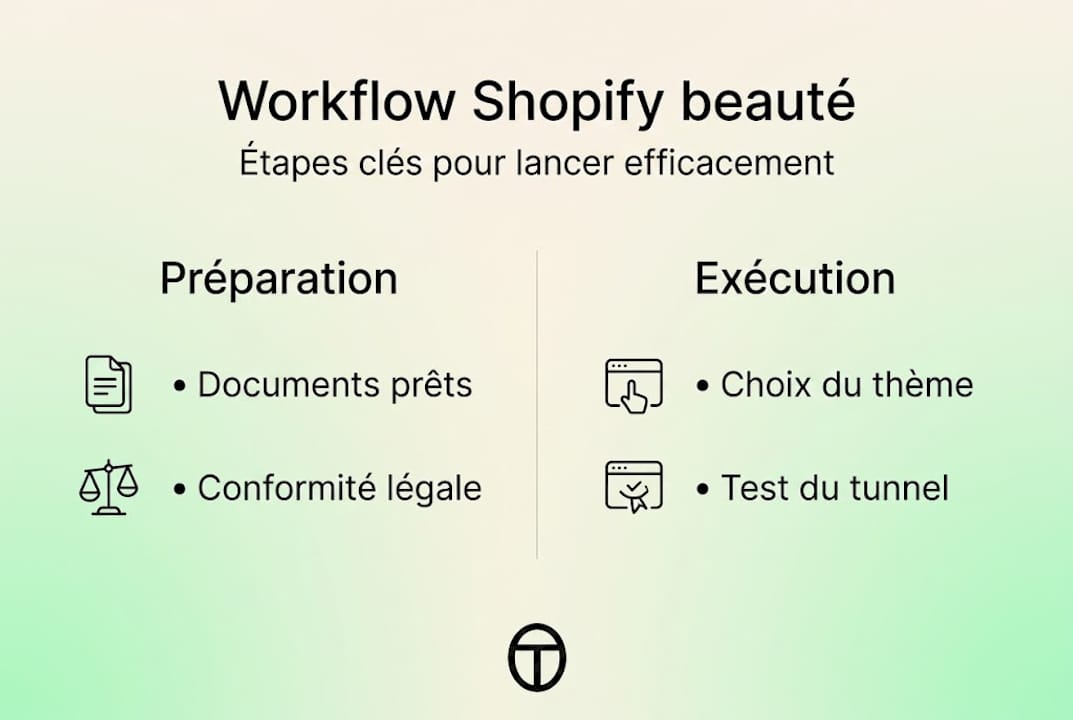
After gathering all the prerequisites, the workflow execution can begin in a structured and sequential manner. Each step prepares for the next. Skipping a phase often means having to go back at the worst possible moment.
The Fundamental Steps of Launching
The 7-step guide to creating a brand identifies critical steps that we adapt here to the beauty context:
- Market study and positioning: Analyze your niche, competitors, target audience, and the uniqueness of your offer. Clearly define what sets you apart.
- Complete branding: Create or finalize your brand name, logo, story, and graphic charter. This identity must be consistent across all touchpoints.
- Back-office configuration: Set up your accounting, payment methods, shipping options, and ERP or logistics integrations.
- Essential pages: Write contact pages, general terms and conditions, privacy policy, legal notices, and return policy, all compliant with GDPR.
- Purchase funnel tests: Simulate the entire customer journey, from the product page to confirmed payment. Test on mobile, tablet, and desktop.
- Analytics tools: Install Google Analytics 4, Google Search Console, and the Meta pixel before launch. Configure conversion events.
- Phased launch: Opt for a soft launch with limited access before opening to everyone. This allows for correcting final adjustments without impacting your first impressions.
Comparison Table of Shopify Architectures
| Criterion | Standard Shopify | Headless/Custom |
|---|---|---|
| Initial Cost | Low to medium | High |
| Time to Go Live | 2 to 6 weeks | 3 to 6 months |
| Design Flexibility | Medium | Total |
| Technical Performance | Good | Optimized |
| Maintenance | Simple | Complex |
| Ideal for | Start-up and growth | High volume, integrations |
To maximize Shopify design and conversion performance, every technical decision must be correlated with a conversion objective. A beautiful site that doesn't load quickly is a site that loses sales.
Pro tip: Integrate a GDPR-compliant cookie consent banner from the start, and configure your analytics events before generating traffic. Measuring from the very first visitor is essential for a high-performing e-commerce site that learns and improves quickly.
Optimization and Benchmarks: Maximizing Conversions and Sales
After the initial workflow, continuous optimization is the real engine of growth. A launch is a starting point, not an endpoint. Beauty brands that thrive on Shopify treat their store as a living product, constantly improving.
What Sectoral Benchmarks Teach Us
The figures from Shopify migrations in the beauty sector are telling. La Rosée recorded a 53% increase in its conversion rate in just three months after migration, accompanied by an 88% increase in sales. The Griffe brand, for its part, showed a 102% sales increase in the first quarter and a 44% improvement in its conversion rate. These results are not due to chance. They reflect the combined impact of better architecture, optimized UX, and a friction-free purchase funnel.
The loading speed of a site, improved by 40%, has a direct and measurable impact on conversion rates in the beauty sector.
Priority Optimization Factors
To achieve these performance levels, focus your attention on these levers:
- Loading speed: Each additional second in loading reduces conversion. Compress images, limit third-party applications, and activate Shopify CDN.
- Mobile UX: More than 70% of beauty traffic comes from smartphones. Navigation, product pages, and checkout must be mobile-first.
- Simplified purchase funnel: Reduce the number of steps before payment. Offer one-click payment with Shop Pay or Apple Pay.
- Product photography: In the beauty sector, visuals sell. Invest in high-quality photos, texture videos, and interactive swatches.
- Social proof: Customer reviews, ratings, testimonials, and user-generated content increase trust and reduce purchasing hesitation.
Results Observed After Optimization
| Indicator | Before Optimization | After Optimization |
|---|---|---|
| Conversion Rate | 0.8 to 1.2% | 2.0 to 3.5% |
| Average Order Value (AOV) | 45 to 60 € | 65 to 95 € |
| Loading Speed | 4 to 6 seconds | 1.5 to 2.5 seconds |
| Bounce Rate | 65 to 75% | 40 to 55% |
For beauty e-commerce solutions adapted to these challenges, the initial configuration of your store plays a decisive role. The proven techniques for increasing sales also involve cross-sell and upsell strategies well integrated into the customer journey. The store migration example we conducted for La Doudounerie Paris concretely illustrates these gains. Also consult the complete Shopify guide to delve into the basics of configuration.
Launching and Monitoring a New Beauty Product: Pre, Launch, Post
Now that benchmarks show the impact of optimizations, let's see how to apply a precise methodology to effectively launch a new product. A successful product launch in beauty is not improvised. It relies on three distinct and complementary phases.
Phase 1: Pre-launch (Buzz and Pre-orders)
The product launch methodology recommends starting communication well before the sale date. The goal is to create anticipation, conversation, and a community around the product even before it is available.
- Progressive teasing: Publish visual sneak peeks, clues about benefits, testimonials from testers upstream.
- FOMO strategy (Fear Of Missing Out): Announce a limited edition, a launch price, or priority access reserved for subscribers.
- Pre-orders: Open pre-orders to generate revenue before final production and validate real market interest. Discover how Cosmedica creates anticipation around its new products.
- Targeted emailing: Activate your subscriber list with a sequence of three to five preparatory emails, each providing new information.
Phase 2: Launch Day
D-Day is not an end. It's a peak to capitalize on. Here are the actions to prioritize:
- Live content: Stories, reels, Instagram or TikTok lives with real-time product demonstration.
- Pre-order activation: Automatically confirm orders and send a personalized welcome email.
- Responsive customer service: Answer questions within the first few hours. Responsiveness builds trust and reduces cart abandonment.
Phase 3: Post-launch Monitoring and KPIs
Pro tip: Always test your store in sandbox mode before activating real payments. Collect product feedback from the first buyers via an automatic email at D+7 and adjust your product pages based on their recurring questions.
Indicators to monitor closely after a launch:
- Traffic: Sources, volumes, behavior of new visitors versus recurring visitors
- Conversion Rate (CR): Ratio between visitors and buyers, segmented by device and traffic source
- Average Order Value (AOV): Value of orders, and impact of cross-sell or bundle offers
- Retention rate: Proportion of customers who return within 30 and 90 days
- Return rate: Key indicator of product satisfaction and product page quality
To maximize the impact of these analyses, beauty e-commerce UX must be designed to naturally guide visitors towards purchase, without unnecessary friction.
Our perspective: the real catalyst for success in Shopify beauty
Here's what seven years of supporting beauty brands has really taught us: most struggling stores don't lack products or budget. They lack consistency in their approach.
The workflow is not a document to be checked off once. It's a cycle. The most successful stores we've supported regularly revisit their structure, test new hypotheses, and adapt their experience based on real customer data.
Omnichannel is often sacrificed for a single platform. However, a beauty brand that synchronizes its online experience, social networks, and physical points of sale generates unparalleled loyalty. Post-purchase follow-up is also underestimated. A well-thought-out email on D+7 is sometimes worth more than an advertising campaign.
Finally, storytelling and brand authenticity are not ornaments. They are conversion levers. Beauty customers buy a promise, a story, a relationship. A store that seduces as much as it performs is a store that builds loyalty. This is our deepest conviction, built project after project.
Benefit from Tamara Agency's support for an optimized workflow
Structuring a rigorous launch workflow, complying with regulatory obligations, optimizing conversions, and launching a new product methodically require expertise that few brands develop on their own. At Tamara Agency, we support beauty brands at every step of this journey since 2018.
Whether you want to strengthen your skills through a Shopify beauty training or entrust the creation of your Shopify beauty store to a specialized team, we have the resources and experience to transform your project into measurable success. A site must perform as well as it seduces. Let's talk about your launch.
Frequently asked questions about the Shopify beauty store launch workflow
What are the specific regulatory steps for selling cosmetics online?
You must check ANSM regulations, register each product on CPNP and prepare a Product Information File (PIF), and ensure controlled temperature and humidity storage before any commercialization.
How to guarantee the performance of the purchase funnel during launch?
Test the entire purchase funnel upstream, set up your analytics tools and ensure a progressive launch, and opt for a responsive and fast design on all devices.
Which KPIs to track after store launch to evaluate success?
Key indicators are traffic, conversion rate, and AOV, to be analyzed by source, device, and period to quickly identify areas for improvement.
Is there a method to create buzz before launch?
Organize a pre-launch with exclusive content, pre-orders, and a well-dosed FOMO strategy to generate anticipation and build a list of potential buyers before opening.
How much time should be allocated to launch a beauty store on Shopify?
Allow between 10 to 19 key steps; the process takes several weeks depending on the complexity of the brand, the chosen architecture, and the regulatory constraints to be respected.