


Boost Your Beauty Sales: Shopify E-commerce Solutions
TL;DR:
- A high-performing beauty store reflects the brand's DNA to increase conversion.
- Automation and personalization apps boost AOV and loyalty.
- Transparency and UGC build trust and foster customer loyalty.
The average conversion rate in the online beauty sector is between 2.5 and 3.5%, a figure that may seem decent, but hides a more nuanced reality: the majority of stores do not reach this threshold. Too often, brands invest in exceptional products and neglect the online experience that showcases them. However, a well-designed, personalized, and transparent Shopify store can significantly exceed this benchmark. In this article, we explore concrete levers to optimize your brand image, improve your sales performance, and build lasting customer loyalty.
Table of Contents
- The Foundations of E-commerce Success for Beauty Brands
- Optimizing Sales Performance: The Impact of Shopify Apps
- Personalization, Transparency, and Engagement: Key Levers for Loyalty
- Managing Challenges: Returns, Compliance, and Seasonality
- Our View on Beauty E-commerce Growth in 2026
- Shopify Expertise for Your Beauty Brand
- Frequently Asked Questions about Beauty E-commerce Solutions
Key Points
| Point | Details |
|---|---|
| Invest in UX/UI | A user experience tailored to the brand's universe increases credibility and conversions. |
| Automate and personalize | Shopify apps and automations boost AOV, retention, and customer LTV. |
| Prioritize transparency | Displaying ingredients and clinical claims builds trust and differentiation. |
| Adapt to industry challenges | AI shade finders, mobile-first logistics, and compliance are key to reducing returns and optimizing profitability. |
| Target retention and engagement | Loyalty, community, and UGC outweigh mass acquisition for sustainable growth. |
The Foundations of E-commerce Success for Beauty Brands
After understanding the overall challenge, let's explore the fundamental elements that build credibility and foster customer loyalty.
A successful beauty store doesn't look like a generalist store. The visual universe, editorial tone, and navigation: everything must reflect your brand's DNA. Good Shopify UX practices show that a user experience consistent with the brand identity increases time spent on the site and reduces bounce rate. This is not an aesthetic detail; it's a direct conversion lever.
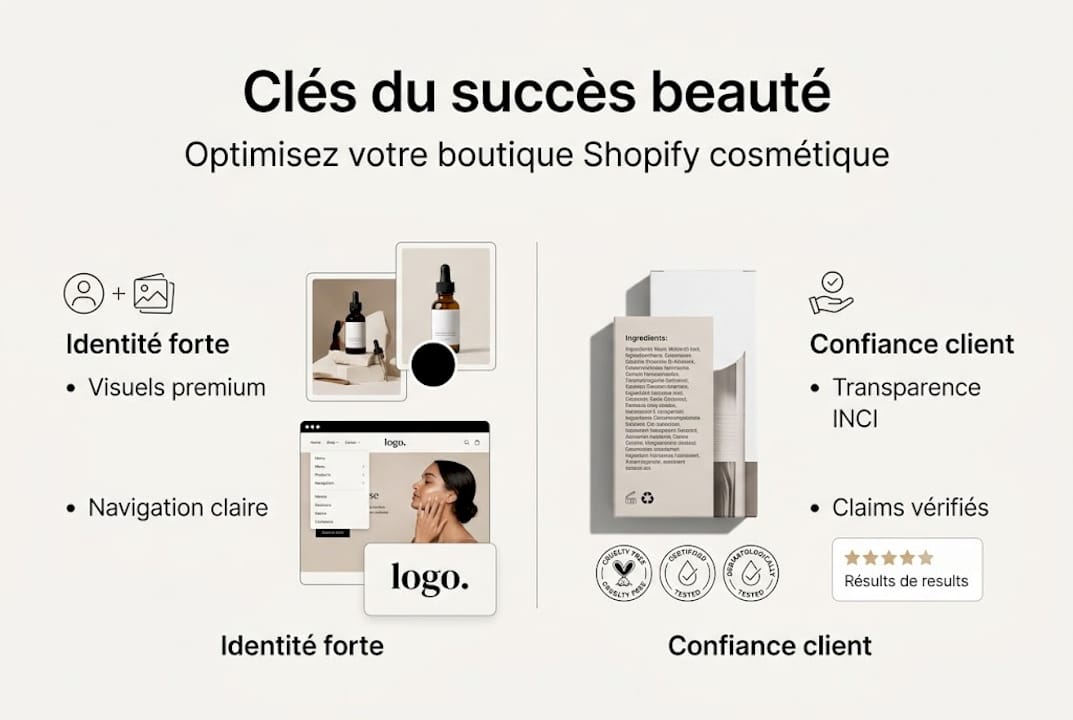
Shopify now enables personalized diagnostics via AI, transparency on ingredients, and premium visuals that transform browsing into a true sensory experience. Shade finders, routine quizzes, and intelligent recommendations reduce purchase hesitation. The result: fuller baskets and more confident customers.
Transparency is also a fundamental issue. Displaying the complete INCI list, verified clinical claims, and certifications (vegan, clean, eco-responsible) reassures an increasingly demanding clientele. This is not just a trend: it is a fundamental expectation of beauty consumers in 2026.
Premium visuals also play a decisive role. High-resolution photos, texture videos, and realistic staging significantly increase conversion. A store that invests in visual quality sends a strong signal: that of a serious brand that respects its customers.
| Criteria | Standard Store | Optimized Store |
|---|---|---|
| Personalized UX/UI | Generic | True to brand universe |
| Ingredient Transparency | Partial | Full INCI + clinical claims |
| Product Visuals | Basic photos | Videos + HD photos + staging |
| Personalization | Absent | Shade finder, quiz, AI recommendations |
| Conversion Rate | 1 to 2% | 3 to 5% |
Here are the essential elements of a solid beauty store:
- A graphic charter consistent with the brand identity
- Rich product sheets: INCI, tutorials, verified reviews
- Personalization tools (quiz, shade finder, routine builder)
- Premium visuals adapted for mobile
- Intuitive and fast navigation
Pro tip: Integrate a diagnostic quiz right on the homepage. It grabs attention, collects valuable data, and directs visitors to the products that truly suit them. This is one of the most effective tools to reduce bounce rate and increase average order value. To go further, consult our analysis of beauty e-commerce challenges.
Optimizing Sales Performance: The Impact of Shopify Apps
Once the brand foundation is established, it's about maximizing commercial value through smart tools and apps.

Shopify boasts an app ecosystem particularly well-suited for beauty brands. Automation, upsell, and subscription apps transform a decent store into a recurring revenue machine. It's not magic: it's well-executed strategy.
Shopify Flow allows for automating complex sequences: cart reminders, personalized post-purchase offers, restock alerts. Routine upsells increase AOV by 25 to 40%, and subscriptions generate between 25 and 45% recurring revenue for brands that adopt them. These figures are not anecdotal: they represent a structural transformation of your business model.
Site speed is often underestimated. A loading time greater than 3 seconds causes a significant portion of visitors to leave. A customized checkout, with adapted payment options (buy now pay later, Apple Pay, Google Pay), measurably reduces cart abandonment. Discover the Shopify sales techniques that make a difference.
| Leverage | Estimated Impact |
|---|---|
| Routine upsells | +25 to 40% on AOV |
| Subscriptions | 25 to 45% recurring revenue |
| Optimized checkout | 15 to 20% reduction in cart abandonment |
| Email opt-in | 8 to 15% adoption rate with pop-up |
Apps to prioritize for a beauty brand:
- Shopify Flow: advanced codeless automations
- ReCharge or Bold Subscriptions: subscription management
- Frequently Bought Together: intelligent product bundles
- Klaviyo: ultra-precise email and SMS segmentation
- PageSpeed Optimizer: technical performance improvement
Pro tip: A/B test two approaches: offering a discounted routine bundle versus offering a free product above a certain amount. Results vary by brand, but bundles generally generate a higher AOV. Micro-interactions for conversion also play a key role in engagement and purchase completion.
Personalization, Transparency, and Engagement: Key Levers for Loyalty
After technical optimization, differentiation comes down to a personalized customer approach and authenticity.
Personalization is no longer a luxury reserved for major brands. On Shopify, routine builders, skin quizzes, and shade finders allow every visitor to find exactly what they need. This approach reduces returns, increases satisfaction, and creates a strong emotional connection with the brand.
Transparency goes beyond the ingredient list. It encompasses verified clinical claims, eco-responsible certifications, and ethical commitments. A brand that explains why it chose a particular active ingredient, how it works, and what tests have been conducted, builds a lasting relationship of trust. This is what beauty consumers are looking for in 2026.
UGC (user-generated content) is one of the most powerful levers. Photo reviews increase purchase intent by 28%. A customer who sees a real person using the product is far more convinced than a customer looking at a studio photo. Integrate customer photo galleries, testimonial videos, and verified ratings directly onto your product pages.
“A store that gives a voice to its customers builds a community. A loyal community is the best protection against competition.”
Steps for an effective personalization strategy:
- Integrate a diagnostic quiz as soon as customers enter the site
- Offer product recommendations based on responses
- Display the full INCI and clinical claims on each product page
- Collect and highlight customer photo reviews
- Use ingredient SEO to capture qualified searches
Explore Shopify beauty designs that elegantly integrate these features, and check out our Shopify design checklist to make sure you don't miss anything.
Pro tip: Gamified pop-ups (spin wheel, scratch card) generate 10 to 15% more opt-ins compared to classic pop-ups. They create a fun moment that leaves an impression and encourages registration. Combine them with an attractive welcome offer to maximize the effect. The impact of ethical e-commerce on customer loyalty is also a topic not to be overlooked.
Managing Challenges: Returns, Compliance, and Seasonality
Alongside strategy, there are still sectoral obstacles to overcome to ensure sustainable growth.
The beauty sector presents specific challenges that brands must anticipate. Shade mismatch is one of the most costly: 15 to 25% of returns in color cosmetics are due to an incorrect shade match. AI shade-finding tools significantly reduce this figure by guiding the customer to the exact shade before purchase.
Seasonality requires rigorous logistical management. Peaks from November to December, spring/summer collection launches: each period demands anticipation of stock, delivery times, and promotional campaigns. A well-configured Shopify store can automate much of this management.
“Mobile is no longer a secondary channel. It’s the primary channel. A store not designed mobile-first loses between 79 and 85% of its visitors before they even see a product.”
Challenges to anticipate for sustainable growth:
- Shade mismatch: integrate an AI shade finder to reduce returns
- Regulatory compliance: adhere to INCI and FDA standards depending on markets
- Mobile-first: optimize every page for smooth smartphone navigation
- Seasonality: plan stocks and campaigns in advance
- Differentiation: clearly position clean, vegan, or eco-responsible values
E-commerce cosmetic trends in 2026 confirm that brands investing in these technical solutions gain profitability and loyalty. Our team at Shopify beauty agency supports these transformations daily.
Our View on Beauty E-commerce Growth in 2026
It's tempting to believe that beauty e-commerce growth is primarily driven by acquisition: more advertising, more budget, more reach. We believe the opposite. The brands that truly perform in 2026 are those that have chosen to prioritize retention over acquisition, and transparency over packaging.
A loyal customer costs five times less to retain than to acquire. LTV (lifetime value) is the true health indicator of a beauty brand. And it is built through memorable experiences, explained ingredients, and engaged communities. Not through permanent promotions.
We recommend that brands prioritize Shopify redesigns focused on personalized UX and retention apps to maximize LTV. Investing in customer education (tutorials, ingredient guides, expert content) generates organic engagement that is far more sustainable than any paid campaign. The Shopify e-commerce redesign is often the starting point for this transformation.
Shopify Expertise for Your Beauty Brand
You now have a clear vision of the levers that make a difference: bespoke UX/UI, performance apps, personalization, and transparency. The question is no longer what to do, but how to do it with rigor and consistency.

Since 2018, we have been supporting ambitious beauty and cosmetics brands in the creation and redesign of their Shopify stores. Our approach combines strategy, design, and technical performance for concrete results. Whether you want to redesign your existing store or launch a new online presence, our Shopify beauty store services are designed to meet the demands of your industry. Discuss with our Shopify consultant to define the best strategy for your brand together.
Frequently Asked Questions about Beauty E-commerce Solutions
Why is UX/UI essential for a beauty brand on Shopify?
UX/UI that is true to your brand's universe strengthens your brand's credibility, improves conversion, and encourages long-term loyalty. It is the foundation upon which all commercial performance rests.
What types of Shopify apps maximize sales performance in beauty?
Automation apps, upsell bundling, and subscription tools increase AOV and generate recurring revenue by 25-45%. These are the most profitable levers to activate after UX redesign.
How to reduce returns related to shade mismatch in color cosmetics?
AI shade finders guide customers to the exact shade before purchase, reducing returns due to matching errors by 15-25%. This is a technical investment with a high return on investment.
Does ingredient transparency really impact loyalty?
Yes: displaying a complete INCI list and verified clinical claims builds consumer trust and encourages them to return. Transparency has become as important a purchasing criterion as price.