


Shopify vs Other CMS: Key Advantages for Fashion and Beauty
TL;DR:
- The choice of CMS determines the speed of launch, customer experience, and long-term growth.
- Shopify offers ease of use, optimal performance, and scalability suitable for ambitious brands.
- The decision must consider the true cost, support, aesthetics, and ability to adapt to growth.
Choosing an e-commerce platform is one of the most foundational decisions for a fashion or beauty brand. However, many entrepreneurs treat it as a simple technical choice, comparing only advertised subscription prices. This is a mistake that can cost months of delays and thousands of euros in redesigns. What you choose today impacts your launch speed, customer experience quality, maintenance costs, and ability to grow. This article compares Shopify to its main competitors on the criteria that truly matter: ease of use, true cost, performance, and scalability for ambitious brands.
Table of Contents
- Overview of e-commerce CMS: Who are Shopify's competitors?
- Shopify vs. WooCommerce, Magento, BigCommerce: Major Differences Explained
- User Experience, Design, and Performance: Shopify's True Advantage
- Scalability, Support, and Long-Term Strategy: Which CMS for Your Brand's Growth?
- Why Founders' Intuition Often Leads to the Wrong CMS Choice
- Need expert support for your Shopify store?
- Frequently Asked Questions about Shopify and other CMS
Key Points
| Point | Details |
|---|---|
| Strategic CMS Choice | The right CMS enables more growth, agility, and a better customer experience. |
| Shopify: Speed and Simplicity | Shopify offers fast launch and an easy-to-manage interface for the fashion and beauty sector. |
| Costs and Customization | WooCommerce and Magento offer more customization, but Shopify balances cost, scalability, and simplicity. |
| Performance and Design | Shopify's speed, mobile designs, and ready-to-sell templates give it an edge over Wix and Squarespace. |
| Plan for the Future | An evaluation based on your future needs, not just upfront costs, avoids costly migrations. |
Overview of e-commerce CMS: Who are Shopify's competitors?
An e-commerce CMS (Content Management System) is the software that allows you to create, manage, and evolve your online store. It handles everything: product catalog, purchase funnel, payments, and customer interface. The market now offers several major solutions, each with a distinct positioning.
Here are the main players competing with Shopify:
- WooCommerce: an open-source extension for WordPress. Very flexible, ideal for brands already using WordPress. Find a complete analysis of the advantages of WooCommerce to better position this option.
- Magento / Adobe Commerce: the enterprise solution par excellence. Infinite scalability and custom code, but setup costs exceeding $50,000 and an implementation delay of 3 to 6 months.
- BigCommerce: similar to Shopify in terms of features, with native B2B and multi-currency capabilities with no transaction fees, targeting the mid-market segment.
- Wix: an all-in-one, very accessible solution, designed for small businesses that want a beautiful website quickly.
- Squarespace: design and editorial content-oriented, popular with independent creators and small shops.
| CMS | Target Profile | Technical Level | Estimated Cost |
|---|---|---|---|
| Shopify | SMBs to Large Brands | Low to Medium | $39 to $399/month |
| WooCommerce | Brands on WordPress | Medium to High | Variable |
| Magento | Enterprises | Very High | $50,000+ setup |
| BigCommerce | Mid-market | Medium | $39 to $399/month |
| Wix | Small Shops | Low | $17 to $35/month |
| Squarespace | Creators, Portfolios | Low | $23 to $65/month |
The choice of CMS directly influences the experience perceived by your customers, the speed at which you can react to trends, and the budget you allocate to technology rather than marketing. Consult this complete CMS comparison for an even more detailed overview.
Shopify vs. WooCommerce, Magento, BigCommerce: Major Differences Explained
After identifying the players, let's now analyze their fundamental differences from Shopify. Four axes reveal the essentials: time to market, total cost of ownership, technical complexity, and level of support.
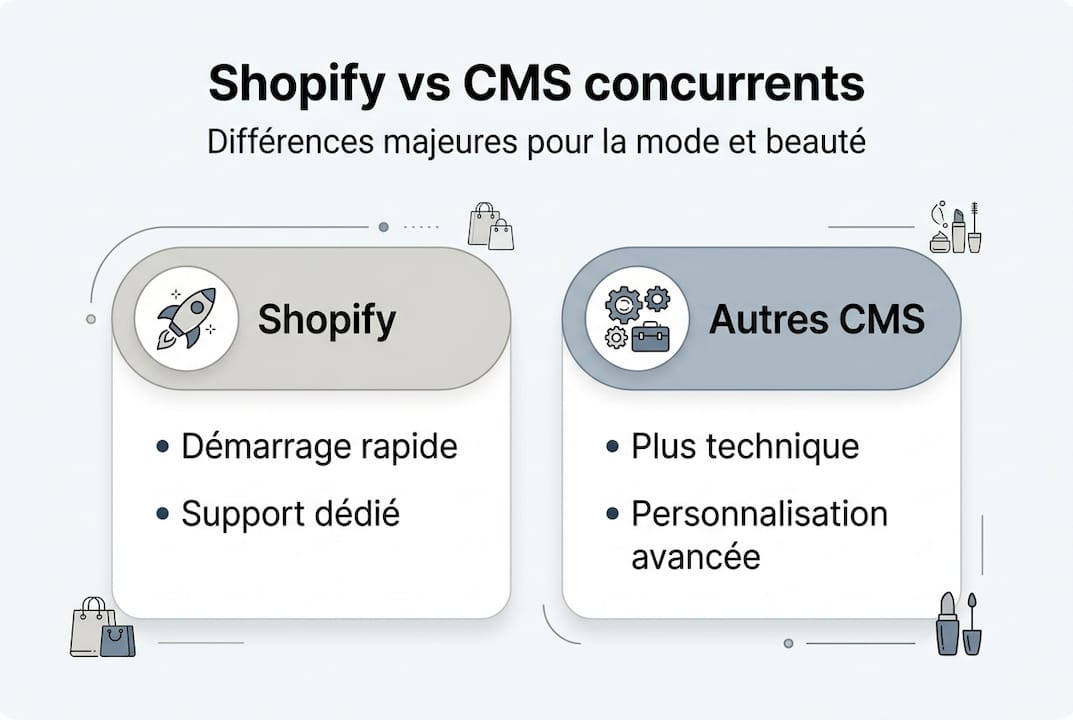
1. Time to market Shopify allows a functional store to be launched in a few hours or days. WooCommerce requires several weeks of configuration. As for Magento benchmarks, they confirm a delay of 3 to 6 months for a full deployment.
2. Total Cost of Ownership Comparing subscription prices is misleading. At $500,000 GMV, WooCommerce costs approximately $2,400 per year compared to $4,800 for Shopify. But this calculation ignores the hosting, security, maintenance, and developer costs that WooCommerce imposes. Shopify integrates all of this natively.
3. Integration Complexity WooCommerce offers great flexibility, but each added plugin creates a risk of conflict. Shopify centralizes apps in a controlled ecosystem. If you are considering a WordPress to Shopify migration, it's often to regain this stability.
4. Support and Community BigCommerce at $39 per month scores 4.62 out of 5 and charges no transaction fees. It's a serious alternative, but its ecosystem of specialized agencies remains more limited than Shopify's.
Pro Tip: Never compare two CMS solely on their monthly subscription price. Calculate the real cost over 24 months, including hosting, developers, plugins, and internal time spent on maintenance. This total reveals the true value of each platform.
To delve deeper into the differences between WooCommerce and Shopify based on concrete criteria, our sectoral analysis will give you a clear vision adapted to fashion and beauty.
User Experience, Design, and Performance: Shopify's True Advantage
Having detailed the major functional differences, let's look at the experience perceived by end customers. This is where Shopify shows the most visible gap, especially for the fashion and beauty sectors where aesthetics and fluidity are non-negotiable.
Loading speed The numbers speak for themselves. Shopify displays loading times between 2.5 and 3.8 seconds, compared to 3.2 to 4.8 seconds for Wix. Squarespace is in a similar range to Wix, with limited scalability for growing stores. Each extra second of delay measurably reduces the conversion rate.
Key Statistic: A one-second delay in page loading can reduce conversions by 7%. For a store generating 100,000 euros per month, that's 7,000 euros lost each month.
Quality of themes for fashion and beauty Shopify offers themes specifically designed to showcase visual products. Shopify designs for fashion allow for immersive galleries, fluid product zooms, and editorial layouts that Wix or Squarespace struggle to reproduce on a large scale.
Mobile experience and social sales Your customers discover your products on Instagram or TikTok before placing an order. Shopify is natively optimized for this reality: responsive design, direct integration with social networks, and simplified mobile checkout. Shopify's best UX practices show how to convert this social traffic into real sales.
Pro Tip: When choosing a Shopify theme, always test its speed via Google PageSpeed Insights before purchasing it. A visually perfect but slow theme can ruin your conversion rate. Prioritize themes with a mobile score above 70.
Wix and Squarespace are suitable for stores with fewer than 50 references and low traffic. As soon as you aim for real growth, their technical limitations become concrete obstacles.

Scalability, Support, and Long-Term Strategy: Which CMS for Your Brand's Growth?
Let's move beyond immediate launch to discuss the CMS's ability to support your business over time. A successful beauty or fashion brand sees its catalog expand, its traffic explode during launches, and its ambitions extend internationally.
Here are the scalability criteria that distinguish platforms:
- Hosting and load management: Shopify automatically handles traffic peaks (sales, launches). WooCommerce requires dedicated hosting and manual configuration to handle the load.
- Internationalization: Shopify Markets allows selling in multiple languages and currencies from a single interface. This is a decisive advantage for brands targeting Europe or Asia.
- B2B management: BigCommerce's B2B capabilities are native and robust. Shopify Plus has offered comparable B2B features since 2022, closing this gap.
- Agency ecosystem: Shopify has the densest network of certified partners in the world, which facilitates recruiting an agency specialized in your sector.
“The true cost of a platform is not measured by the monthly subscription, but by its ability not to hinder your growth when you need it most.”
Magento remains the benchmark for very large accounts, but its 3 to 6-month time to market and high costs reserve it for companies with dedicated technical teams. For a developing brand, this delay can mean missing an entire season.
Follow cosmetic e-commerce trends to anticipate market developments. And if you are on an unsuitable platform, a beauty store migration to Shopify can transform your commercial trajectory.
Why Founders' Intuition Often Leads to the Wrong CMS Choice
We've observed a recurring pattern since 2018: founders choose their CMS based on current buzz, a recommendation from an entrepreneur friend, or simply because it appears to be the cheapest solution. This logic is understandable, but it misses the essential point.
The true criterion for choice is not the advertised price. It's the alignment between the platform, your industry, your real needs today, and your growth potential in 18 months. A beauty brand that chooses WooCommerce because it's free initially might end up paying a full-time developer to maintain its site.
Hasty technical choices are costly in the medium term. Redesign, migration, loss of SEO, team frustration: the consequences accumulate. To make a rational decision, ask yourself three questions: How much time can I dedicate to technical aspects? What is my growth projection over 2 years? Does my industry have specific aesthetic requirements? The challenges of beauty e-commerce deserve strategic consideration, not a 10-minute decision.
Need expert support for your Shopify store?
Choosing the right platform is one thing. Deploying it with excellence is another. At Tamar Agency, since 2018, we have supported fashion, beauty, and cosmetic brands in the creation and redesign of their Shopify stores. Our sectoral expertise allows us to go far beyond simple technical configuration.

Whether you're starting from scratch or want to migrate from another platform, we offer solutions tailored to your ambition level. Discover our Shopify store creation services, our Shopify training programs to gain autonomy, and our expertise dedicated to beauty and cosmetics brands. Let's discuss your project.
Frequently Asked Questions about Shopify and other CMS
Is Shopify suitable for fashion or beauty brands with high volumes or rapid growth?
Yes, Shopify offers strong scalability via Shopify Plus, multi-store management, and internationalization, while remaining simple to administer daily. Its superior scalability compared to Magento with lower costs makes it the preferred choice for fast-growing brands.
Is Shopify more expensive than WooCommerce or Magento in the long term?
Shopify can be more expensive than WooCommerce for very high volumes, but it remains cheaper and much faster to deploy than Magento for 90% of stores. Shopify's unbeatable time-to-market largely offsets the subscription cost difference.
Can you customize as much on Shopify as on Magento or WooCommerce?
Magento offers total customization via open source code, but Shopify provides enough native options and apps to cover the vast majority of needs, with code access if necessary.
Why choose Shopify if you already sell on Instagram or TikTok?
Shopify is optimized for omnichannel sales and integrates natively with social networks, simplifying catalog and order management from a single centralized interface.