


Measuring Shopify E-commerce Performance: 2026 Guide
TL;DR:
- Beauty stores have a conversion rate above 6%, higher than the industry average.
- Mastering key KPIs such as conversion rate, AOV, CLV, and CAC optimizes performance.
- Funnel optimization, personalization, and a mobile experience significantly improve sales.
The majority of Shopify stores display a conversion rate of 2% to 3%, while leaders in the beauty sector easily exceed 6%. This difference is not a coincidence. It reflects a precise mastery of performance indicators, a fine reading of sectoral data, and an ability to transform every insight into concrete action. This guide will walk you step-by-step through identifying essential KPIs, sector benchmarks, advanced measurement methods, and proven optimization levers. Whether you sell cosmetics, fashion, or wellness products, you'll leave with a clear vision to make your store perform as well as it captivates.
Table of Contents
- Identify essential KPIs for Shopify
- Understand sectoral benchmarks: beauty, fashion, and wellness
- Advanced methods for measuring and analyzing performance
- Optimize performance: concrete levers and case studies
- Our analysis: what indicators don't reveal
- Discover our Shopify solutions adapted to your sector
- Frequently asked questions about Shopify e-commerce measurement
Key Points
| Point | Details |
|---|---|
| Essential Shopify KPIs | Mastering CR, AOV, CLV, CAC, and cart abandonment rate is vital for managing your store. |
| Sectoral Benchmarks | Position your performance with specific beauty, fashion, and wellness benchmarks to target realistic goals. |
| Advanced Methods | Use Shopify Analytics, GA4, and cross-reference data to avoid the pitfalls of overly simplistic statistics. |
| Concrete Optimizations | A/B testing, AI personalization, and sizing tools are major levers for boosting conversion and loyalty. |
| Strategic Vision | Don't limit yourself to conversion rates: long-term profitability depends on the LTV/CAC ratio and the specifics of your products. |
Identify essential KPIs for Shopify
After understanding the importance of measuring performance, you need to know which indicators to monitor. Not all numbers are created equal. Some reveal the true health of your store, while others merely flatter the ego without guiding decisions.
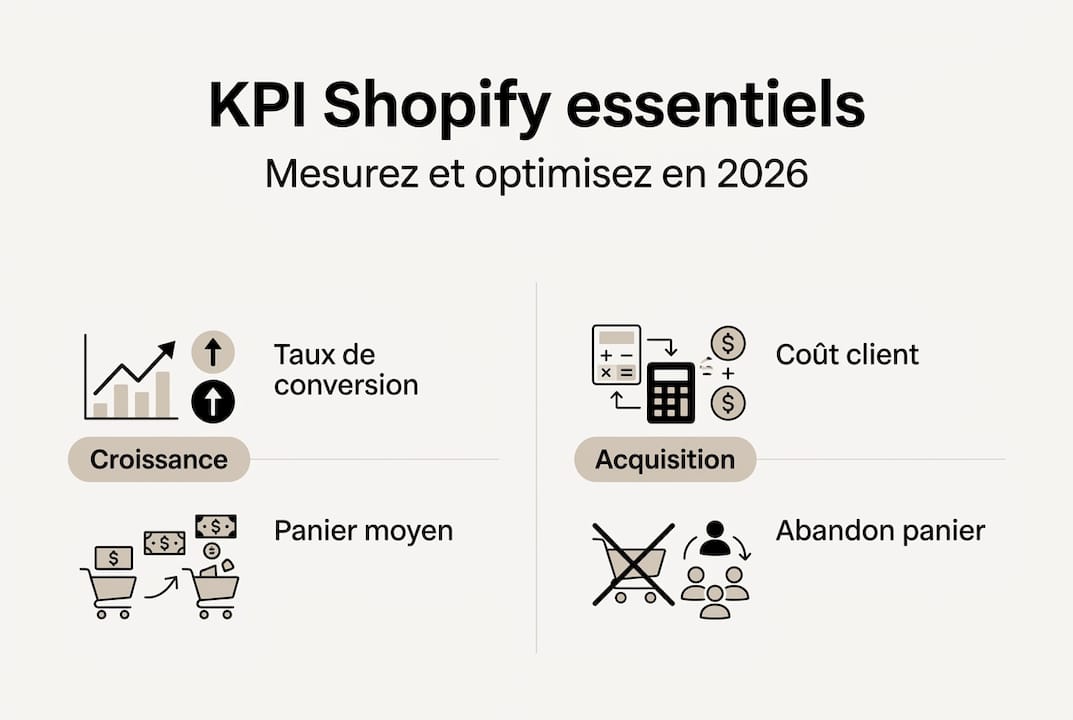
Here are the essential indicators for managing a Shopify store with precision:
- Conversion Rate (CR): percentage of visitors who complete a purchase. This is the central indicator of your sales funnel's effectiveness.
- Average Order Value (AOV): the average amount spent per order. It guides your cross-sell and upsell strategies.
- Customer Lifetime Value (CLV): total revenue generated by a customer over their entire relationship with your brand. Essential for evaluating long-term profitability.
- Customer Acquisition Cost (CAC): marketing expenses divided by the number of new customers. Absolutely vital to cross-reference with CLV.
- Cart Abandonment Rate: proportion of sessions where a product is added to the cart but the purchase is not completed.
- ROAS (Return on Ad Spend): revenue generated for every euro invested in advertising.
- NPS (Net Promoter Score): measures your customers' likelihood to recommend your brand.
Beyond these classic Shopify growth indicators, micro-conversions deserve your attention. A click on an "Add to cart" button, a newsletter signup, or a consultation of the return policy page are all behavioral signals that reveal friction in your purchase journey. The best beauty UX practices show that these micro-signals can precisely identify where visitors drop off.
| KPI | Formula | Tracking Frequency |
|---|---|---|
| Conversion Rate | (Orders / Sessions) x 100 | Daily |
| Average Order Value (AOV) | Revenue / Number of Orders | Weekly |
| CLV | AOV x Frequency x Relationship Duration | Monthly |
| CAC | Marketing Expenses / New Customers | Monthly |
| Cart Abandonment Rate | 1 - (Orders / Carts Created) | Weekly |
The power of these Shopify KPI calculations lies in their cross-referencing. A high CR with a low AOV may mean you're attracting the right visitors but your premium offer isn't valued. Conversely, a strong AOV with excessive CAC indicates a problem of structural profitability. E-commerce micro-interactions also play an often-underestimated role in a visitor's progression towards purchase.
Pro Tip: Use Shopify Analytics for native tracking of your orders and sessions, and couple this with GA4 to analyze browsing behavior and conversion funnels. These two tools are complementary and offer a 360° view of your performance.
Understand sectoral benchmarks: beauty, fashion, and wellness
After identifying your KPIs, it's crucial to compare your results to industry standards. A 2% conversion rate can be excellent in one sector, and very disappointing in another.

Here is a comparative table of sectoral benchmarks to help you position yourself:
| Sector | Average CR | Average AOV | Cart Abandonment Rate |
|---|---|---|---|
| Beauty and Cosmetics | 4.5% to 6.8% | €45 to €80 | 68% |
| Fashion and Ready-to-wear | 1.6% to 3.1% | €70 to €120 | 72% |
| Wellness and Health | 3.0% to 3.5% | €55 to €90 | 69% |
These figures from the 2026 beauty/fashion/wellness benchmarks reveal very different dynamics across sectors. Beauty converts better because the act of buying is often impulsive and emotional. Fashion suffers more from returns and size-related hesitations.
"The cart abandonment rate averages 70% on Shopify. This is not inevitable; it's a massive optimization lever still underutilized by most brands."
Several factors explain these sectoral differences:
- Device: Mobile generates more traffic but converts less well than desktop, especially in fashion where virtual fitting remains limited.
- Repeat purchase: Beauty benefits from a high repeat purchase rate (beauty routine), which naturally boosts CLV.
- Returns: Fashion records return rates as high as 30% to 40%, which impacts real profitability.
- Sizing tools: Size guides and configurators reduce hesitation in fashion and improve CR.
The impact of mobile in beauty is particularly significant: over 65% of beauty traffic comes from mobile, but desktop remains dominant in terms of purchase completion. Optimizing the mobile experience is therefore an absolute priority. The most effective beauty/fashion conversion techniques precisely address these specific frictions in each sector.
Advanced methods for measuring and analyzing performance
Knowing the benchmarks is not enough; you also need to apply precise methodologies for measurement. Here's how to calculate each KPI rigorously, according to standard Shopify formulas:
- Conversion Rate: (Number of orders / Number of sessions) x 100. Be careful not to confuse sessions with unique visitors.
- AOV: Total revenue / Number of orders over the period. Segment by channel to identify your most profitable sources.
- CLV: AOV x Annual purchase frequency x Average retention duration (in years). This is your long-term profitability compass.
- CAC: Total marketing and sales expenses / Number of new customers acquired over the period.
- ROAS: Revenue generated by ads / Total cost of ads.
The golden rule to remember: your CLV must be at least 3 times higher than your CAC. Below this ratio, your business model is not sustainable in the long term, regardless of your volume growth.
Key data: According to the Shopify conversion rate guide, an improvement of just 0.5% in the conversion rate can represent tens of thousands of euros in additional annual revenue for a high-traffic store.
Pitfalls to absolutely avoid:
- Vanity metrics: the number of visitors or followers says nothing about your profitability.
- Unqualified cold traffic: a poorly targeted advertising traffic spike will mechanically lower your CR without reflecting a real problem.
- Ignoring micro-conversions: a visitor who adds to the cart without buying is much closer to conversion than a mere visitor.
Pro Tip: Analyze your funnel step by step: product page, add to cart, checkout initiation, completion. Each step has its own drop-off rate. Identifying the weakest link allows you to act precisely rather than optimizing everything at once. A well-structured migration to Shopify systematically includes this funnel mapping from the outset.
Optimize performance: concrete levers and case studies
Once the measurements are in place, how do you translate them into concrete results? Optimization levers vary by sector, but some principles apply universally.
The most effective levers by sector:
- Beauty: AI personalization of product recommendations, UGC (user-generated content), beauty diagnostic quizzes to guide purchase.
- Fashion: interactive size guides, simplified returns, inspirational lookbooks to increase AOV.
- Wellness: loyalty programs, recurring subscriptions, educational content to build trust.
- All sectors: systematic A/B testing of product pages, abandoned cart recovery, social proof (verified reviews, number of sales).
The La Rosée case study perfectly illustrates the impact of structured optimization. After migrating to Shopify, the brand recorded +53% conversion rate and +88% sales. These results are not the result of a single action but of a global overhaul: rethought UX, optimized conversion funnel, and prioritized mobile experience.
| Lever | Impact on CR | Impact on AOV |
|---|---|---|
| AI Personalization | +15 to 30% | +10% |
| Abandoned Cart Recovery | +5 to 10% | Neutral |
| Social Proof (reviews) | +10 to 20% | +5% |
| Loyalty Program | +8% | +15 to 25% |
| Product Quiz | +20% | +12% |
Sectoral data: Beauty stores that integrate AI personalization achieve conversion rates above 6%, compared to an industry average of 4.5%.
The creation of a high-performing Shopify beauty store integrates these levers from the design phase, rather than adding them as corrections afterwards. The impact of returns on beauty brands is also a factor to anticipate in your overall performance strategy.
Our analysis: what indicators don't reveal
We have been working with beauty, fashion, and wellness brands since 2018, and we have learned one essential thing: global benchmarks can be misleading. A 3% conversion rate can hide excellent profitability or a financial disaster depending on your CAC and CLV.
Industry benchmarks vary significantly depending on the sources. This is why we always recommend comparing yourself to your own history before measuring yourself against sectoral averages.
What classic KPIs don't capture:
- Seasonal product cycles that naturally cause CR to vary by 40% to 60% depending on the period.
- The impact of returns on actual margin, particularly critical in fashion.
- The quality of customer relationships, which determines repeat purchases much more than any advertising campaign.
The obsession with traffic is the most common pitfall. Doubling your traffic without optimizing your funnel is like filling a leaky bucket. Focus first on conversion, then on acquisition. The 2026 cosmetic e-commerce trends confirm this priority: brands that perform invest as much in experience as in visibility.
Discover our Shopify solutions adapted to your sector
Measure, analyze, optimize: this virtuous cycle is at the heart of our approach at Tamar Agency. Since 2018, we have been supporting beauty, fashion, and wellness brands in building Shopify stores that perform as well as they captivate.

Whether you need a complete Shopify store creation, Shopify training to master your analytics, or a tailor-made solution for your sector, our teams are ready to support you. We also offer performance audits to precisely identify your growth levers. Discover our solutions for beauty and cosmetic brands and let's discuss your project.
Frequently asked questions about Shopify e-commerce measurement
What are the most important KPIs for a beauty Shopify store?
The essential Shopify KPIs are conversion rate, average order value, customer lifetime value, customer acquisition cost, cart abandonment rate, and retention rate. These six indicators, when cross-referenced, provide a complete picture of your sales performance.
What is a good conversion rate for the beauty, fashion, and wellness sectors?
According to 2026 benchmarks, beauty aims for 4.5 to 6.8%, fashion for 1.6 to 3.1%, and wellness for 3 to 3.5%. Exceeding 3% is generally considered very high performing across all sectors.
How to calculate CLV and CAC on Shopify?
CLV and CAC are calculated using these formulas: CLV = AOV x purchase frequency x retention duration; CAC = marketing spend / new customers. For solid profitability, your CLV should be at least 3 times higher than your CAC.
Are cart abandonment rates inevitable?
A 70% cart abandonment rate is high but not unavoidable. With automated retargeting techniques, checkout optimization, and friction reduction, it's possible to drop below 65% and recover a significant portion of lost revenue.