


E-commerce Audit Guide: Boost Your Shopify Store
TL;DR:
- Regular audits identify and correct obstacles to growth and conversion.
- Speed, compliance, and social proof are essential for performance in beauty.
- Prioritizing 4 to 6 actions per quarter quickly optimizes your store's performance.
Your Shopify store attracts traffic, but your sales are stagnating. Your product pages are meticulously crafted, your visuals impeccable, yet the conversion rate isn't taking off. This scenario is more common than one might think in the beauty and wellness sectors. 51% of Shopify stores with fewer than 10,000 visitors have no email strategy in place. This is often a sign of broader blind spots. A structured audit helps identify and correct them, allowing you to regain control of your performance. This guide provides a concrete method, adapted to the demands of the beauty and wellness sector.
Table of Contents
- Why audit your e-commerce site?
- Preparing your audit: tools, data, and the T.A.P.S. method
- Key steps of the audit: analyze each performance lever
- Monitor, correct, progress: regular follow-up and benchmarks
- Our perspective on auditing: prioritize useful simplicity
- Need dedicated support for your Shopify audit?
- Frequently asked questions about auditing a Shopify e-commerce site
Key Points
| Point | Details |
|---|---|
| Regular audit essential | A structured quarterly review boosts conversions and industry compliance. |
| T.A.P.S. Method | Prioritize Tech, Ads, Performance, Scale to simplify your audits and progress quickly. |
| Focus on customer experience | Leverage speed, UGC, and beauty routine bundles to maximize impact. |
| Key indicators | Monitor conversion rate, CLV, ROAS, and compliance for effective management. |
Why audit your e-commerce site?
An e-commerce site is never static. It evolves with your collections, your campaigns, your third-party applications. And every change can introduce an invisible blockage: a page that slows down, a purchase funnel that gets stuck, a product page that is poorly referenced. Without regular audits, these problems silently accumulate and erode your revenue.
Beauty e-commerce challenges are specific. Your customers expect a fluid, aesthetic, and reassuring experience. A slow loading time or confusing navigation, and they'll go to a competitor in less than three seconds. The audit offers an objective view of what your customer actually experiences on your store.
Here are the four main reasons to regularly audit your site:
- Unlock growth: identify obstacles in the purchase funnel (slow pages, inconspicuous CTAs, overly long forms)
- Optimize conversion: pinpoint high-potential pages that are underperforming and correct them first
- Ensure compliance: in beauty, FDA INCI compliance and WCAG standards are legal and strategic imperatives
- Stay competitive: 2026 cosmetic Shopify trends evolve quickly, and the audit helps you adapt
An audit is not a global questioning of your strategy. It's a precision tool to locate what is hindering your performance and act quickly.
In the beauty and wellness sector, compliance is an often underestimated point. Ingredient lists (INCI), legal notices on cosmetics, and digital accessibility (WCAG 2.1) are all criteria that can influence your natural ranking as well as your credibility with customers. Neglecting these aspects means taking a real commercial and legal risk.
Regular auditing is also a lever for internal trust. It provides you with reliable data to make informed decisions, prioritize your investments, and present clear results to your teams or partners.
Preparing your audit: tools, data, and the T.A.P.S. method
Before diving into the analysis, you need the right tools and benchmarks. Rigorous preparation determines the quality of your conclusions.
Essential tools to connect before your audit:
- Google Analytics 4: traffic, behavior, conversion rate by source
- Google Search Console: SEO performance, indexing errors, key queries
- Shopify Analytics: sales, average order value, cart abandonment rate
- Heatmaps (Hotjar or Microsoft Clarity): clicked areas, scroll, visual friction
- PageSpeed Insights or GTmetrix: loading speed and Core Web Vitals
KPIs to track to benchmark your performance:
| Indicator | Simple definition | Beauty benchmark 2026 |
|---|---|---|
| Conversion Rate | % of visitors who purchase | 1.5% to 3.5% |
| ROAS | Return on Ad Spend | 3x to 6x depending on channel |
| CLV | Customer Lifetime Value over 12 months | Target 3x average cart value |
| LCP | Main content load time | Less than 2.5 seconds |
| Cart Abandonment Rate | % of unconverted carts | 65% to 75% on average |
With this data established, you can structure your audit using the T.A.P.S. framework, developed from the analysis of over 40,000 stores. T.A.P.S. stands for: Tech (technical infrastructure), Ads/Analytics (advertising and data), Performance (UX and conversion), Scale (growth levers). This method compels you to audit each dimension in order, without omitting any essential layer.
For Shopify beauty UX stores, the Performance aspect often reveals the quickest gains. Navigation, product pages, social proof: these are actionable levers in just a few days.

Pro Tip: Always start by exporting your last 90 days of data before launching the audit. Comparing two equivalent periods will give you much more reliable insights than a snapshot.
A high-performing Shopify beauty site is built on solid foundations. The T.A.P.S. audit is the most effective method for identifying and strengthening these foundations.
Key steps of the audit: analyze each performance lever
Tools ready? Here's how to audit each major lever using T.A.P.S.
1. Tech Audit: infrastructure and speed
Start with your loading speed. An LCP under 2.5s is the threshold not to exceed to maintain a good Google ranking and avoid abandonments. Audit each installed Shopify app: each app adds JavaScript and can slow down your store. Remove those that do not generate measurable value.
Also check your theme. An aging theme can accumulate unused code. Core Web Vitals tests on PageSpeed Insights will give you an objective score.
2. Ads/Analytics Audit: data and tracking
Are your Meta and Google pixels correctly configured? A misconfigured pixel skews your ROAS data and leads to poor budget allocation decisions. Check each conversion event and test your flows via Meta Event Manager.
Analyze your personas: do they match your actual traffic? This exercise often reveals discrepancies between the targeted audience and the audience that actually converts.
3. Performance/UX Audit: conversion and trust
| Element | Common Error | Best Practice |
|---|---|---|
| Product Pages | Too short descriptions | Complete INCI, storytelling, benefits |
| Social Proof | Reviews not very visible | UGC and before/after photos at the top of the page |
| Bundles | Absent or poorly highlighted | Routine bundles to increase average order value |
| Mobile Navigation | Complex menus | Maximum 2-level hierarchy |
The most effective Shopify beauty solutions consistently integrate social proof. UGC and before/after photos can increase conversion by 32%. This is significant, and often underutilized.
Pro Tip: In beauty, routine bundles (morning care, evening care, body ritual) significantly boost the average cart value. Test at least one bundle offer on your top product.
For your beauty CRO techniques, also consider subscriptions. An automatic replenishment program builds loyalty and secures your recurring revenue. Finally, your beauty digital strategy must include a compliance audit: cosmetic legal notices, clear return policy, WCAG accessibility.
Monitor, correct, progress: regular follow-up and benchmarks
After analyzing, it is still necessary to monitor evolution and correct continuously. A one-off audit without follow-up only produces a limited effect over time.
Indicators to monitor after each audit:
- Overall conversion rate and by traffic source
- Core Web Vitals score (LCP, CLS, FID) on mobile and desktop
- Cart abandonment rate and exit point in the funnel
- ROAS per advertising channel (Meta, Google, TikTok)
- Customer Lifetime Value (CLV) at 30, 60, and 90 days
- Open and click rates of automated emails
The ideal frequency: a full audit every quarter, and a speed check every month. This rhythm allows you to quickly detect the impact of a theme update, a new application, or a traffic spike related to a campaign.
Industry comparison is often overlooked. Yet, it objectifies your real position. According to an analysis of over 40,000 beauty stores, less than 36% pass the Core Web Vitals test. In other words, improving your loading speed immediately places you in the top third of your industry.
Key figure: Less than 36% of beauty stores pass Core Web Vitals. Acting on this point means already outperforming the majority of your competitors.
Regularly consult the 2026 beauty benchmarks to calibrate your objectives with real market standards. A conversion rate of 2% can be excellent for a premium brand and insufficient for a mass-market brand. Context matters as much as the raw figure.
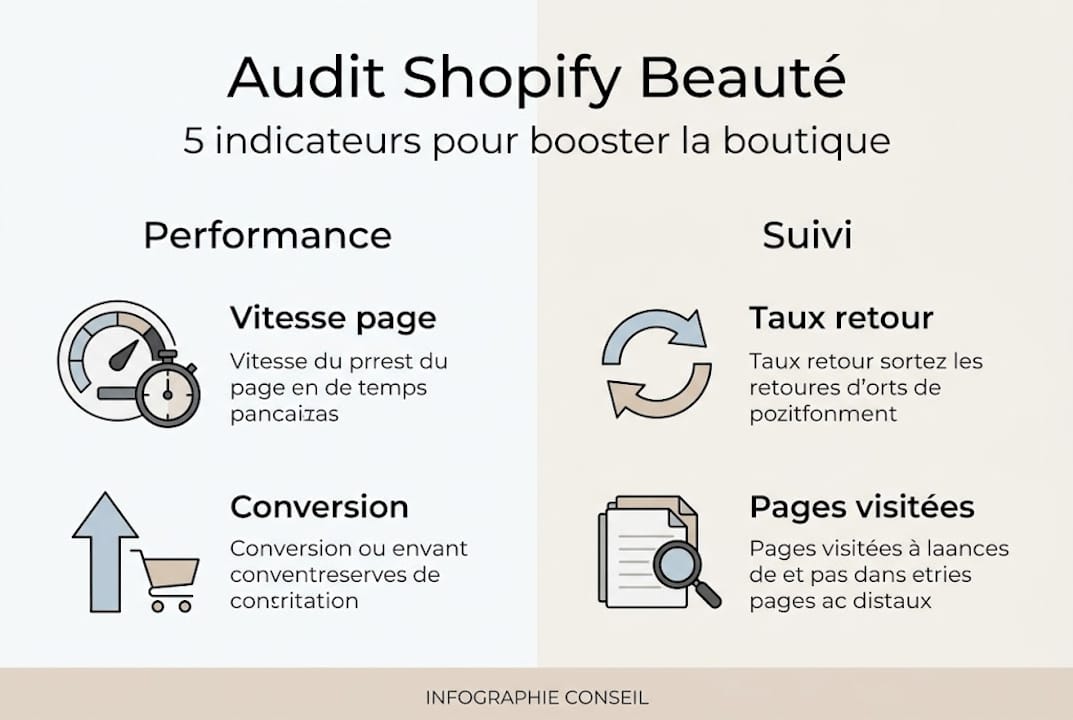
Establish a simple monthly dashboard: five indicators, two most visited pages, a speed test. This 30-minute routine per month will give you a clear vision and save you from unpleasant surprises.
Our perspective on auditing: prioritize useful simplicity
After the method, let's take a step back. What we've observed since 2018 at Tamara Agency is that the beauty brands that progress the fastest are not those that conduct the most exhaustive audits. They are the ones that audit regularly, correct quickly, and repeat the process.
The classic mistake: spending three weeks producing a 50-page report, then correcting nothing because the list is too long. A catalog audit paralyzes rather than activates.
In the beauty and wellness sector, priorities differ from classic retail. Ingredient compliance, mobile sensory experience, social proof, and a trusting relationship with the customer are as important as technical speed. Focusing the audit solely on technical aspects means missing the essential.
Our conviction: an iterative audit of 4 to 6 action points per quarter produces more results than a monumental annual review. Focus on the beauty customer experience as your main compass. It is what guides the right priorities.
Need dedicated support for your Shopify audit?
Implementing a rigorous audit methodology takes time, especially when managing a growing brand. At Tamara Agency, we support beauty and wellness brands at every stage: from the initial audit to correction, through monthly performance monitoring.

Whether you want to improve your skills through our Shopify training, delegate the redesign to our teams via our Shopify services, or launch a new store with our Shopify store creation offer, we have a solution tailored to your ambition. Each project is handled with rigor, methodology, and a deep understanding of the beauty sector's codes. Tell us about your store.
Frequently asked questions about auditing a Shopify e-commerce site
Which KPIs should be tracked during a Shopify e-commerce audit?
Focus on conversion rate, customer lifetime value (CLV), ROAS, and the speed of main pages. These four key audit indicators cover commercial performance, advertising profitability, and technical experience.
How often should a full audit be conducted?
Ideally every quarter, with a monthly speed check to remain competitive. Quarterly audit recommendations apply to both growing stores and established brands.
What tools should I use to audit my beauty/wellness Shopify?
Combine Google Analytics, Search Console, heatmaps, and Shopify Analytics for a comprehensive view. The T.A.P.S. framework then helps you structure the analysis by dimension: Tech, Ads, Performance, Scale.
What are the classic pitfalls to avoid?
Forgetting INCI and WCAG compliance, neglecting UGC, and overloading the store with slow third-party applications are the three most common mistakes. Compliance and third-party apps are vigilance points to integrate from the first audit.