


Beauty e-commerce: definition, challenges, and key levers
TL;DR:
- More than 25% of cosmetic sales are already online, with continuous growth expected.
- Success on Shopify depends on a combination of personalization, speed, omnichannel experience, and authenticity.
- Customer differentiation through proprietary data collection and transparency is key to lasting loyalty.
Beauty e-commerce is disrupting a sector long dominated by in-store advice and large physical retailers. Yet, a common misconception persists: selling cosmetics online would be reserved for giants like Sephora or Amazon. The reality is quite different. More than 25% of cosmetic sales are already made online, and this figure could reach one-third of global sales by 2026. For ambitious brands, understanding precisely what beauty e-commerce encompasses is not an option. It's the first step to building a lasting strategic advantage on Shopify and outperforming the competition.
Table of Contents
- Definition of Beauty E-commerce: Overview and Specificities
- What are the strategic levers for success in beauty on Shopify?
- KPIs to Monitor and Performance Benchmarks on Shopify Beauty
- Case Studies: The Success of Beauty Brands on Shopify
- Our Perspective: Why Customer Differentiation is the Real Key to Success
- Accelerate the Performance of Your Beauty Store
- Frequently Asked Questions about Beauty E-commerce
Key Points
| Point | Details |
|---|---|
| Beauty E-commerce on Shopify | It's a rapid growth opportunity but requires a methodical, customer-centric approach. |
| Key Performance Levers | Personalization, site speed, and community building are crucial for gaining market share. |
| Data-driven management | Monitor your KPIs to optimize every aspect of the buying journey and effectively build loyalty. |
| Concrete Examples | Brands that invest in their digital experience see spectacular increases in conversion and sales. |
Definition of Beauty E-commerce: Overview and Specificities
Beauty e-commerce refers to the online sale of cosmetic products, skincare, makeup, perfumes, and beauty accessories through digital channels. Unlike traditional retail, it removes physical intermediaries and places customer relationship at the heart of an entirely digital experience. The brand communicates directly with its community, collects valuable data, and manages its image without relying on a third-party distributor.
The main product categories concerned are:
- Skincare: serums, creams, cleansers, masks
- Makeup: foundations, lipsticks, palettes
- Perfumes and fragrances: eau de toilette, perfumed oils
- Beauty supplements: vitamins, collagen, probiotics
- Accessories: brushes, massage tools, LED devices
The market shows remarkable progress. Beauty e-commerce sales increased by +5% in 2023, then by +4% in 2024, representing a cumulative increase of +41% between 2019 and 2024, exceeding 3 billion euros annually in France. Amazon, Sephora, and Nocibé dominate this market, but leave real space for independent brands that know how to differentiate themselves.
“A beauty e-commerce site must perform as much as it attracts. Aesthetics without conversion is a luxury few brands can afford.”
Two main types of players coexist. On one side, marketplaces and multi-brand retailers that aggregate offers and attract massive traffic. On the other, DNVBs (Digital Native Vertical Brands), brands born online that control their distribution, storytelling, and customer data from end to end. To follow beauty market trends and anticipate future ones, it's essential to understand where your brand stands.
Until 2026, three structuring trends will be dominant: algorithmic personalization of the experience, the rise of short video formats for product discovery, and the increasing demand for transparency on formulations and environmental impact. Consulting beauty e-commerce market statistics helps calibrate ambitions realistically.
What are the strategic levers for success in beauty on Shopify?
Now that the definition is clear, let's explore the growth accelerators for performing online. Beauty brands that succeed on Shopify do not rely on a single lever. They combine several complementary approaches to create a coherent and engaging experience.
Here are the priority levers to activate:
- AI personalization: skin diagnostic quizzes and algorithmic product recommendations significantly increase conversion and reduce returns.
- Loading speed: a site that loads in under 3 seconds is non-negotiable. Core Web Vitals (Google performance metrics) directly impact your SEO and conversion rate.
- Augmented Reality (AR) try-on: allowing users to virtually try on a lipstick or foundation reduces hesitation to purchase.
- Omnichannel experience via Shopify POS: synchronizing physical and online stores offers brand consistency and facilitates loyalty.
- User-Generated Content (UGC): reviews, photos, and videos from real customers reassure and convert better than any advertisement.
The most effective Shopify beauty strategies combine personalization, speed, omnichannel, SEO, and community. Ethics and sustainability are also becoming decisive purchasing criteria: clearly displaying your environmental commitments is no longer a differentiator, it's an expectation.
| Lever | Conversion Impact | Implementation Complexity |
|---|---|---|
| Personalized AI Quiz | Very High | Medium |
| Speed < 3 seconds | High | Low to Medium |
| AR try-on | High | High |
| Integrated UGC | Medium to High | Low |
| Omnichannel Shopify POS | Medium | Medium |
Good UX practices for Shopify beauty show that user experience is often the decisive factor between a visit and a purchase. Shopify conversion micro-interactions like hover animations or add-to-cart confirmations also help reassure the buyer.

Pro Tip: Prioritize investing in a product personalization quiz. This tool reduces the return rate by over 60% and can quadruple your conversion rate by guiding each visitor to the product that truly matches them.
KPIs to Monitor and Performance Benchmarks on Shopify Beauty
Once the strategy is in place, it's important to track the right indicators to ensure sustainable growth. Without precise monitoring, even a beautiful store can stagnate without you understanding why.
The absolutely essential indicators to monitor are:
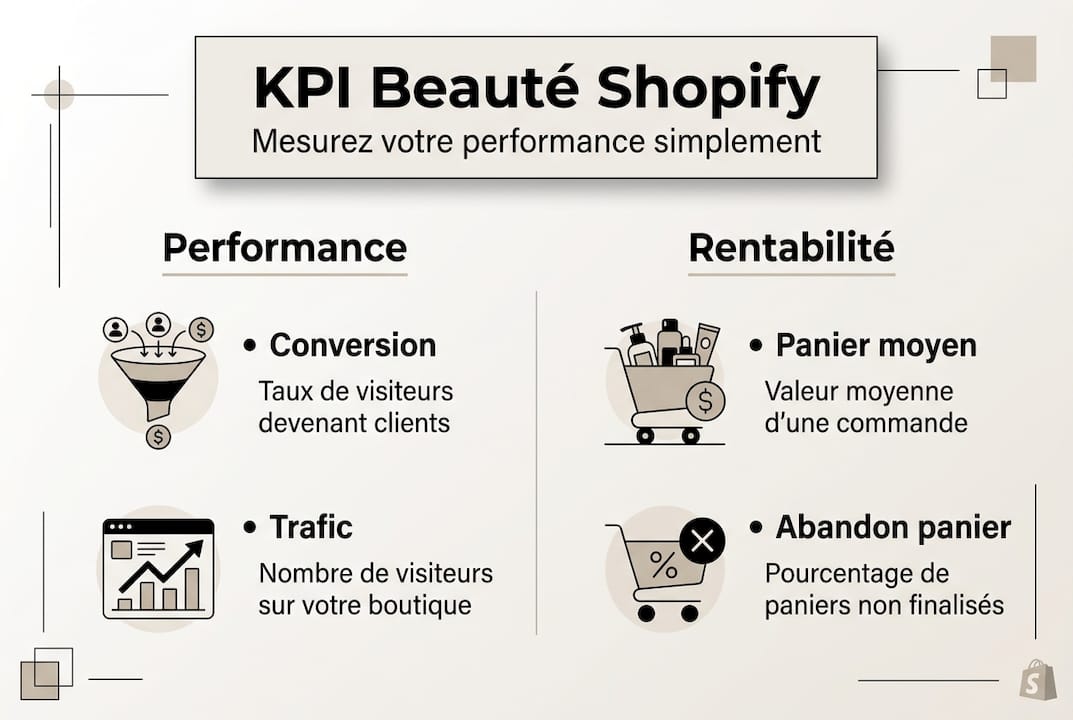
- Conversion rate: percentage of visitors who place an order
- Average Order Value (AOV): average value of each order
- Customer Acquisition Cost (CAC): advertising budget spent to acquire a new customer
- ROAS: return on ad spend
- Repurchase rate: proportion of customers who order a second time
- Cart abandonment rate: visitors who add to cart without completing the purchase
Conversion rate benchmarks for the beauty sector on Shopify are between 1.4% and 3%, with the top 20% of performing stores exceeding 3.2%. Each additional second of loading time erodes this rate. According to the 5 KPIs to monitor on Shopify, the cart abandonment rate is close to 70% in the beauty sector, representing a considerable source of revenue to recover via automated email sequences.
| KPI | Beauty Sector Average | Top 20% |
|---|---|---|
| Conversion Rate | 1.4% to 3% | > 3.2% |
| Average Order Value | €45 to €75 | > €90 |
| Repurchase Rate | 25% to 35% | > 45% |
| Cart Abandonment Rate | ~70% | < 55% |
Key figure to remember: almost 70% of beauty carts are abandoned before purchase. Recovering even 10% of these carts via a well-constructed email sequence can transform your profitability.
The Shopify beauty KPIs guide will help you structure an operational dashboard. And to go further on accountability issues, ethical beauty e-commerce challenges are increasingly integrated into consumer purchasing decisions.
Case Studies: The Success of Beauty Brands on Shopify
To illustrate these best practices, let's look at some remarkable successes on Shopify in the beauty sector. These examples show that results are not reserved for large companies with unlimited budgets.
The most striking concrete Shopify beauty cases demonstrate spectacular progress after migration or redesign:
- Dermalogica: after migrating to Shopify, the brand recorded +119% sales, +45% conversion rate, and +44% faster loading time. A total transformation driven by a UX redesign and a rethought technical architecture.
- La Rosée: +88% sales and +53% conversion rate after a complete redesign of its Shopify store, focusing on clear product pages and customer trust.
- Omy: +60% sessions in just 3 months thanks to a strong personalization strategy and strong community content.
These results share several common points. A user-centric UX redesign, optimized loading speed, and personalization of the experience adapted to the beauty sector's codes. Creating a Shopify beauty store is not just about choosing an attractive theme. It's a fundamental work on conversion, loyalty, and brand image.
The migration of a beauty store to Shopify is often the starting point for new commercial momentum. And the choice of performing Shopify designs conditions both aesthetics and technical performance.
Pro Tip: Never separate aesthetic redesign and technical optimization. The brands that progress fastest are those that treat UX, speed, and personalization as a single coherent project, not as three separate undertakings.
Our Perspective: Why Customer Differentiation is the Real Key to Success
The figures are eloquent, but they mask a deeper reality. The battle of beauty e-commerce is no longer about price or even product quality. It's about customer knowledge and the ability to create a lasting relationship.
Since 2018, we have observed that the brands that increase profitability are those that invest in their first-party data, i.e., data collected directly from their customers, without relying on third-party platforms. With the gradual end of third-party cookies, this proprietary data becomes a decisive strategic weapon.
Advertising budgets are increasing everywhere, but their effectiveness is decreasing. Building an engaged community, fostering a relationship of trust through authentic content, and personalizing each interaction: this is what creates lasting loyalty. Brands that anticipate future expectations—ecological transparency, authentic formulations, direct conversation—build an advantage that no one can easily copy. Ethical beauty e-commerce is not a fleeting trend. It is the new norm.
Accelerate the Performance of Your Beauty Store
Do you want to go further and quickly outperform your competitors? At Tamara Agency, we have been supporting beauty and cosmetics brands since 2018 in the creation, redesign, and optimization of their Shopify stores. Our approach combines aesthetic demandingness, technical performance, and tailor-made conversion strategy.

Whether you're starting from scratch or looking to transform an existing store, our team offers a personalized audit to identify your priority areas for improvement. Discover our Shopify beauty support offer or speak directly with a Shopify beauty consultant to build the store your brand deserves together.
Frequently Asked Questions about Beauty E-commerce
How to start a beauty e-commerce business on Shopify?
Identify your niche, build a conversion-optimized store, choose suitable logistics solutions, and take care of your communication to quickly retain your first customers. Beauty store creation tips will guide you on essential regulatory and practical aspects.
What KPIs should you monitor to manage your online beauty store?
Essential KPIs are conversion rate, average order value, acquisition cost, retention rate, cart abandonment rate, and repurchase rate. Find details on the 5 key Shopify KPIs to structure your management.
Is personalization really profitable on a beauty site?
```Yes, adding AI quizzes or personalized analytics can quadruple conversion and reduce product returns by over 60%. Beauty personalization data confirms that this is one of the most profitable investments in the industry.
How to stand out from giants like Amazon or Sephora?
Invest in your branding, offer tailor-made experiences, develop an engaged community, and prioritize transparency and ethics. Beauty market trends show that well-targeted niches are very resilient against generalist players.