

7 Best E-Commerce Apps to Discover in 2026
E-commerce is undergoing a rapid transformation. In 2026, choosing the right e-commerce app will be crucial for success and standing out in a constantly evolving market.
This article presents the 7 best current solutions to boost your sales, simplify management, and offer your customers an impeccable experience. Whether you're a budding entrepreneur or an experienced merchant, discover innovative tools tailored to every need.
We will analyze the key features, advantages, pricing, as well as the strengths and weaknesses of each application. Ready to explore the future of e-commerce and take your store to the next level?
Why e-commerce apps are essential in 2026
The online retail landscape is evolving at an unprecedented pace. In 2026, the massive adoption of smartphones and accelerated digitalization are radically transforming how consumers discover, purchase, and interact with brands. E-commerce apps are thus becoming essential pillars for any store looking to remain competitive and meet new market demands.
The rise of mobile shopping is undeniable. According to a recent study, mobile commerce now accounts for 73% of online purchases, highlighting the importance for every business to have a suitable and high-performing e-commerce app. This figure demonstrates not only consumers' preference for simplicity and speed but also the direct impact of these tools on conversion rates, especially on social platforms like TikTok where the increase reaches +64%.
Customer expectations in 2026 focus on immediacy, personalization, and security. A modern e-commerce app must offer a fluid experience, from secure payment to omnichannel management, while integrating advanced artificial intelligence features. AI optimizes inventory management, automates customer service with chatbots, and provides personalized recommendations, thereby improving satisfaction and loyalty.
The integration of payment, logistics, and marketing tools is now essential for a high-performing store. E-commerce apps facilitate synchronization with external platforms, allowing for centralized management and automated processes. Many brands have seen their sales skyrocket thanks to innovative applications that anticipate customer needs and adapt offers in real-time.
Finally, the trend towards internationalization is pushing businesses to choose multilingual and scalable solutions. The most effective e-commerce apps integrate automatic translation modules, advanced analytics, and compatibility with local regulations. Upcoming innovations, such as generative AI and predictive analysis, promise to open new perspectives for ambitious stores.
In summary, choosing the right e-commerce app in 2026 is a strategic lever for capturing new markets, optimizing management, and providing an impeccable customer experience. Businesses that invest in these tools are positioning themselves at the forefront of a rapidly changing sector.
7 Best E-commerce Apps to Discover in 2026
On the eve of 2026, choosing an innovative e-commerce app has never been more strategic for online merchants. The digital environment is evolving, and customer expectations are pushing for the adoption of high-performing, intuitive, and connected solutions.
In this selection, discover 7 essential e-commerce apps, each meeting specific needs: automation, content generation, omnichannel management, multilingual support, and performance analysis. Market trends, such as the rise of AI and social commerce, make these tools essential for staying competitive and offering an optimal customer experience. To delve deeper into the structural trends guiding this selection, consult The 10 essential e-commerce trends for 2026.
Pizi – Ultra-fast AI Product Sheet Generation
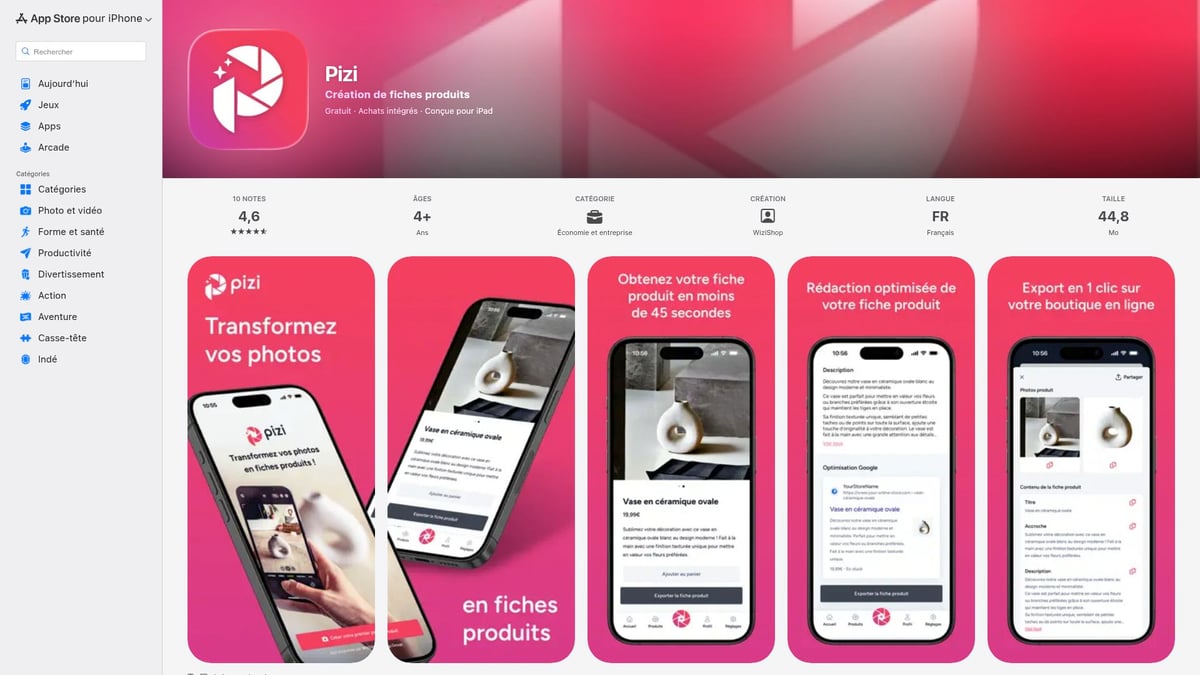
Pizi stands out as a leading e-commerce app for creating product sheets in record time. Thanks to artificial intelligence, simply take a photo, and Pizi automatically generates the title, SEO-optimized description, and price suggestions.
Main features:
- Product sheet generation from a photo or text.
- Automatic SEO optimization for each sheet.
- Market-adapted price proposals.
- Intuitive mobile app, usable anywhere.
Pricing:
- Free for WiziShop subscribers.
- Standalone offer at €2.99/week or €99.99/year.
Advantages:
- Considerable time savings for e-merchants.
- Professional quality descriptions, designed for SEO.
- No technical skills required.
Use cases:
- Ideal for freelancers, very small businesses/SMEs, dropshippers looking for a mobile e-commerce app.
- Perfect for quickly launching new products.
Strengths:
- Speed of execution.
- Ease of use.
- Professional results.
Weaknesses:
- Advanced features reserved for the WiziShop ecosystem.
- Dependence on AI for fine-tuned personalization.
According to Sistrix, the click-through rate for the first Google result reaches 28.5%, highlighting the importance of a well-optimized product sheet via a high-performing e-commerce app.
Jotform Apps – No-code e-commerce app creation
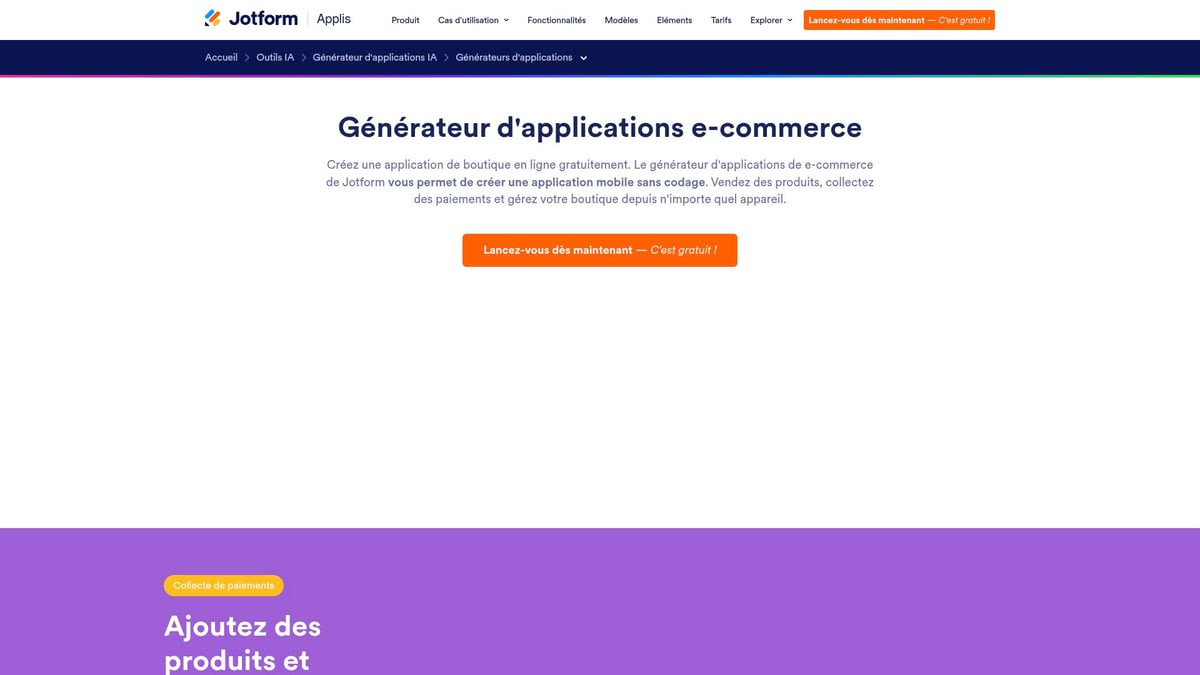
Jotform Apps is a no-code e-commerce app that allows anyone, without technical skills, to create a mobile online store application in minutes.
Key features:
- Drag-and-drop mobile app builder.
- Customizable product catalog.
- Integration of over 40 payment methods (PayPal, Stripe, Apple Pay, etc.).
- Easy sharing via link or QR code.
Pricing:
- Free version available.
- Premium subscriptions based on transaction volume.
Advantages:
- Access to e-commerce without a developer.
- Ready-to-use templates.
- Centralized multichannel management.
Use cases:
- Entrepreneurs, SMEs, associations, physical businesses wishing to digitize their offering via an e-commerce app.
- Rapid launch of an online activity.
Strengths:
- Flexibility and speed of implementation.
- Centralization of customer data.
Weaknesses:
- Advanced customization limited for very specific needs.
Jotform reminds that the B2C model remains the most common in e-commerce, and the ease of access offered by this e-commerce app attracts many creators.
Tamara Agency – Custom Shopify store creation and redesign
Tamara Agency positions itself as a hybrid e-commerce app, combining human service and technology, dedicated to the creation and redesign of Shopify and Shopify Plus stores.

Presentation and services:
- Creation, redesign, migration of e-commerce stores.
- Custom UX/UI design, personalized development.
- SEO and conversion optimization (CRO).
Advantages:
- Comprehensive strategic support.
- Custom solutions tailored to the sector (beauty, fashion, wellness).
- Proven results: +30% to +98% sales for some clients.
Use cases:
- Ambitious brands, growing businesses.
- Professional migration or redesign projects via a specialized e-commerce app.
Strengths:
- Sectoral expertise.
- Over 400 projects completed.
- Human and strategic approach.
Weaknesses:
- Higher investment than a standard app.
- Completion times (2 to 6 months depending on the project).
Clients such as Decathlon, Leonor Greyl, and Diega trust this e-commerce app for their growth on Shopify.
TikTok Pixel – Advertising targeting and conversion tracking
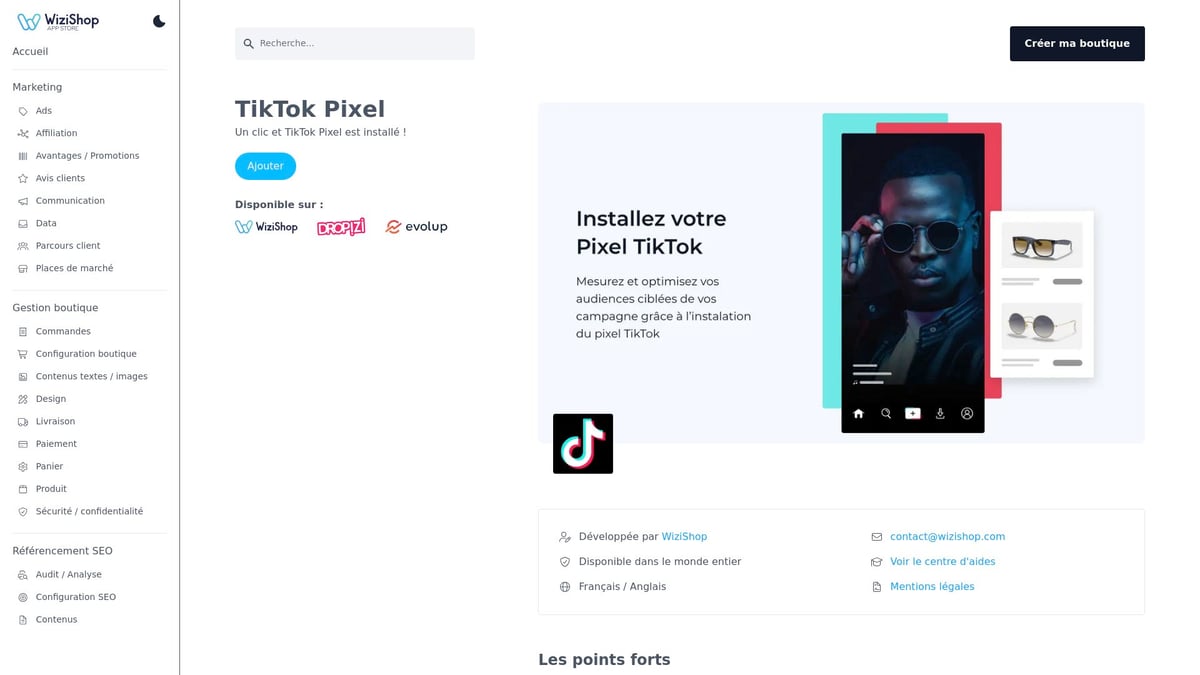
TikTok Pixel is an indispensable e-commerce app for brands looking to effectively target Generation Z and boost their sales via TikTok.
Features:
- Simplified TikTok pixel installation.
- Precise conversion tracking.
- Behavioral analysis and custom audience creation.
Pricing:
- Free for WiziShop users.
Advantages:
- High advertising ROI (+64% vs. other platforms).
- Real-time data for campaign optimization.
Use cases:
- Social commerce-focused brands.
- E-merchants wishing to leverage TikTok's potential with a suitable e-commerce app.
Strengths:
- Fast installation.
- Budget optimization.
Weaknesses:
- Reliance on a creative strategy on TikTok.
- Requires constant adaptation to trends.
According to Nielsen, 61% of TikTok users make a purchase after seeing an ad, proving the impact of this e-commerce app on conversions.
AI Product Sheet Translation – Automated Multilingual
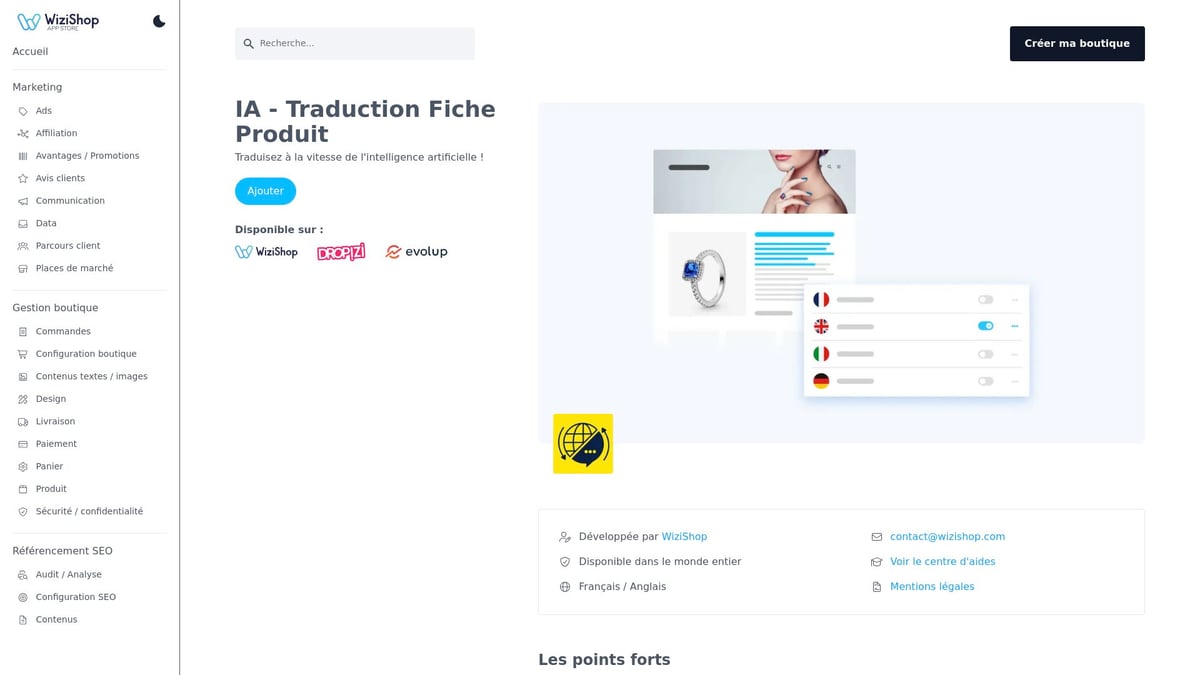
Automated product sheet translation is becoming a must-have for any e-commerce app looking to go international.
Features:
- Automatic translation into 7 major languages.
- Cultural adaptation and multilingual SEO optimization.
- Direct integration into the store.
Pricing:
- Free for WiziShop subscribers.
Advantages:
- Access to new markets effortlessly.
- Significant time savings.
- Consistency of multilingual content.
Use cases:
- Stores expanding internationally.
- International dropshippers using a multilingual e-commerce app.
Strengths:
- Speed and quality of translations.
- Ease of integration.
Weaknesses:
- Dependence on WiziShop.
- Less manual control over translations.
Internationalization, facilitated by this e-commerce app, typically leads to a 30% increase in turnover.
Search Statistics – Customer needs analysis
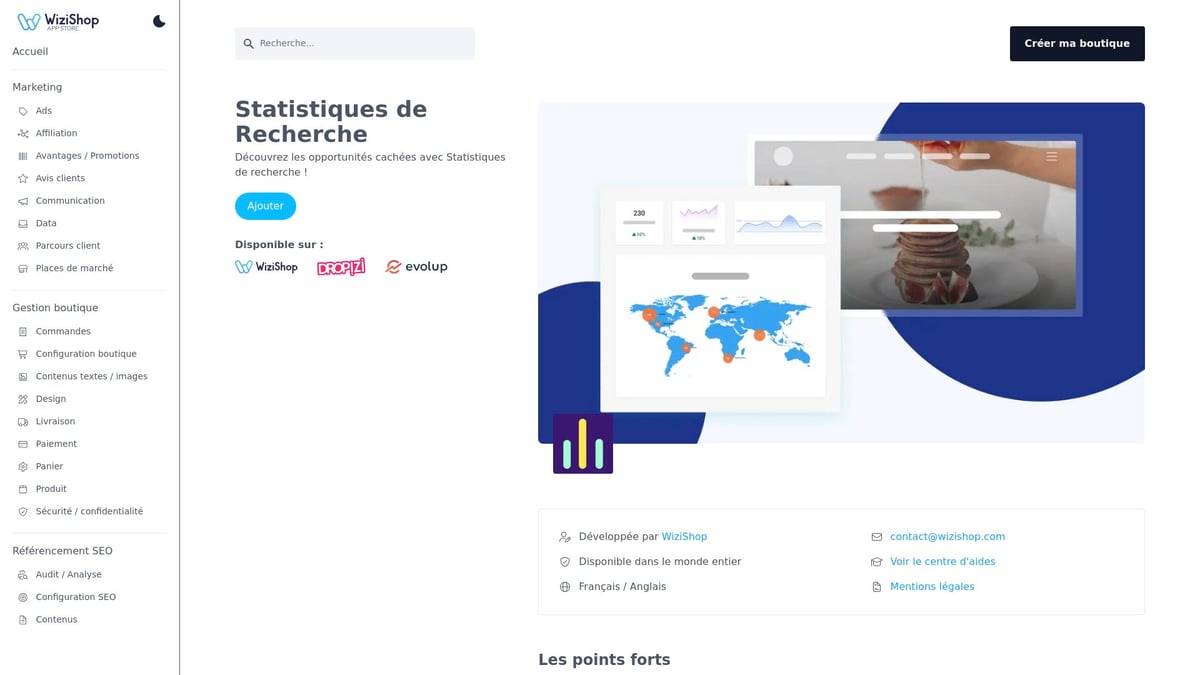
Understanding customer needs is vital, and this e-commerce app dedicated to internal search analysis provides immediate added value.
Features:
- Tracking of visitors' internal searches.
- Analysis of trends and identification of product opportunities.
- Recommendations for optimizing UX and the catalog.
Pricing:
- Free with WiziShop.
Advantages:
- Clear vision of customer expectations.
- Rapid catalog adaptation to maximize conversion.
Use cases:
- Sites with large catalogs.
- E-merchants wishing to refine their offering with an analytical e-commerce app.
Strengths:
- Real-time data.
- Intuitive interface.
Weaknesses:
- Limited to the WiziShop ecosystem.
- Analysis focused on the site only.
UX optimization via this e-commerce app can increase the conversion rate by 20% according to industry studies.
Zapier – E-commerce task automation
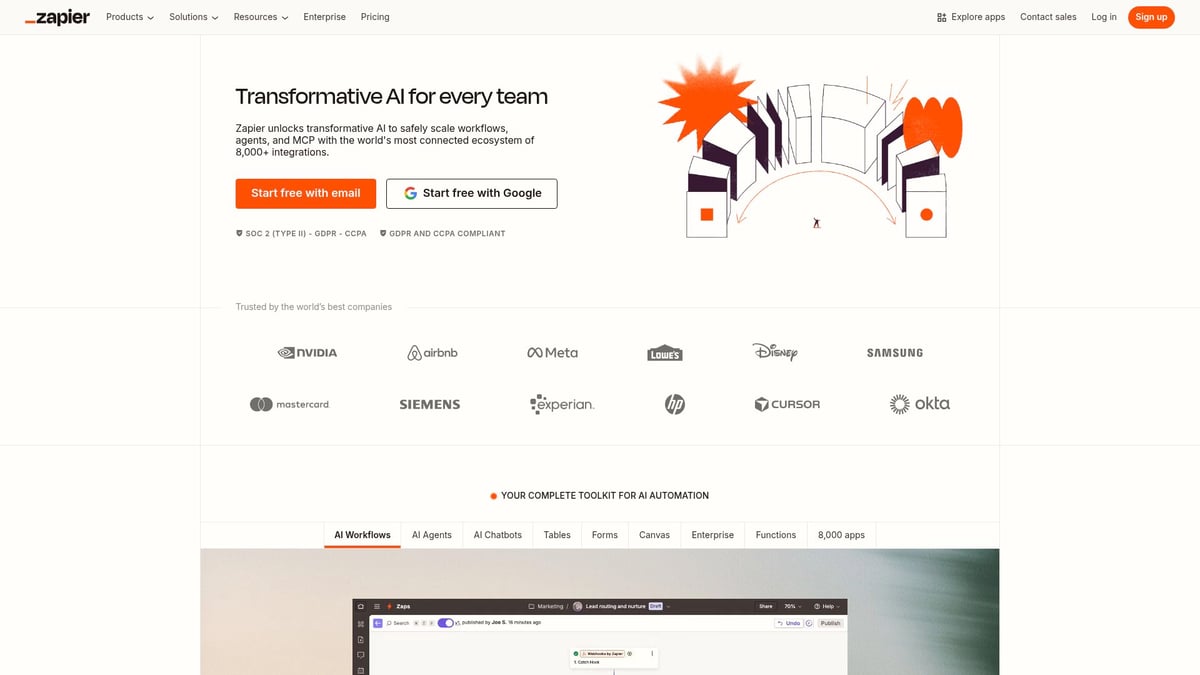
Zapier is the flagship e-commerce app for automation, connecting hundreds of tools to reduce manual tasks.
Features:
- Automation between CRM, email, logistics, accounting.
- Custom workflows based on needs.
- Integration of hundreds of third-party applications.
Pricing:
- Limited free version.
- Paid plans based on automation volume.
Advantages:
- Considerable time savings.
- Reduction of human errors.
- Guaranteed scalability for any e-commerce app.
Use cases:
- E-merchants using multiple tools.
- Growing teams needing fluid synchronization.
Strengths:
- Exceptional connectivity.
- Ease of setup.
Weaknesses:
- Learning curve for advanced automations.
- Costs for large data volumes.
According to Zapier, 80% of SMEs automate at least one business process via an e-commerce app, proving the importance of automation for performance.
Summary table of the best e-commerce apps for 2026:
| Application | Key Feature | Ideal for | Strengths | Main Limitations |
|---|---|---|---|---|
| Pizi | AI sheet generation | Freelancers, SMEs | Speed, SEO | Outside WiziShop, AI dependence |
| Jotform Apps | No-code mobile app | Entrepreneurs, SMEs | Flexibility, simplicity | Limited customization |
| Tamara Agency | Custom Shopify creation | Growing brands | Expertise, support | Investment, deadlines |
| TikTok Pixel | TikTok ad targeting | Social commerce, youth | ROI, fast installation | TikTok dependence |
| AI Translation | Multilingual translation | Export, dropshipping | Internationalization | Partial control |
| Search Statistics | Customer needs analysis | Large catalogs | Real-time data | Limited to WiziShop |
| Zapier | Multi-tool automation | Multi-app teams | Connectivity, scalability | Learning curve |
Each e-commerce app presented here has distinct advantages to meet varied needs. Adopting one or more of these solutions ensures a competitive advantage and an enriched customer experience for 2026.
Criteria for selecting an e-commerce application in 2026
Choosing the right e-commerce app in 2026 requires a rigorous analysis of several essential criteria. Each store has its specificities, and an informed decision guarantees the performance and sustainability of your online activity.
Compatibility and integrations
The compatibility of the e-commerce app with your current platform is an indispensable starting point. Shopify, WooCommerce, or no-code solutions do not offer the same integration possibilities. It is wise to consult resources like the Shopify or WooCommerce comparison to better understand the ecosystems compatible with the applications under consideration.
Also, check the application's ability to integrate natively with your existing tools: ERP, CRM, marketing automation solutions. This connectivity ensures smooth management and limits duplicates or data loss.
Security and data management
Payment security and customer data protection are non-negotiable criteria for any e-commerce app. The application must guarantee strict compliance with current standards, particularly GDPR and PCI DSS, to reassure your customers and preserve your reputation.
Recent studies, such as the one on the security evaluation of Android e-commerce applications, highlight the importance of prioritizing tested solutions recognized for their robustness in terms of security. Regular auditing and transparent access management are recommended practices.
Scalability, user experience, and support
The chosen e-commerce app must support your store's growth without hindering your ambitions. Evaluate scalability: can the application handle a sudden increase in traffic, orders, or product references?
The user experience (UX), both for the merchant and the end customer, must be fluid and intuitive. Prioritize solutions that offer responsive customer support, clear documentation, and an active community, in order to quickly resolve any blockages.
Total cost and feedback
The total cost of ownership of an e-commerce app is not limited to the subscription price. Also include commissions, hidden fees, or integration costs in your calculation. It is important to analyze the value for money and anticipate evolving needs in the medium term.
Do not hesitate to consult testimonials from other e-merchants already using the application. Their feedback will give you concrete insights into the strengths and limitations of each solution. By taking all these criteria into account, you maximize your chances of selecting an e-commerce app perfectly suited to your 2026 challenges.
Trends and innovations to watch in e-commerce apps
The technological revolution is transforming the e-commerce app sector at an unprecedented speed. In 2026, merchants are relying on a wave of innovations to remain competitive and meet the expectations of an increasingly demanding clientele. Let's discover the major trends that are redefining e-commerce applications.
Generative AI and personalization
The integration of generative artificial intelligence into every e-commerce app marks a turning point. These solutions allow for the creation of personalized content, from product sheets to dynamic recommendations. Customers benefit from a tailor-made experience that adjusts in real time to their behavior.
Generative AI boosts the creation of texts, images, and even videos, making each store unique and engaging. It also facilitates SEO optimization and inventory management. According to experts, AI will be at the heart of e-commerce app differentiation in the coming years.
Automation and omnichannel strategy
Advanced automation is becoming the norm in every high-performing e-commerce app. Intelligent chatbots provide 24/7 customer service, while automatic reminders and intelligent inventory management reduce human errors.
Omnichannel strategy is strengthening, connecting physical and digital stores via mobile applications or PWAs. This convergence streamlines the shopping experience, from online cart to in-store pickup. To learn more about major upcoming developments, consult the 10 technological trends that will transform business in 2026.
Social commerce and predictive analytics
Social commerce is establishing itself as a strategic lever for any e-commerce app wishing to reach Generation Z and new consumers. Direct integrations with Instagram, TikTok, or Pinterest facilitate frictionless purchases from social networks.
Predictive analytics, meanwhile, uses data to anticipate needs, optimize inventory management, and personalize offers. This approach increases conversion rates and customer satisfaction, making the use of an e-commerce app essential.
Sustainability, accessibility, and future innovations
Tomorrow's e-commerce apps focus on sustainability and accessibility. Eco-responsible applications promote local consumption, traceability, and the reduction of the carbon footprint. Mobile accessibility is essential, especially since mobile commerce accounts for 73% of online purchases.
Finally, innovations such as lightweight apps (PWA), fast loading times, and multilingual inclusion open up new perspectives. E-commerce apps are evolving to offer a fluid, inclusive, and responsible experience to a global clientele.