


Defining a high-performing e-commerce site: a Shopify beauty guide
TL;DR:
- Improved technical performance significantly increases conversion and loyalty.
- The three essential pillars are loading time, visual stability, and responsiveness.
- Optimizing images, limiting apps, and choosing a lightweight theme are key for beauty performance.
Gaining an additional 8.4% conversion for every tenth of a second saved on loading time: this figure should concern all beauty and wellness brands present on Shopify. Yet, technical performance remains one of the most underestimated levers in the sector. Many brands invest in polished visuals and costly advertising campaigns but neglect the infrastructure that conditions the user's actual experience. This guide aims to clarify what a high-performing Shopify site truly means, identify the priority technical criteria for your sector, and provide you with a concrete method to take action.
Table of Contents
- What is a high-performing e-commerce site?
- Essential technical criteria for beauty on Shopify
- Commercial performance: benchmarks and real-world cases
- Audit methods, monitoring, and optimization for your store
- Our perspective on beauty e-commerce performance in 2026
- How to go further with Tamara Agency
- Frequently Asked Questions
Key Points
| Point | Details |
|---|---|
| Priority User Experience | A high-performing site streamlines navigation and maximizes customer engagement. |
| Targeted Technical Optimization | Core Web Vitals and mobile speed are strategic levers for beauty on Shopify. |
| Direct Impact on Conversion | Every second gained in site speed significantly increases sales. |
| Essential Audit and Monitoring | Regular monitoring via specialized tools allows for continuous performance adjustment. |
What is a high-performing e-commerce site?
The performance of an e-commerce site is not limited to its display speed. It's a dual concept: technical and commercial. Technically, a high-performing site loads quickly, remains visually stable during loading, and responds instantly to user interactions. Commercially, it converts better, builds more loyalty, and generates measurable return on investment.
For beauty and wellness brands, this duality is particularly critical. Your customers expect a smooth user experience that reflects the quality of your products. A slow or unstable site immediately breaks this brand promise.
The three technical pillars of performance
- Loading Time: delay between the request and the display of the main content (LCP)
- Visual Stability: absence of unexpected shifts of elements during loading (CLS)
- Responsiveness: response time to user interactions like clicks or inputs (INP)
These three metrics constitute Google's Core Web Vitals. They directly influence your natural referencing and your conversion rate.
Sectoral benchmarks to know
| Metric | Target Objective | Critical Threshold |
|---|---|---|
| LCP (loading) | Less than 2.5s | More than 4s |
| CLS (stability) | Less than 0.1 | More than 0.25 |
| INP (responsiveness) | Less than 200ms | More than 500ms |
| Mobile PageSpeed Score | 70 and above | Less than 50 |
The Shopify benchmarks on Core Web Vitals show that the majority of beauty stores still struggle to reach these thresholds on mobile, which represents a real opportunity for differentiation.
"A site must perform as well as it seduces. For a beauty brand, slowness is as strong a negative signal as damaged packaging."
Understanding the definition of beauty e-commerce in its full depth allows one to grasp why technical performance is not an option, but a fundamental requirement. The most effective Shopify beauty solutions integrate this dimension from the design stage.
Essential technical criteria for beauty on Shopify
The beauty sector presents specific technical constraints. Stores are naturally rich in high-resolution images, demonstration videos, and subtle animations. These elements are indispensable for customer seduction, but they also constitute the main sources of slowdown.

Priority metrics for your sector
Optimizing Core Web Vitals on Shopify relies on three fundamental actions: reducing image weight, limiting third-party scripts, and choosing a lightweight native theme. Shopify's integrated CDN (Content Delivery Network) distributes your content from servers close to your visitors, significantly reducing latency.
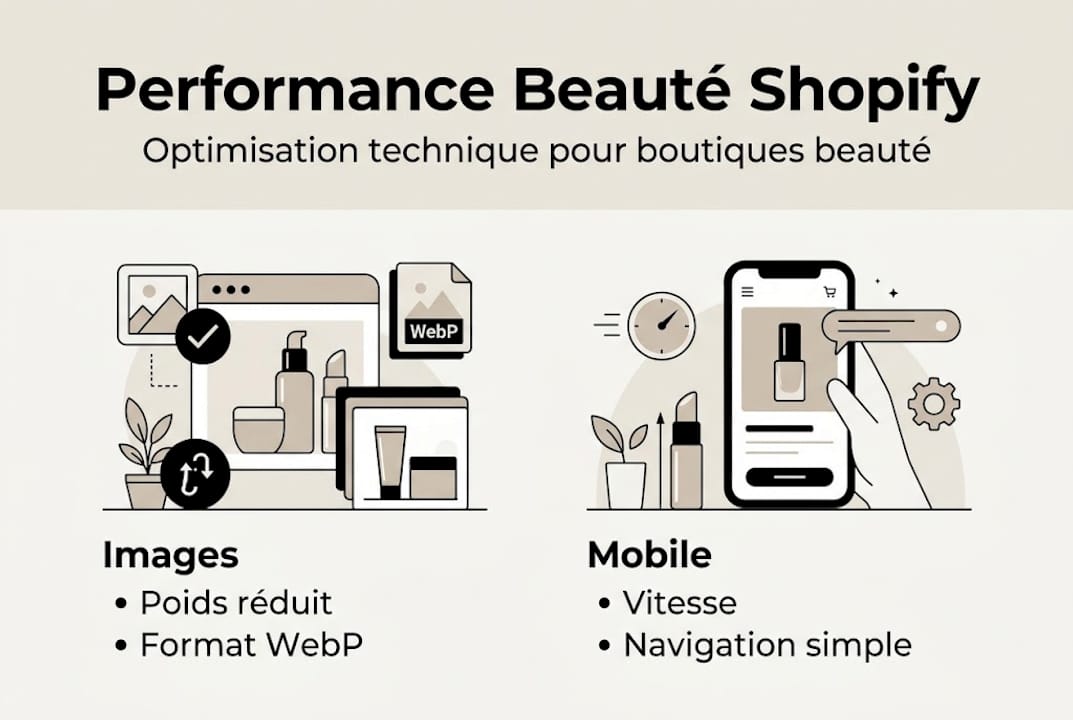
Images often represent 45 to 65% of the total weight of a beauty page. Optimizing images and mobile traffic is therefore the absolute priority, especially since 70% of beauty e-commerce traffic now comes from smartphones.
Comparison of technical approaches
| Approach | Performance Impact | Complexity | Recommended for |
|---|---|---|---|
| Dawn Theme (Shopify native) | High | Low | Start-up brands |
| Optimized Premium Theme | High | Medium | Established brands |
| Headless Architecture | Very High | High | High-volume brands |
| Heavy Custom Theme | Low | High | To be avoided |
Concrete actions to prioritize
- Convert all images to WebP or AVIF format
- Activate lazy loading on off-screen images
- Delete unused or redundant Shopify apps
- Use Shopify CDN for static files
- Regularly test your mobile score via PageSpeed Insights
Pro tip: Each installed Shopify app adds JavaScript code to your store. An unused but still active app can reduce your performance score by 5 to 15 points. Conduct a quarterly audit of your apps and don't hesitate to delete any that don't provide measurable value.
The Shopify design checklist we developed covers these points precisely. To go further on user experience, e-commerce micro-interactions are a powerful complementary lever.
Commercial performance: benchmarks and real-world cases
The figures speak for themselves. In the beauty and wellness sector, average conversion rates range between 1.6% and 3.3% depending on the segments. But stores that invest in technical performance regularly achieve double these averages.
Quantified impact of performance on sales
| Technical Improvement | Estimated Conversion Impact | Average Basket Impact |
|---|---|---|
| 1 second gain on LCP | +7 to +8% | +2 to +3% |
| Mobile score from 50 to 80 | +15 to +25% | Stable |
| CLS reduction to 0 | +5 to +10% | +1 to +2% |
| Image optimization | +10 to +20% | Stable |
+53% conversion: this was the result achieved by Dermalogica after a performance-focused redesign. Shopify case studies regularly document this type of result for brands that prioritize the technical experience.
Priority actions to boost your sales
- Audit your LCP on product pages (the most visited ones)
- Compress all images without noticeable loss of visual quality
- Activate a mobile-optimized theme as a priority
- Reduce the number of apps to less than 10 active simultaneously
- Set up monthly monitoring of your Core Web Vitals
Best UX practices for beauty show that technical performance and design must go hand in hand. Exploring the different types of Shopify designs allows you to find the balance between aesthetics and speed.
Audit methods, monitoring, and optimization for your store
Knowing the metrics is not enough. A structured method is needed to move from analysis to continuous improvement. Regular auditing via PageSpeed Insights and the Shopify Web Performance Dashboard are the two basic tools essential for any serious brand.
Essential tools
- Google PageSpeed Insights: detailed analysis of Core Web Vitals per page
- Shopify Web Performance Dashboard: overview of your store's metrics
- Google Search Console: alerts for pages below CWV thresholds
- Hotjar or Microsoft Clarity: behavioral analysis to identify friction points
- Shopify Analytics: correlation between performance and actual conversion rate
A structured four-step approach
First, audit your strategic pages: homepage, category pages, product pages. These concentrate traffic and conversion opportunities. Second, prioritize corrections according to their potential impact on LCP, as this is the metric most correlated with conversion for image-heavy sites.
Third, test your changes via A/B tests before deploying them globally. Fourth, set up automated monthly monitoring to detect regressions, especially after each theme update or app installation.
Pro tip: Before installing a new Shopify app, test its impact on your PageSpeed score in a development environment. Some apps add several seconds of loading time for minor functionalities. The trade-off between functionality and performance should always be evaluated.
"Performance is not a state, it's a process. It is built, measured, and maintained over time."
The fact that 52% of Shopify stores still fail Core Web Vitals on mobile in 2026 clearly illustrates that the majority of brands have not yet integrated this discipline into their operational routine. This is precisely where your competitive advantage lies.
To structure your approach, our guide on measuring Shopify performance provides a complete and actionable framework.
Our perspective on beauty e-commerce performance in 2026
We have been supporting beauty and wellness brands since 2018, and we always observe the same pattern: teams invest in content, marketing, influencers, but postpone technical decisions. Performance then becomes a reactive problem rather than a strategic priority.
What experience has taught us is that poorly adapted technology costs more than absent technology. A visually magnificent but unoptimized mobile theme, dozens of apps piled up without performance auditing, uncompressed images because "it takes time": these are the choices that silently weigh down commercial results.
The true uniqueness of beauty brands on Shopify is that they need technical performance calibrated for visually rich sites. This is not the same equation as for a generic product store. Investing in continuous monitoring and Shopify beauty store creation adapted to your sector means choosing to grow your brand on solid foundations.
How to go further with Tamara Agency
You now have a clear vision of what performance means for a Shopify store in beauty and wellness. The next step is to translate this understanding into concrete results for your brand.

Since 2018, we have been supporting ambitious brands with an approach that combines technical rigor and sectoral sensitivity. Whether you want to optimize your existing Shopify store or create a beauty store designed to perform from day one, we build tailor-made solutions with you. Because a site that seduces must also convert.
Frequently Asked Questions
What are the key performance indicators for a beauty e-commerce site?
Loading time, visual stability, responsiveness, and Core Web Vitals (LCP, INP, CLS) are the main indicators to monitor for a beauty store on Shopify.
How do I know if my Shopify site is performing well?
Use tools like PageSpeed Insights and the Shopify Web Performance Dashboard to measure your technical metrics. Regular auditing will allow you to quickly detect friction points and opportunities for improvement.
Which technical actions are most effective for optimizing a beauty store on Shopify?
Optimize your images to WebP, reduce unnecessary apps, choose a lightweight theme, and prioritize mobile speed. Images and superfluous apps are the two main causes of slowdown in the beauty sector.
What is the real impact of performance on conversion in beauty/wellness?
```Every second saved can generate up to 7 to 8% additional conversion, with documented case studies showing gains of 40 to 53% after technical optimization on Shopify.