


Segmenting your e-commerce customer base to maximize conversion
TL;DR:
- Customer segmentation significantly increases conversion rates and average order value.
- Combining demographic, behavioral, RFM, and predictive segmentation leads to greater effectiveness.
- Automated activation scenarios optimize engagement and loyalty in online beauty.
More audience does not mean more sales. This is a mistake too many online beauty brands still make: investing heavily in acquisition without ever questioning the relevance of their messages. Yet, fine segmentation doubles the performance of e-commerce campaigns. In other words, speaking to the right person, at the right time, with the right offer, changes everything. In this article, we explain what customer segmentation concretely is, why it is particularly powerful in the beauty sector, and how to implement it to turn your store into a true conversion machine.
Table of Contents
- Understanding Customer Segmentation in E-commerce
- Concrete Benefits of Segmentation: Figures and Examples
- Keys to Effective Segmentation in Beauty
- Applying Segmentation at Each Stage of the Customer Journey
- Our Expert View on Customer Segmentation
- Take Action with Customer Segmentation
- Frequently Asked Questions about E-commerce Customer Segmentation
Key Points
| Point | Details |
|---|---|
| Doubling results | Segmentation doubles marketing effectiveness and conversion on a beauty site. |
| Hybridizing approaches | Mixing RFM, behavioral data, and AI provides deeper customer understanding. |
| Act, don't analyze | Segmentation is only useful if it activates concrete, personalized campaigns. |
| Start simply | No need to over-segment from the start; progress based on market feedback. |
Understanding Customer Segmentation in E-commerce
Customer segmentation involves dividing your buyer base into homogeneous groups based on precise criteria: purchasing behavior, visit frequency, type of products viewed, demographic profile, or stage in the customer lifecycle. The objective is simple: to address each group with a message, offer, or experience that truly suits them.
In the beauty universe, this logic is particularly crucial. Your customers are not all at the same stage. A bio-skincare enthusiast does not have the same expectations as a regular buyer of luxury makeup, nor as a new visitor discovering your brand. The challenges of beauty e-commerce require this granularity to remain competitive.
There are four main types of segmentation to be aware of:
- Demographic: age, gender, location, income. Useful as a starting point, but insufficient on its own.
- Behavioral: analysis of clicks, page views, abandoned carts, purchased products. Very powerful for real-time personalization.
- RFM (Recency, Frequency, Monetary): classifies your customers based on their purchase history to identify your VIPs, dormant customers, or occasional buyers.
- Predictive: uses artificial intelligence to anticipate future behaviors, such as the probability of repurchase or unsubscribing.
These four approaches are complementary, not exclusive. The brands that perform best combine them according to their objectives.
| Segmentation type | Data used | Ideal for |
|---|---|---|
| Demographic | Age, gender, location | Initial advertising targeting |
| Behavioral | Clicks, pages, carts | Website and email personalization |
| RFM | Purchase history | Loyalty and reactivation |
| Predictive | AI, behavioral signals | Anticipation and retention |
“Segmentation is not an option in the beauty sector. It is the condition for every euro invested in marketing to generate a measurable return.”
In summary, to segment is to stop talking to everyone and start talking to someone. And in beauty, that someone has very specific expectations.
Concrete Benefits of Segmentation: Figures and Examples
Theory is convincing. But results are what matters. Here's what segmentation actually produces for the performance of an online beauty store.
Take Sephora. For several years, the brand has been using advanced RFM logic to identify its best customers, personalize its recommendations, and adapt its promotional offers. The result: significantly increased average baskets. Based on similar logic, Luisaviaroma recorded a 40% increase in its average baskets thanks to a well-structured RFM segmentation.
Here are the most common measured impacts:
- Conversion rate: Segmented emails generate on average 2 to 3 times more clicks than generic mailings.
- Average order value: Product recommendation personalization increases order value.
- Retention rate: A customer who receives communications tailored to their profile remains active longer.
- Reactivation: Targeted campaigns for dormant customers (identified via RFM) help recover a portion of lost revenue.
| Indicator | Without segmentation | With segmentation |
|---|---|---|
| Email open rate | 18% | 35 to 45% |
| Conversion rate | 1.5% | 3 to 5% |
| Average order value | Stable | +15 to +40% |
| 6-month retention rate | 25% | 45 to 60% |
These figures are not abstract promises. They reflect what we observe among our clients who adopt structured Shopify customer segmentation from the design of their store.
The long-term benefit is even more strategic. A customer who feels understood returns. She recommends. She becomes an ambassador. Segmentation is not just an immediate sales lever: it is an investment in customer lifetime value (CLV), which is the true profitability driver of a beauty brand.

Keys to Effective Segmentation in Beauty
Knowing that you need to segment is one thing. Knowing how to do it without getting lost is another. Here are the best practices we recommend.
First mistake to avoid: limiting yourself to age and gender. This data is too crude for the beauty sector. A 35-year-old woman can be passionate about natural skincare or intense makeup. What matters is what she does on your site, what she buys, how often, and what content engages her.
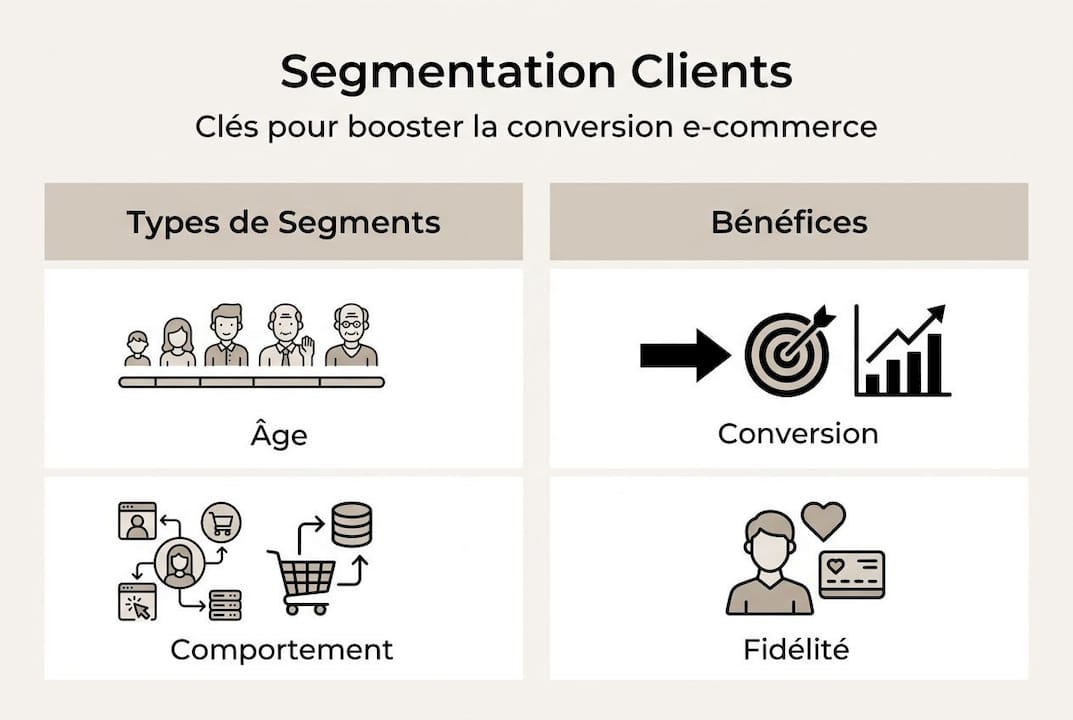
Demographics alone have their limits: you need to hybridize with actual behaviors and, if possible, predictive signals from AI. This combination allows you to identify your VIP profiles, customers at risk of churn, and new high-potential buyers.
Here are the most effective practices:
- Observe browsing behavior: what categories does she consult? Skincare, organic, luxury, makeup? These signals reveal intent long before purchase.
- Cross-reference RFM and behavior: a customer who buys often but whose recency decreases is a warning sign. Act before she leaves.
- Activate each segment on multiple channels: email, SMS, social networks. A consistent beauty e-commerce UX reinforces the impact of each message.
- Automate scenarios: do not rely on manual sends. Automation ensures responsiveness and regularity.
Pro tip: Start with 3 to 4 simple and clear segments. Gradually enrich them as you collect data. Over-segmentation from the start is counterproductive. Personalization on Shopify becomes powerful when it is based on stable and well-defined segments.
The goal is not to segment everything. It is to segment what has a real impact on your revenue.
Applying Segmentation at Each Stage of the Customer Journey
Knowing best practices is good. But how do you organize and apply segmentation day after day, concretely, in your store?
The key is to think in terms of activation scenarios rather than static lists. Omnichannel automated activation consistently outperforms purely descriptive segmentation in terms of return on investment.
Here is an operational framework in 5 steps:
- Define your priority segments: start with new visitors, first-time buyers, regular customers, and dormant customers. These four groups cover the core of the lifecycle.
- Set up triggers: each action (first order, abandoned cart, 60 days without purchase) automatically triggers an adapted scenario.
- Personalize content: a post-first-order email should not look like a generic newsletter. It should recommend complementary products based on what has just been purchased.
- Activate on multiple channels: email, SMS, push notifications, segmented beauty campaigns on social networks. Consistency across channels amplifies the effect.
- Measure and adjust: analyze open, click, and conversion rates by segment each month. Remove what doesn't perform, strengthen what works.
An effective digital beauty strategy integrates segmentation from the design stage, not as an option.
Pro tip: Don't segment for segmentation's sake. Each segment must correspond to a clear activation scenario and a measurable objective. If you don't know what to do with a segment, it's probably useless. The most effective solutions for boosting sales are those based on actionable segments, not on complex reports.
Our Expert View on Customer Segmentation
Since 2018, we have been supporting ambitious beauty brands in structuring their online presence. And here's what we've learned: most brands that fail at segmentation don't lack data. They lack clarity on what they want to do with it.
Static segmentation, which classifies your customers once and never changes, freezes your vision. The real value lies in the quality of activation scenarios and your ability to continuously adjust. A VIP customer today can become dormant tomorrow if you don't nurture them.
The other trap we often observe: wanting to overcomplicate everything too quickly. Dozens of segments, nested rules, endless flows. Success comes from simplicity, clarity of persona, and pragmatic experimentation.
Tomorrow, segmentation will be driven in real-time by AI across all channels. But to take advantage of it, you need to lay solid foundations today. Consistent beauty branding and well-designed data architecture are indispensable prerequisites.
Take Action with Customer Segmentation
Customer segmentation only has a real impact if it is deployed in an adapted technical environment. A poorly structured store, without the right automation tools or a UX architecture designed for personalization, will never be able to fully exploit the potential of your segments.

At Tamara Agency, we design Shopify stores that perform as well as they attract. Whether you need custom Shopify beauty store creation, a Shopify store redesign to activate your existing segments, or specialized Shopify training to master your tools independently, we are here for you. Let's talk about your project.
Frequently Asked Questions about E-commerce Customer Segmentation
What is the difference between RFM and behavioral segmentation?
RFM segmentation is based on the recency, frequency, and monetary value of purchases, while behavioral segmentation analyzes actual interaction on the site (clicks, abandonments, page views). The two are complementary and benefit from being combined.
How many customer segments is it optimal to target?
It is recommended to start with 3 to 5 well-defined segments and adjust according to feedback and catalog growth. It is better to have few well-activated segments than many ignored ones.
Is customer segmentation valid if I am new to e-commerce?
Yes, even basic segmentation targets offers better. The larger your customer base grows, the more you will refine your groups later. Starting early gives you a head start in customer knowledge.
What tools facilitate segmentation on Shopify?
Tools like Klaviyo, Shopify Flow, or specialized CRMs make it easy to set up segments and automate your campaigns, as shown in the e-commerce benchmarks 2026 on personalization solutions.