

The Role of Copywriting in Online Stores: 2026 Guide
TL;DR:
- Copywriting in an online store plays a crucial role in quickly persuading visitors, reducing uncertainty, and increasing sales. It relies on techniques such as the 3-second rule, the AIDA structure, and highlighting benefits to capture attention and reassure customers. In the age of AI, a consistent and authentic strategy with a distinct brand voice helps optimize conversion, SEO, and customer loyalty.
The role of copywriting in an online store is often underestimated, even though it is one of the most powerful conversion levers at your disposal. A visitor who lands on your product page makes their decision in a few seconds. It is not design alone that convinces them to buy. It is the text. Carefully chosen words reduce doubts, address objections, and turn hesitation into a purchase. This guide provides the fundamentals, techniques, and strategic vision to make copywriting a real asset for your store.
Table of Contents
- Key Points
- The Role of Copywriting in an Online Store: The Fundamentals
- Key Techniques for Your Product Pages
- The Measurable Impact of Copywriting
- Copywriting in the Age of AI and Omnichannel
- My View on Personalized Copywriting
- Your Store Deserves Copywriting to Match
- FAQ
Key Points
| Point | Details |
|---|---|
| Copywriting goes beyond description | Effective copy persuades, reassures, and reduces purchase barriers in less than 3 seconds. |
| The AIDA structure guides conversion | Adapting this model to your product pages increases engagement and makes purchasing decisions easier. |
| Benefits take precedence over features | Explaining how the product solves a concrete problem generates more sales than listing its specs. |
| Copywriting improves transactional SEO | Copy targeted at purchase intent attracts qualified traffic and reduces bounce rates. |
| Humanity remains irreplaceable in the face of AI | Automated tools produce volume, but only a human touch creates an authentic brand voice. |
The Role of Copywriting in an Online Store: The Fundamentals
Many online stores confuse product descriptions with copywriting. A description lists what the product is. Copywriting, on the other hand, explains why this product matters to you, right now, in your life. It is a fundamental difference that changes everything when it comes to sales performance.
The true role of product content is not to inform, but to reduce purchase uncertainty. Your customer cannot touch the product, smell it, or try it. Every unanswered question in your text is a reason not to buy. Effective copywriting anticipates these questions and answers them before they are even asked.
In practical terms, good copywriting serves three functions in your store:
- Capture attention from the very first lines, with a hook that speaks directly to the customer's situation
- Persuade by translating technical features into perceived and desirable benefits
- Reassure through social proof, guarantees, and a tone that inspires confidence
Effective product content connects the product to real needs and user profiles, rather than simply listing features. Take a moisturizer, for example. A classic description says: “Hyaluronic acid-based formula, 50 ml.” Effective copywriting says: “Your skin regains comfort in 24 hours, even in cold weather, thanks to a concentrated hyaluronic acid formula.” The product is the same. The effect on the reader is radically different.
Key Techniques for Your Product Pages

Moving from theory to practice requires a method. Here are the approaches that produce measurable results for online stores.
1. The 3-Second Rule
A high-performing product page must allow visitors to understand the offer in less than 3 seconds. If your visitor has to search to understand what you sell and who it is for, they will leave. Structure your page with a clear title, a benefit-focused hook first, and then the details.
2. The AIDA Model Adapted for E-commerce
- Attention: a hook that names the customer's problem or desire
- Interest: show that you understand their situation better than anyone
- Desire: transform features into concrete and emotional benefits
- Action: a clear call to action, without ambiguity or excessive pressure
3. Features versus Benefits
Transforming technical features into concrete benefits increases desire and makes purchasing decisions easier. Always ask yourself: “So, what does this change for my customer?” A 5,000 mAh battery becomes “two days of battery life without looking for an outlet.” Breathable fabric becomes “comfortable even on the busiest days.”
4. Integrated Social Proof
Integrating reviews and testimonials directly into the product page positively influences the purchasing decision. Do not reserve customer reviews for a separate tab. Quote them in the body text where they address a specific objection. “Ideal for sensitive skin” in your description, followed by a customer testimonial that confirms exactly that, creates a powerful validation effect.
5. Uncompromising Writing Quality
| Common Mistake | Real Impact |
|---|---|
| Spelling mistakes | Immediate loss of credibility |
| Sentences that are too long | Reader abandons the text |
| Unexplained technical jargon | Customer feels excluded |
| Text copied from the supplier | SEO penalty and lack of differentiation |
Linguistic errors are perceived as a lack of professionalism, which negatively impacts trust. A mistake in a text is perceived as an indicator of unreliability, regardless of the actual quality of the product.
Pro tip: Read each product page aloud before publishing it. If you stumble over a sentence, your customer will too. Rephrase it until the text flows naturally.
The Measurable Impact of Copywriting
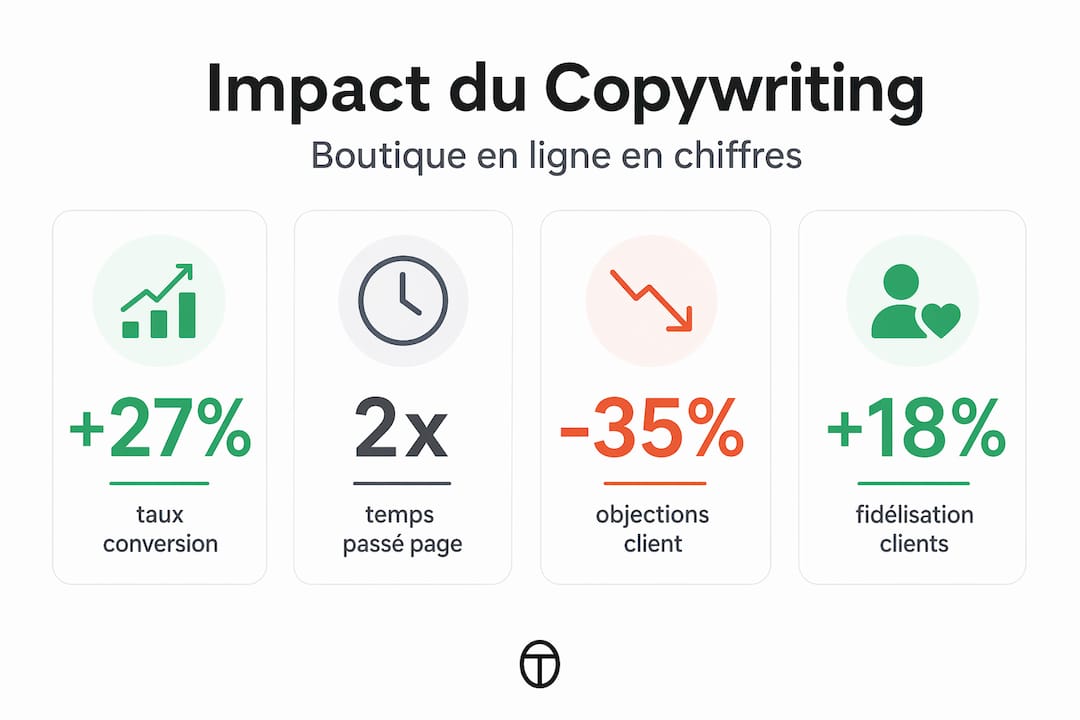
Copywriting is not measured only by how it feels. Its effects are concrete, quantifiable, and affect several dimensions of your sales performance.
Transactional SEO
Copy optimized for purchase intent attracts qualified traffic. A visitor who searches for “night moisturizer for dry skin” is ready to buy. If your product page answers this intent precisely with natural vocabulary and complete information, you capture this traffic and convert it. To learn more about optimizing Shopify conversion strategies, combining SEO and product copywriting is the winning combination.
Reducing Objections and Conversion Rates
“Copywriting transforms a promise into measurable action and helps reduce objections during the purchasing journey.” Source: Djust.io, 2025
Every friction point not addressed by the text on a product page is a potential lost sale. Copywriting that anticipates doubts (size, compatibility, delivery time, return policy) mechanically reduces cart abandonment. It is not magic. It is psychology applied to text.
Customer Loyalty Through Brand Voice
A consistent, recognizable, and human tone creates a lasting bond with your customers. When your store speaks to your customers like a brand that truly understands them, they return. They recommend. They become ambassadors. Copywriting in 2025-2026 is moving toward empathetic, authentic communication focused on the customer's real problems. This is exactly what distinguishes brands that last from those that disappear.
The impact of copywriting on the beauty user experience is particularly visible in sectors where emotion guides the purchase, such as cosmetics or fashion.
Copywriting in the Age of AI and Omnichannel
The profession is evolving. Artificial intelligence produces text at high speed. But producing text and writing effective copywriting are two very different things.
The role of the copywriter is evolving toward strategic design and the use of AI tools to enrich creativity. Writers are now directing these tools to produce qualified content while maintaining control over strategy, tone, and brand consistency. AI generates a first version. A human makes it authentic.
In a context of automation, copywriting plays an even more precise role:
- Automated emails: a personalized and well-written message humanizes automated communications, strengthening the customer relationship and conversion
- Push notifications and SMS: every word counts when you have 160 characters to persuade
- Social media and ads: consistency of tone between your store and your external channels strengthens trust
The omnichannel strategy requires a unified brand voice. If your store speaks one way and your emails another, you create a dissonance that weakens trust. Copywriting is the common thread that connects all your touchpoints.
Pro tip: Create a “brand voice” document with 10 to 15 examples of phrasing you use and others you avoid. Share it with anyone who writes for your store, human or AI.
My View on Personalized Copywriting
I have supported dozens of brands in creating and redesigning their Shopify stores. And what I systematically observe is that the most costly mistake is not technical. It is textual.
Many entrepreneurs copy their suppliers' descriptions or reuse generic texts without adapting them to their customers. The result is a store that looks like all the others and does not speak to anyone in particular. Treating your customer like a human with specific needs, precise doubts, and real aspirations is what makes the difference between a store that survives and a brand that thrives.
I have seen stores double their conversion rate simply by rewriting their product pages with a benefits-oriented approach and incorporating answers to frequent objections. No design overhaul. No new advertising budget. Just better-chosen words.
My most direct advice: never write for your product. Write for the person who needs it.
— Tamara
Your Store Deserves Copywriting to Match

At Tamaragency, we know that a Shopify store must perform as well as it attracts. Since 2018, we have supported ambitious brands in the beauty, fashion, and wellness sectors by integrating copywriting as a strategic component of every project. It is not a last-minute addition. It is at the heart of our UX and conversion approach.
Whether you want to create a new store or optimize an existing one, our Shopify creation services integrate copywriting thinking from the design stage. And if you want to build your in-house skills, our Shopify training covers the fundamentals of high-performing content. Let's talk about your project via our our services page.
FAQ
What is copywriting in an online store?
Copywriting in an online store refers to the art of writing texts (product pages, homepages, emails) designed to persuade and convert. It goes beyond simple description by addressing objections and guiding the customer toward the purchase.
Why does copywriting improve the conversion rate?
A well-structured text reduces customer uncertainty and removes purchase barriers. Every unaddressed friction point on a product page represents a potential lost sale.
How to improve your copywriting quickly?
Start by rewriting your product page titles to highlight the main benefit, then incorporate a targeted customer testimonial to address the most frequent objection. These two adjustments produce measurable results in a few days.
Does copywriting influence organic search?
Yes. Copywriting aligned with transactional search intent improves SEO ranking and attracts more qualified traffic, which reduces the bounce rate and increases conversions.
Should you hire a professional to write your product pages?
Not necessarily at first, but mastering the basics (benefits, AIDA structure, social proof) is essential. For high-volume stores or in competitive sectors like beauty or cosmetics, professional support generates a quick return on investment.