

The Role of Pop-ups in Beauty: A Guide for Brands
TL;DR:
- Pop-ups, often poorly received, play a strategic role in beauty conversion, particularly through targeted formats and tailored personalization. When used effectively, they improve email collection, stimulate impulse purchases, and enrich the customer experience, while respecting SEO and UX requirements. Physical and phygital pop-up stores create lasting immersive experiences, strengthening the emotional bond with the brand.
Pop-ups have a bad reputation. They are accused of interrupting, annoying, and driving users away. And yet, the role of pop-ups in beauty is far more strategic than we think. Used precisely, they generate sign-ups, trigger impulse purchases, and create memorable experiences, both online and in physical stores. This guide shows you how to transform an often misused tool into a real conversion lever, covering digital formats, targeting strategies, SEO impact, and immersive pop-up stores that get the most ambitious brands talking.
Table of Contents
- Key Points
- Types of Beauty Pop-ups and Their Effectiveness
- Impact of Pop-ups on UX and SEO
- Physical Pop-up Stores: Immersion and Conversion
- Optimizing Digital Pop-ups: Targeting and Personalization
- Measuring the Effectiveness of Your Pop-ups
- My View on Beauty Pop-ups
- Creating High-Performing Pop-ups with Tamara Agency
- FAQ
Key Points
| Point | Details |
|---|---|
| Proven effectiveness | Beauty e-commerce pop-ups show an average conversion rate of 4.01%, or even 14.40% for targeted interstitials. |
| SEO and UX to protect | A full-screen pop-up on page load penalizes mobile ranking. Timing and size are crucial. |
| Physical immersion | Pop-up stores transform the brand into a sensory experience and generate measurable direct conversions. |
| Personalization first and foremost | Behavioral targeting and segmentation increase relevance and reduce the bounce rate of digital pop-ups. |
| Continuous measurement | Tracking click-through rate, conversion rate, and bounce rate allows you to adjust each pop-up for better performance. |
Types of Beauty Pop-ups and Their Effectiveness
Pop-ups do not form a homogeneous category. In beauty, we distinguish four main formats, each with its own performance rules.
Classic e-commerce pop-ups appear on a shopping site to offer a welcome discount, collect emails, or highlight a product. According to 2024 data, beauty e-commerce pop-ups show an average conversion rate of 4.01%. This figure may seem modest, but compared to the traffic volume of an active Shopify store, it represents hundreds of additional sign-ups every month.
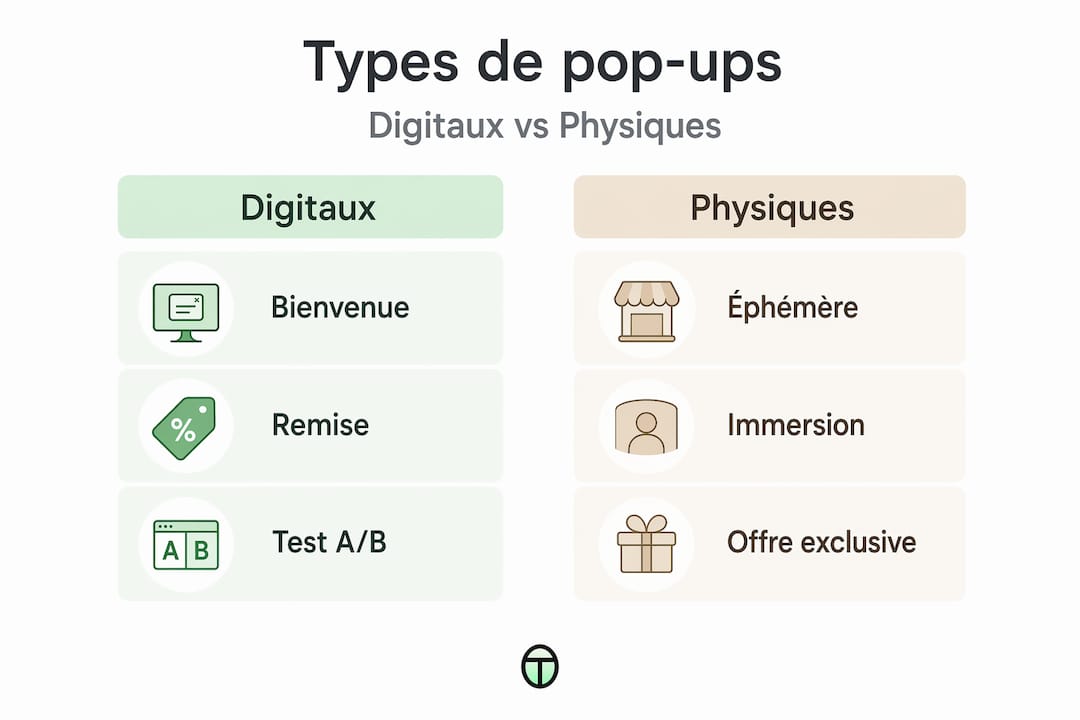
Interstitial pop-ups occupy a larger portion of the screen. When well-targeted, they can achieve a conversion rate of 14.40%, making them the most powerful format in terms of raw results. The condition is to avoid displaying them on page load.
Physical pop-up stores are a category in their own right. These are temporary spaces that a beauty brand sets up in a shopping mall, a trendy neighborhood, or with a distribution partner. Their strength: create an event, urgency, a place for sensory discovery.
Integrated QR codes constitute the fourth format, at the crossroads of physical and digital. The use of QR codes in beauty retail increased by 40% in 2023, with 80% of consumers ready to scan to simplify their shopping experience.
| Format | Average conversion rate | Ideal for |
|---|---|---|
| Classic e-commerce pop-up | 4.01% | Email collection, welcome offer |
| Targeted interstitial pop-up | 14.40% | Promotions, cart recovery |
| Physical pop-up store | Variable depending on traffic | Product launch, brand awareness |
| In-store QR code | Depends on context | Phygital link, purchase traceability |
- Trigger pop-ups after 30 seconds or when the user shows exit intent, never upon arrival on the page.
- Limit display to once per session to avoid saturation.
- Always offer clear value: discount, exclusive content, early access.
Pro tip: Systematically test two versions of your pop-up with an A/B test: a minimalist version and an enriched version with a product image. The results will often surprise you.
Impact of Pop-ups on UX and SEO
This is where many beauty brands make mistakes that cost them dearly, not in immediate revenue, but in organic positioning on Google.
An intrusive full-screen pop-up displayed on page load directly penalizes mobile ranking. Since 2017, Google has applied strict rules on interstitials that hide the main content on mobile, and these rules are stricter in 2026 with mobile-first indexing. The concrete result: a drop in ranking for even well-optimized queries.
Well-calibrated pop-ups that respect timing and size are essential to avoid frustration and preserve mobile-first SEO ranking.
The effects do not stop at SEO. A poorly designed pop-up increases the bounce rate and reduces session duration, two negative signals for the Google algorithm. On mobile, an overlay that covers more than half the screen without a visible close button creates immediate frustration.
Here are the practices compliant with Google requirements for beauty brands:
- Display the pop-up after the user has interacted with the page (scroll, click, minimum delay of 15 seconds).
- Opt for banners at the bottom of the page or discreet overlays that do not obscure the main content.
- Provide a clearly visible close button, accessible without zooming on mobile.
- Respect Core Web Vitals by avoiding pop-ups that delay page rendering.
To delve deeper into the best UX practices for beauty e-commerce, every design decision must serve both the user experience and technical performance.
Physical Pop-up Stores: Immersion and Conversion
Pop-up stores have changed on a different level. They are no longer just temporary stands. In beauty, they have become full-fledged experiences, scripted, sensory, and designed to generate both emotion and conversion.
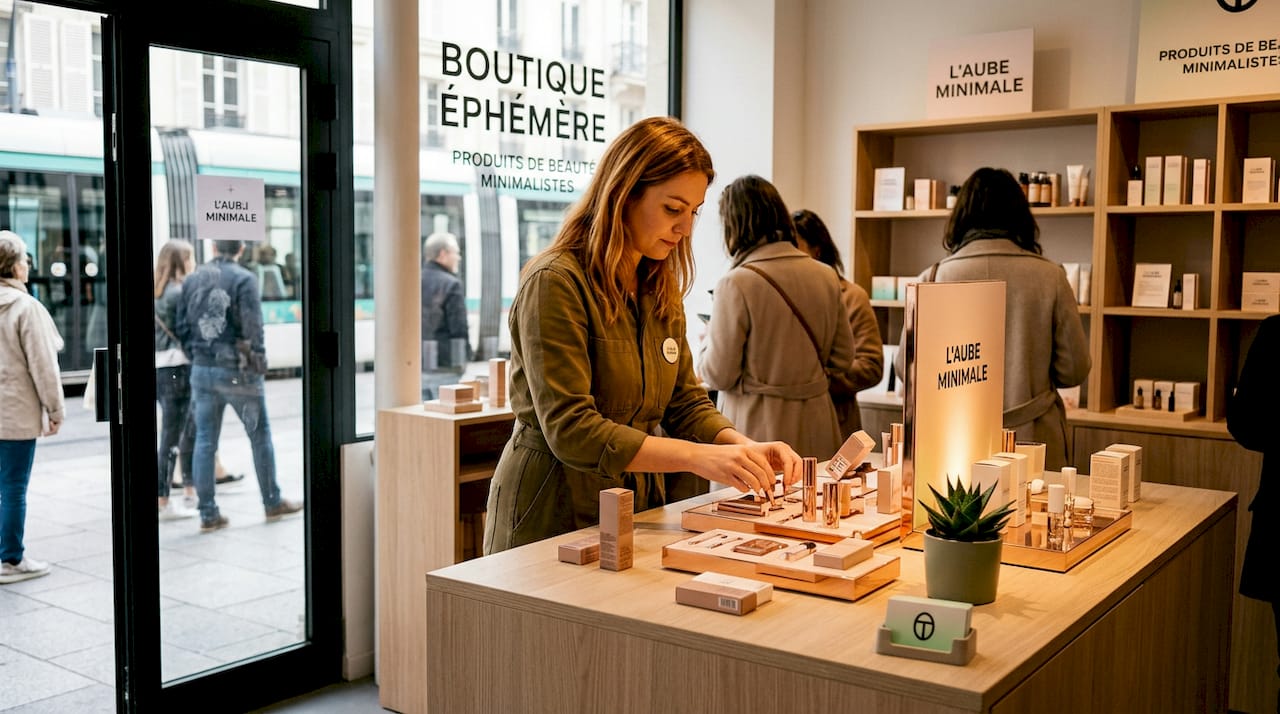
The sensory storytelling in pop-up stores transforms a brand's identity into an immersive experience. Charlotte Tilbury, in partnership with Sephora, created a universe where every detail, from the lighting to the diffused fragrances and the staff's attire, told the brand's story. The beauty retail pop-up becomes a narrative space where the consumer becomes an actor in the brand, creating a lasting emotional bond.
To structure a high-performing physical pop-up store, here are the key steps:
- Define a strong narrative concept. Each pop-up must have a central story. For YSL Lash Latex, it was the glamour of latex applied to beauty, translated into every element of the scenography.
- Design a complete sensory experience. Light, materials, sounds, scents: each activated sense reinforces brand memorability.
- Train staff who embody the brand. Salespeople do not present products, they animate an experience. Their posture, their speech, their mastery of storytelling are decisive.
- Integrate technology to measure and extend. QR codes allow you to track in-store sales and extend the experience online after the visit. The volume of marketing QR scans increased by 323% in 2023.
- Create a social sharing trigger. An iconic photo space, a surprising experience, or exclusive packaging naturally invites sharing on Instagram and TikTok, extending the pop-up's reach far beyond physical visitors.
The YSL Lash Latex pop-up attracted 1,571 visitors in just 12 hours of opening, with a return-to-store card mechanism to convert enthusiasm into a deferred purchase. Success is not measured solely by visual appeal, but by measurable conversion in a fluid customer journey integrating digital and physical retail.
Pro tip: Plan an exclusive offer reserved for pop-up store visitors, a limited-edition product, or a free service. Exclusivity reinforces urgency and justifies the trip.
Optimizing Digital Pop-ups: Targeting and Personalization
A high-performing beauty pop-up is not the one that appears everywhere. It is the one that appears at the right time, to the right person, with the right message.
Timing is the first lever. A scroll trigger (after 50% of the page is read) targets a visitor who is already engaged. An exit intent trigger captures those who are about to leave. For beauty pop-up strategies, combining these two triggers according to user behavior gives better results than a fixed-delay pop-up.
Personalization is the second lever. A visitor browsing a skincare page should not see the same offer as a visitor browsing a makeup page. Segmentation by category viewed, by traffic source, or by purchase history allows you to adapt the message and increase perceived relevance.
| Strategy | Advantage | Limitation |
|---|---|---|
| Exit intent trigger | Captures lost visitors | Can be ignored if the message is generic |
| Scroll trigger | Targets engaged visitors | Less suitable for short pages |
| Category personalization | Ultra-relevant message | Requires well-configured segmentation |
| Timed pop-up (15s+) | Easy to configure | Less precise than behavioral triggers |
A well-designed pop-up increases newsletter sign-ups, generates qualified leads, and highlights strategic offers. The design must reflect the brand's visual identity: typography, color palette, editorial tone. A pop-up that breaks with the site's style creates a dissonance that reduces trust and therefore conversion.
- Use micro-interactions (subtle animation on opening, visual confirmation on sign-up) to make the experience fluid.
- Write a benefit-oriented call to action: "Get my 15% code" rather than "Sign up".
- A/B test the CTA button color: it is often the detail that makes the difference between 2% and 6% conversion.
Measuring the Effectiveness of Your Pop-ups
Configuring a pop-up is not enough. Data must guide every adjustment.
Key metrics to track for your beauty pop-ups:
- Pop-up conversion rate: percentage of visitors who performed the desired action (sign-up, click, purchase).
- Close rate: a high rate indicates low relevance or bad timing.
- Impact on bounce rate: monitor if adding a pop-up increases this rate on the pages concerned.
- Session duration after interaction: a well-received pop-up often generates prolonged navigation.
- CTA click-through rate: direct measure of the quality of the message and design.
| Metric | Recommended tool | Target goal |
|---|---|---|
| Conversion rate | Google Analytics 4, native pop-up tool | Above 4% |
| Close rate | Heatmaps (Hotjar, Microsoft Clarity) | Below 70% |
| Bounce impact | Google Analytics 4 | Stability or decrease |
| Post-pop-up engagement | Session recordings | Navigation on 2+ pages |
Integrating pop-ups into an omnichannel strategy involves connecting digital and physical data. Beauty e-commerce solutions on Shopify allow you to centralize this data to drive performance consistently.
My View on Beauty Pop-ups
I have supported dozens of beauty brands on Shopify since 2018, and I have seen the same mistake repeated: treating pop-ups as simple email collection tools. It is too narrow a vision.
What I have learned is that the most effective pop-ups do not sell. They create a moment. A well-calibrated surprise, an offer that comes at the right time, a visual that extends the brand's universe: that is what really converts. The best-performing brands do not think "how to get one more email" but "how to make this pop-up the first good impression of our brand".
The other common mistake is neglecting mobile. Even today, I encounter beauty sites whose pop-up covers 90% of the smartphone screen. It is not only a bad experience, but it is also a silent SEO penalty that erodes ranking month after month.
My conviction for 2026: the pop-ups that will survive are those that know how to make themselves forgotten while leaving a trace. Discreet in their format, powerful in their message, integrated into a coherent brand experience from the site to the physical space. It is not the tool that matters. It is the intention behind it.
— Tamara
Creating High-Performing Pop-ups with Tamara Agency
At Tamara Agency, we design Shopify stores for beauty and cosmetics brands that want to perform as well as they captivate. The creation of your beauty store on Shopify includes the integration of digital pop-ups designed to convert, respecting both your visual identity and Google's SEO requirements.

We configure each pop-up according to your audience, conversion goals, and the customer journey you want to create. From behavioral triggers to segment personalization, every detail is designed to maximize performance without harming the experience. We also offer Shopify training to give you the necessary autonomy over these tools on a daily basis. Do you have a project or want an audit of your current pop-ups? Let's talk.
FAQ
What is the average conversion rate of a beauty pop-up?
Beauty e-commerce pop-ups show an average conversion rate of 4.01% in 2024. Well-targeted interstitial pop-ups can reach 14.40% depending on their format and display timing.
Do pop-ups harm SEO ranking?
A full-screen pop-up displayed on page load penalizes mobile ranking according to Google's rules. A pop-up triggered after interaction and of reasonable size presents no SEO risk.
What is the difference between a digital pop-up and a pop-up store?
A digital pop-up is an overlay window on a website to collect data or promote an offer. A pop-up store is a temporary physical retail space that creates an immersive experience around the brand.
How to personalize a pop-up for a cosmetics brand?
Adapt the message according to the page viewed (skincare, makeup, perfume), the traffic source, and the user's behavior. A pop-up aligned with the visitor's intent generates a significantly higher conversion rate than a generic pop-up.
What tools to use to measure the performance of your pop-ups?
Google Analytics 4 allows you to track conversions and the bounce rate. Heatmap tools like Hotjar or Microsoft Clarity complement the analysis by visualizing visitors' actual interactions with the pop-up.