

The Role of E-commerce Migration for Beauty Brands
TL;DR:
- Migrating an e-commerce store to Shopify is essential for beauty brands to improve speed, SEO, and customer experience. It can significantly boost sales, as demonstrated by La Rosée, which saw an 88% increase in three months. Careful planning and a tailored SEO strategy are essential to ensure a successful transition without losing traffic.
A beauty brand can see its sales increase by 88% in three months after a well-executed e-commerce migration. Yet many teams put off the project, paralyzed by the fear of losing traffic or disrupting sales. E-commerce migration is much more than a simple “technical update”: it is a powerful tool for business transformation. In this article, we explain why and how to migrate your store to Shopify effectively, while preserving your SEO and maximizing results.
Table of Contents
- Why E-commerce Migration Is Essential for Beauty Brands
- The Measurable Benefits of Migrating Beauty Brands to Shopify
- Protecting Your SEO: The Key to a Successful E-commerce Migration
- Strategies for a Successful Migration: Methodology, Testing, and Monitoring
- Optimizing Customer Experience and Boosting Conversions After Migration
- Why View Migration as an Opportunity, Not a Risk
- Boost Your Transition to Shopify with Tamara Agency
- Frequently Asked Questions
Key Points
| Point | Details |
|---|---|
| Strategic migration | Migrating to Shopify is a key way to overcome technical limitations and boost growth for beauty brands. |
| Importance of SEO | Preserving organic search rankings through comprehensive URL mapping and 301 redirects is essential to avoid losing traffic. |
| Measurable gains | After migration, brands see significant improvements in speed, conversion rates, and revenue. |
| Rigorous methodology | Audits, sandbox testing, and post-launch monitoring are the pillars of a successful migration. |
| Experience optimization | Shopify offers a fast, personalized checkout process that significantly improves conversion rates and customer satisfaction. |
Why E-commerce Migration Is Essential for Beauty Brands
Now that we have established the stakes, let’s explore why migrating to Shopify is becoming a practical necessity for your beauty store.
E-commerce migration involves moving from an existing platform to a new infrastructure and transferring product, customer, order, and content data. For beauty and wellness brands, this change is rarely a matter of choice. It happens because the current platform is hindering growth.
The most common warning signs we see among our clients are:
- Repeated slowdowns during traffic peaks (sales, collection launches)
- Rising maintenance costs without any visible performance improvements
- Complete dependence on the technical team for every minor visual change
- Missing features: personalization, subscriptions, product bundles
- Poor mobile experience, even though more than 70% of beauty orders come from smartphones
Speed is often the deciding factor. According to e-commerce research, load times longer than 3 seconds drive away shoppers and destroy conversion rates. In a sector as competitive as beauty, every lost second is a lost sale.
“Before deciding to migrate, ask yourself honestly: can these problems be fixed with simple optimizations on your current platform? If the answer is no, migration is no longer an option—it’s a business decision.”
Shopify offers a direct solution to these obstacles: native speed, editorial autonomy for your teams, and an infrastructure that grows with your catalog without causing your technical costs to skyrocket. For more on this topic, our guide to migrating a beauty store to Shopify details the decision criteria.
The Measurable Benefits of Migrating Beauty Brands to Shopify
Understanding why migration is crucial is important, but the concrete benefits that migrating to Shopify can offer speak even louder.
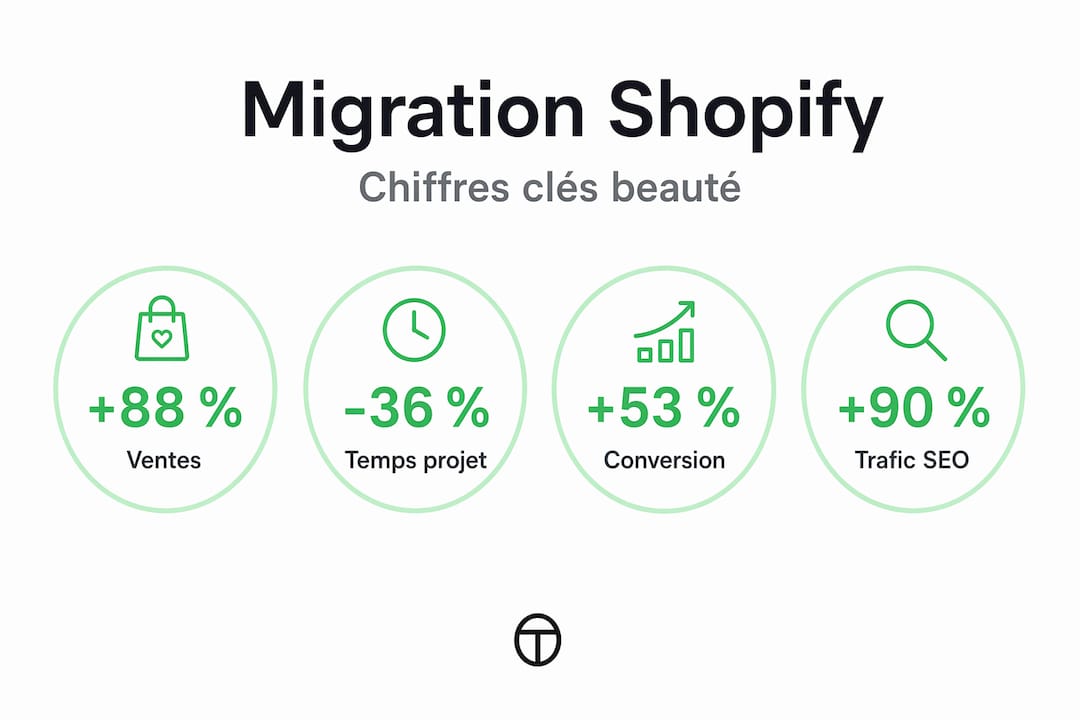
The numbers speak for themselves. The French brand La Rosée saw 88% growth in sales in just three months after migrating to Shopify, with a 53% increase in conversion rate and a 40% reduction in load times. This is not an isolated case; it is the result of a well-planned migration to a technically superior platform.
| Metric | Before migration | After migrating to Shopify |
|---|---|---|
| Load time | +4 seconds | 2.4 seconds |
| Conversion rate | Baseline | +53% |
| Sales volume | Baseline | +88% in 3 months |
| Customer service requests | High | Reduced by 30% |
Shopify also offers Shopify Flow, an automation tool that allows you to create personalized customer journeys without writing a single line of code. For a beauty brand, this means automated loyalty sequences after an initial purchase, stock alerts for bestsellers, or targeted promotions based on purchase history.
“Technical performance and customer experience are not two separate issues. On Shopify, a beautiful site must also perform: that is exactly the equation we aim to solve for every brand.”
The impact on the mobile experience is also significant. Shopify themes are designed with a mobile-first approach, which reduces checkout friction and naturally improves completion rates. Discover how we address these challenges in our article on Shopify beauty e-commerce solutions.

Protecting Your SEO: The Key to a Successful E-commerce Migration
After the technical and business benefits, let’s discuss the fundamental aspect of SEO that must be managed during migration.
This is often beauty brands’ biggest fear: “What if we lose all our Google rankings after migration?” This concern is legitimate. Changing platforms changes the URL structure, sometimes the content, and can disrupt search rankings if the migration is rushed. But with careful preparation, traffic loss is largely avoidable.
Here are the essential steps for solid SEO management during migration:
- Complete SEO audit of the current store: inventory of indexed pages, organic traffic volume per URL, and inbound backlinks
- Comprehensive URL mapping: each old URL is mapped to its new target URL on Shopify
- Implementation of 301 redirects: they transfer the “SEO juice” from the old pages to the new ones
- Verification of metadata: titles, descriptions, and H1 tags must be migrated and optimized
- Testing in a staging environment before any production cutover
- Submission of the sitemap to Google Search Console upon launch
- Post-launch monitoring for at least 4 weeks to detect 404 errors
A comprehensive URL map can preserve more than 90% of organic traffic. For a store with fewer than 500 products, allow 4 to 6 weeks for this preparatory phase alone.
Pro tip: never schedule a migration during a high-traffic period. Black Friday, the holiday season, or a new collection launch are times to absolutely avoid. Choose a slower period instead, with a pre-validated testing environment (staging).
Our article on how to successfully migrate your SEO provides full details on every step.
Strategies for a Successful Migration: Methodology, Testing, and Monitoring
With these SEO principles in mind, let’s look at how to plan and execute the migration.
Online migration strategies fall into two main approaches:
- “Big bang” migration: everything switches over at once. Faster, but carries a higher risk if something goes wrong. Suitable for mid-sized stores with a well-structured catalog.
- Phased migration: sections are migrated in stages. More secure for large catalogs or stores with critical, continuous traffic.
For beauty brands with catalogs rich in variants (shades, sizes, sets), a phased migration is often preferable. It allows you to clean up product data as you go, validate each section before moving on to the next, and reduce the risk of errors with variants.
| Phase | Key Action | Estimated Duration |
|---|---|---|
| Preparation | Audit, URL mapping, data cleanup | 2 to 3 weeks |
| Shopify Development | Theme, integrations, data import | 3 to 5 weeks |
| Staging Tests | Functionality, SEO, mobile, performance | 1 to 2 weeks |
| Launch | Redirects, DNS, monitoring | 24 to 72 hours |
| Post-launch Monitoring | Errors, conversions, SEO | Minimum 4 weeks |
A Shopify migration is on average 36% faster, 56% less expensive, and 74% more reliable than custom development. These figures confirm that choosing Shopify also means choosing a proven method.
Pro tip: notify your existing customers before the cutover. A simple email explaining that the store is evolving, with a note about a possible password reset, reduces friction and support tickets after launch. It is a small detail that makes a real difference to the post-migration experience.
Optimizing Customer Experience and Boosting Conversions After Migration
After the technical and SEO migration, let’s discover how to make the most of it for your customer experience.
The definition of e-commerce migration often includes too little of this aspect: a successful migration is not just a data transfer, it is also a redesign of the shopping experience. On Shopify, the levers for improvement are concrete and actionable from launch day.
Here are the most significant impact points for beauty brands:
- One-page checkout: Shopify has simplified its checkout process to reduce abandonment. Fewer steps, less friction, more completed sales.
- Personalized journey: thanks to Shopify’s native tools, you can guide each customer according to their skin type, preferences, or purchase history.
- Automated customer service: dynamic FAQs, real-time order tracking, automated notifications. Brands that migrate to Shopify see a 30% reduction in customer service requests.
- Cart load speed: Shopify carts load up to 50% faster in 2026, which directly reduces the abandonment rate.
“A customer who arrives at a beauty store that is fluid, fast, and consistent with the brand identity buys more, returns more often, and recommends it more easily. Migration is also about this.”
La Rosée’s conversion rate increased by 53% directly thanks to cart speed and automation via Shopify Flow. This is not a magical result: it is the fruit of a user experience designed to convert. Our guide on Shopify conversion optimization supports you through this step.
Why View Migration as an Opportunity, Not a Risk
E-commerce migration is often viewed as a risk to be minimized. We believe the opposite. At Tamara Agency, we have supported enough beauty brands to state one thing: companies that delay migration are not “protecting” their performance, they are letting it deteriorate.
An unsuitable platform generates hidden costs. Hours of development for recurring fixes, lost sales due to slowness, a marketing team that depends on IT for every product page change. This is not stability, it is stagnation.
Migrating to Shopify offers real autonomy, which translates into increased responsiveness to trends. A brand that can launch a product page in two hours, without a technical ticket, responds better to its market than a brand that waits two weeks for its next production release.
What we also observe: brands that plan the migration seriously, dedicating the appropriate time and resources, systematically end up in a stronger competitive position. It is not the migration that is risky. It is a rushed, improvised migration, without SEO preparation or rigorous testing.
The advantage of migration is not solely technical. It is also an opportunity to regain control over your brand image, align your store with your current positioning, and build a solid foundation for the coming years of growth. For more on this topic, our article on Shopify beauty digital strategy offers a complete view of this transformation.
Boost Your Transition to Shopify with Tamara Agency
You now have a clear view of the benefits of e-commerce migration and the steps to make it successful. The question is no longer “should we migrate?” but “how to do it well?”

Since 2018, we have been supporting beauty and wellness brands in their migration to Shopify, from the initial audit to post-launch support. Our method covers every dimension: SEO preparation, data transfer, UX/UI design, rigorous testing, and conversion optimization. If you are considering creating or migrating your beauty Shopify store, our experts are here to secure every step. You can also benefit from personalized support with our Shopify consultant, or build your skills through our Shopify training dedicated to internal teams.
Frequently Asked Questions
What is the average duration of an e-commerce migration to Shopify for a beauty store?
For a store with fewer than 500 products, the migration to Shopify generally takes between 4 and 6 weeks, including complete SEO URL mapping to preserve more than 90% of organic traffic.
How does the migration to Shopify impact organic search ranking?
A well-prepared migration with comprehensive URL mapping and 301 redirects allows you to preserve more than 90% of organic traffic, thus avoiding major SEO losses.
What are the concrete benefits of migrating to Shopify for a beauty brand?
Brands often see an increase in conversion rate (up to +53%), faster site loading (up to 40% improvement), and a significant increase in sales, as evidenced by La Rosée with +88% in three months.
What risks should be anticipated during the e-commerce migration?
The main risks include SEO traffic loss, redirection errors, and post-launch bugs. A rigorous launch strategy and complete staging tests allow you to largely avoid them.
How does Shopify improve the checkout process to boost conversions?
Shopify makes the checkout process up to 50% faster thanks to a simplified single-page tunnel, reducing cart abandonment and promoting a smooth shopping experience.