


Customize your Shopify Store: Boost Sales and Experience
TL;DR:
- Personalization increases online loyalty, engagement, and average order value.
- It allows for significantly exceeding the average conversion rate of 2-3%.
- Using tools like Liquid, metafields, and Shopify apps facilitates effective and consistent personalization.
71% of consumers expect personalization, and 76% say they are frustrated when it's absent. In the beauty, fashion, and well-being sectors, this expectation is no longer a luxury: it's a basic requirement. Your customers want to feel understood, guided, and unique from the first seconds on your store. This guide explains why personalization has become an essential growth lever, how it transforms the user experience, and what concrete methods you can deploy on Shopify to maximize your conversions and retain your customers.
Table of Contents
- Why personalization is becoming essential in beauty, fashion, and well-being
- Personalizing for a better user experience: impacts and mechanisms
- Maximizing conversion through personalization: data and concrete examples
- Tools and methods to effectively personalize your Shopify store
- Limitations, precautions, and best practices for personalization
- Our perspective: Shopify personalization, the subtle balance for performance
- Need help personalizing your Shopify store?
- Frequently Asked Questions
Key Points
| Point | Details |
|---|---|
| Personalization: major lever | Adapting the customer experience on Shopify is key to attracting and retaining in beauty/fashion. |
| Quantified and measurable ROI | Brands see +15 to 30% conversion and increased revenue thanks to personalization. |
| Adapted technological choices | Liquid, apps, and AI are powerful solutions to effectively personalize your Shopify store. |
| Limits & best practices | Control intrusion, transparency, and opt for a relevant balance for your customers. |
Why personalization is becoming essential in beauty, fashion, and well-being
Beauty and fashion consumers are no longer just looking for a product. They are looking for an experience that reflects them. This behavioral evolution is profound, and it redefines the rules of online commerce.
The personalized beauty market is expected to reach 38 billion dollars by 2025, and 71% of buyers say they prefer brands that offer experiences adapted to their profile. This figure does not surprise those who closely observe purchasing behaviors: a customer who immediately finds products suited to her skin type or morphology buys more, returns more often, and recommends more easily.
In these sectors, personalization creates a competitive advantage that is difficult to copy. Here's why it's becoming a strategic priority:
- Strengthened loyalty: a tailor-made experience generates an emotional attachment to the brand, far beyond the product itself.
- Reduced bounce rate: a relevant journey retains attention and reduces premature abandonment.
- Increased average basket: contextual recommendations naturally encourage discovery and complementary purchases.
- Differentiation from the competition: in a saturated market, the uniqueness of the experience becomes a decisive selection criterion.
The concrete results speak for themselves. Omy Labs, a personalized cosmetics brand, recorded a 60% increase in sessions after integrating an interactive skincare diagnostic. La Rosée, for its part, saw its sales grow by 88% in three months thanks to a personalization-oriented redesign. These personalized e-commerce statistics illustrate a phenomenon we regularly observe with our clients.
« Personalization is not a passing trend. It's the new standard for customer experience in sectors where emotion drives purchase. »
For brands wishing to delve deeper into this topic, our articles on Shopify beauty e-commerce solutions and proven beauty techniques offer very concrete additional avenues.
Personalizing for a better user experience: impacts and mechanisms
Before going further, let's clarify an essential distinction. Personalization consists of automatically adapting the experience according to a user's behavioral data (history, location, preferences). Customization, on the other hand, allows the user to modify the interface or product themselves. Both are useful, but their mechanisms and impacts differ.

Personalization reduces friction, increases engagement, and provides a tailored journey for each profile. Concretely, this translates into dynamic recommendations based on previous purchases, homepages that adapt according to the acquisition source, or emails triggered by browsing behavior.
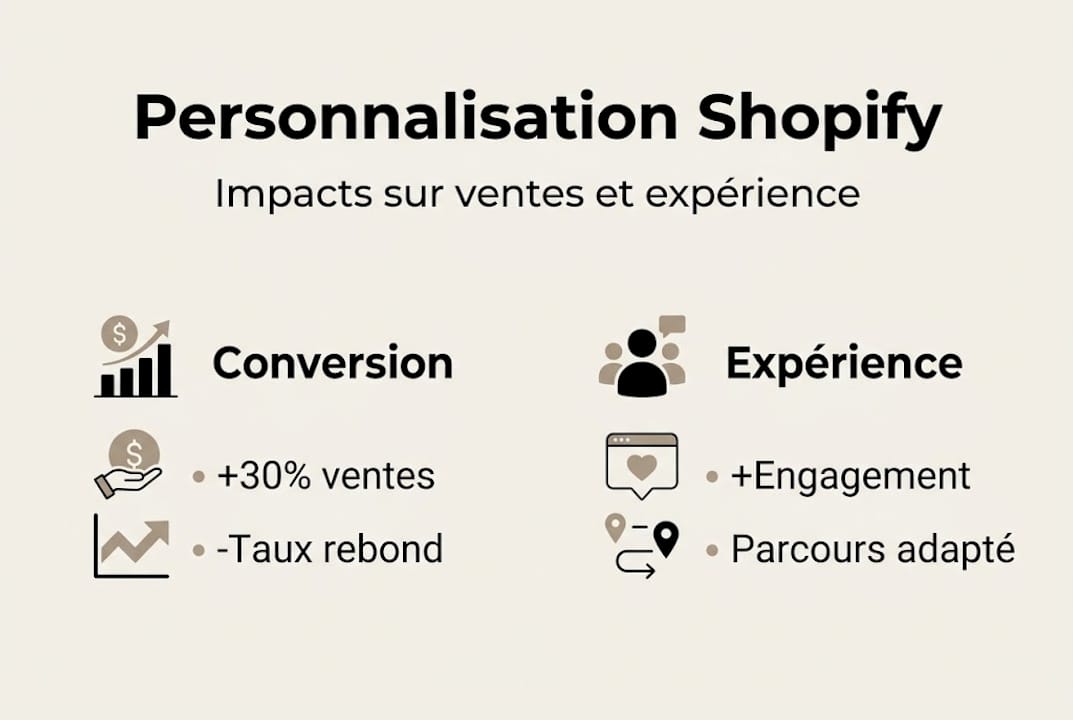
Here's an overview of the impact before and after personalization on key indicators:
| Indicator | Before personalization | After personalization |
|---|---|---|
| Bounce rate | 65% | 42% |
| Engagement rate | 28% | 51% |
| Customer satisfaction (NPS) | 34 | 58 |
| Average session duration | 1 min 20 s | 2 min 45 s |
These gains are not insignificant. They reflect a customer journey that answers the right questions at the right time. A customer looking for a cream for sensitive skin doesn't want to browse 200 references: she wants to be guided, reassured, and converted in three clicks.
Pro tip: Integrate a quiz or product diagnostic right from the homepage. This tool collects valuable first-party data while offering an engaging experience. Brands that use this mechanism observe completion rates above 70%, and a significant increase in the conversion rate on recommended products.
To go further into experience architecture, our resources on UX best practices and high-performing Shopify designs will give you a solid foundation. Product personalization is also a lever to explore depending on your catalog.
Maximizing conversion through personalization: data and concrete examples
The impact of personalization on business results is documented and measurable. The numbers are clear: well-executed personalization generates +15 to 30% conversion rates and up to +25% additional revenue. Dermalogica recorded an 18% increase in its conversion rate after personalizing its B2B purchasing journey on Shopify.
+15 to 30% average conversion rate thanks to e-commerce personalization. A lever that no ambitious brand can do without.
Here are some representative sector results:
| Brand | Personalized Action | Result |
|---|---|---|
| Dermalogica | Personalized B2B journey | +18% conversion |
| Industry West | Dynamic recommendations | +32% average cart |
| Omy Labs | Interactive skincare diagnostic | +60% sessions |
| La Rosée | Personalized UX redesign | +88% sales in 3 months |
The average e-commerce conversion rate hovers around 2 to 3% in the beauty sector. Personalization allows for significantly exceeding this ceiling. ROI can reach 5 to 8x the initial investment depending on the maturity of the strategy.
To concretely measure this impact on your store, here are the steps to follow:
- Define your baseline indicators: conversion rate, average order value, bounce rate, session duration.
- Set up a behavioral tracking tool: Google Analytics 4, Hotjar, or native Shopify analytics.
- Deploy a first personalization action: product recommendations, quizzes, or email segmentation.
- Compare results over 30 to 90 days: before and after implementation.
- Refine and iterate: personalization improves with accumulated data.
Our articles on e-commerce cosmetic trends and the conversion performance checklist will help you structure this approach methodically.
Tools and methods for effectively personalizing your Shopify store
Shopify offers a rich ecosystem for personalizing your store, provided you choose the right tools for your situation. Liquid, metafields, apps, Checkout API and Functions constitute the main toolbox for advanced and flexible personalization.
Here are the main available options:
- Liquid: Shopify's native templating language, ideal for adapting display based on customer profile or browsing context.
- Metafields: allow you to enrich product sheets with specific information (ingredients, skin compatibility, size guide) without weighing down the code.
- Dedicated applications: solutions like Rebuy, LimeSpot, or Nosto offer dynamic recommendations without custom development.
- AI and segmentation: tools like Klaviyo or Omnisend allow for fine segmentation of your customer base and automation of ultra-targeted communications.
- Quizzes and diagnostics: apps like Octane AI or Typeform integrated with Shopify allow you to collect data and guide the purchasing journey.
To choose the right solution for your project, here are the criteria to evaluate:
- Available budget: no-code apps are accessible from a few tens of euros per month, custom development requires a more substantial investment.
- Catalog complexity: the wider your range, the more a scalable solution is needed.
- Primary objective: immediate conversion, loyalty, or first-party data collection?
- Technical compatibility: check integration with your theme and other tools.
Pro tip: Prioritize investment in first-party data collection (quizzes, customer accounts, declared preferences). This data belongs to you, unlike third-party cookies which are expected to disappear. It then feeds your AI tools for ever more precise segmentation.
If you want to explore the concrete possibilities for your brand, our page dedicated to creating Shopify beauty stores details our custom approaches. The distinction between personalization vs. customization also deserves to be well understood before choosing your strategy.
Limitations, precautions, and best practices for personalization
Personalization is powerful. But if poorly dosed, it can produce the opposite effect of what is intended. 58% of consumers are concerned about the protection of their personal data, and overly aggressive personalization is perceived as intrusive, even unsettling.
There are also operational realities not to be underestimated. Implementing a personalization strategy requires time, technical resources, and an internal organization capable of managing data. Initial costs can be high, and results are not immediate.
« Relevant personalization is what the customer doesn't see. They just feel that the brand understands them. »
Here are the best practices to adopt to maintain the right balance:
- Explicitly request consent: inform your customers about the data collected and its use, in accordance with GDPR.
- Prioritize relevance over frequency: a single accurate recommendation is better than ten untimely notifications.
- Test before deploying: an A/B test on a personalized feature avoids unpleasant surprises on a large scale.
- Maintain brand consistency: personalization should not dilute your visual or editorial identity.
- Also measure negative impact: monitor unsubscribes, negative feedback, and cart abandonments after each new implementation.
To delve deeper into the concept of customer experience, the resource on personalizing customer experience offers a nuanced and useful perspective. Effective personalization relies on a balance: being present without being intrusive, guiding without imposing.
Our perspective: Shopify personalization, the subtle balance for performance
Since 2018, we have been supporting beauty, fashion, and well-being brands in building Shopify stores that perform as well as they attract. And here's what experience has taught us: personalization is not a matter of technology. It's a matter of accuracy.
Many brands fall into two opposite traps. The first: not personalizing anything for fear of complexity. The second: personalizing everything without a clear strategy, at the risk of drowning the brand identity under a layer of data. The truth lies somewhere in between.
Effective personalization combines three elements: a deep understanding of your ideal customer, technology suited to your digital maturity, and absolute consistency with your brand values. Shopify micro-interactions are a good example: they subtly personalize the experience without ever overwhelming it.
Our belief: a well-personalized store doesn't look like a personalized store. It simply looks like a store that understands its customers.
Need help personalizing your Shopify store?
You now have a clear vision of the challenges, tools, and best practices related to personalization on Shopify. The next step is to take action with the right partners by your side.

At Tamara Agency, we design custom Shopify stores for beauty, fashion, and wellness brands that want to combine elegance and performance. Whether you want to start with a Shopify store creation, undertake a Shopify store redesign to boost your conversions, or improve your skills through personalized Shopify training, we have the solution tailored to your ambition. Let's talk about your project.
Frequently Asked Questions
Why invest in personalization on Shopify in 2026?
Personalization meets modern customer expectations and generates +15 to 30% conversion rates. In the beauty and fashion sectors, it has become a decisive differentiating factor in the face of growing competition.
Which tools should be prioritized for personalizing a beauty or fashion e-commerce site?
Liquid, metafields, APIs, and apps allow for advanced and scalable personalization on Shopify. The choice depends on your budget, the complexity of your catalog, and your primary objectives.
What are the risks of excessive personalization?
It can be perceived as intrusive: 58% of consumers are concerned about data protection. Transparency, consent, and the relevance of actions are essential to stay within appropriate limits.
How to concretely measure the ROI of personalization?
Compare your conversion rates, average cart value, and recurrence before and after integrating your tools. ROI can reach 5 to 8 times the initial investment depending on the maturity of your strategy.