


Optimize your Shopify checkout: boost your conversions
TL;DR:
- Nearly 70% of cart abandonments occur at checkout, often due to friction or lack of trust.
- Optimizing checkout with levers like express payments, form simplification, and highlighting trust signals significantly increases the conversion rate.
- Prioritizing improvements via the ICE framework and A/B testing can sustainably boost revenue without a complete overhaul.
Nearly 70% of shoppers abandon their carts before completing their order, and the majority of these abandonments happen precisely at checkout, due to friction or a lack of trust. For a beauty or wellness brand, each abandonment represents a customer convinced by your product but lost at the final step. This guide shows you concretely why your Shopify checkout is your most underutilized growth lever, which changes have a real and measurable impact, and how to prioritize your actions to convert more without starting from scratch.
Table of Contents
- Why Checkout is the Breaking Point in E-commerce
- High-Impact Levers for Conversion Optimization
- How to Prioritize and Test Your Optimizations
- Nuances: Payment Customization and Real-World Scenarios
- Our Perspective: What’s Often Forgotten About Checkout Optimization
- Support and Resources for Optimizing Your Shopify Checkout
- Frequently Asked Questions
Key Points
| Point | Details |
|---|---|
| Identify the real hurdles | Checkout accounts for the majority of losses: precisely analyze where friction and lack of trust cause customers to drop off. |
| Prioritize high-impact changes | First, test the most effective optimizations for your target audience—adapted payment methods, simplified journey. |
| Personalize your actions | Adding features only has an effect if they are genuinely useful to your users. |
| Test before generalizing | Measure the impact in your context before applying each recommendation to the entire site. |
Why Checkout is the Breaking Point in E-commerce
Checkout is the sequence of pages your customer goes through after clicking “Buy”: entering contact details, choosing shipping, selecting payment method, and confirmation. On Shopify, this sequence is standardized, but it remains fully configurable. This is precisely where the challenge lies: a generic experience is no longer sufficient given the expectations of demanding customers.
Conversion hurdles at checkout are well-documented. The main reasons for abandonment include unexpected costs (shipping fees discovered at the end of the process), form complexity, lack of suitable payment methods, and lack of trust signals. These irritants seem trivial, but their cumulative effect is devastating.
| Main Irritant | Estimated Impact on Abandonment Rate |
|---|---|
| Unexpected fees at the last step | +48% abandonment |
| Too long or complex form | +28% abandonment |
| Absence of preferred payment method | +19% abandonment |
| Lack of trust signals (SSL, reviews) | +17% abandonment |
Without optimization, your store is literally leaving money on the table every day. Here’s what that means in practice:
- Abandoned carts that generate no revenue despite proven customer interest
- Partially wasted customer acquisition costs (advertising, SEO, influence)
- A weakened brand image if the experience is perceived as frustrating
- Lost loyalty opportunities from the very first transaction
A high-performing Shopify checkout is not a luxury reserved for large brands. It’s a basic requirement for any brand that wants to make its acquisition efforts profitable. The Shopify conversion checklist we developed illustrates how much every detail matters in this final journey.
High-Impact Levers for Conversion Optimization
Not all optimization levers are created equal. Some produce visible results in a few weeks, while others require deeper adjustments. Here are the three priorities we consistently recommend to beauty and wellness brands.
1. Enable wallets and express payments
Apple Pay, Google Pay, Shop Pay: these solutions reduce the payment journey to a single click. Adding a relevant payment method increases conversion by +7.4% and revenue by +12%. For a cosmetics brand with a predominantly mobile customer base, the impact is immediate.

2. Simplify the form
Every extra field is an opportunity to lose your customer. Remove non-essential fields, enable address autofill, and group information logically. Best UX practices in beauty show that a streamlined form significantly reduces mobile abandonment rates.
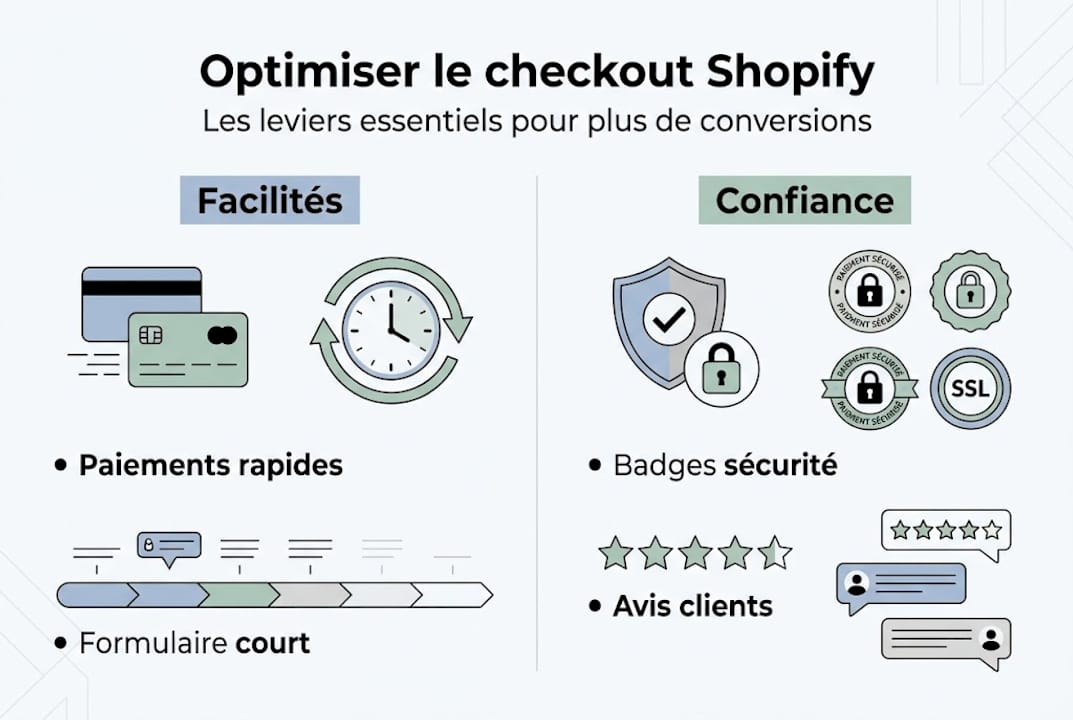
3. Strengthen trust signals
Security badges, visible return policy, customer reviews displayed at checkout: these elements reassure at the precise moment doubt sets in. Shopify micro-interactions also play a key role in guiding the user without friction.
| Optimization Lever | Estimated Gain in Conversion Rate |
|---|---|
| Activation of wallets (Apple Pay, Shop Pay) | +7 to +12% |
| Form simplification | +5 to +8% |
| Visible trust signals | +3 to +6% |
| Clear and varied shipping options | +4 to +7% |
Key Statistic: Brands that combine several of these levers see an average increase in revenue of 15 to 20% on initiated orders, without increasing their advertising budget.
Pro tip: Test each lever separately before deploying them simultaneously. Combining several changes at once makes it impossible to identify what actually worked.
How to Prioritize and Test Your Optimizations
Identifying the levers is good. Knowing the order in which to activate them is better. The method we use with our clients is based on the ICE framework, a simple and highly effective tool for prioritization without getting lost in the details.
The ICE framework evaluates each optimization according to three criteria, scored from 1 to 10:
- Impact: what is the potential effect on conversion?
- Confidence: how confident are you about this effect?
- Ease: how easy is it to implement?
The ICE score is the average of the three scores. Actions with the highest scores go first. Simple, yet structuring.
Next, each optimization must be validated by A/B testing. Here are the steps to follow:
- Define a clear hypothesis: "Adding Apple Pay to checkout will increase the completion rate on mobile."
- Segment traffic: expose 50% of visitors to the modified version, 50% to the original version.
- Set a testing period: a minimum of two weeks to collect significant data.
- Measure the right indicators: checkout completion rate, average order value, revenue per session.
- Make a decision based on data, not intuition.
The impact of a change strongly depends on the traffic segment and context. An effective optimization for a premium skincare brand may not necessarily produce the same results for a supplement brand. Prioritization by framework and experimentation remains the most reliable approach.
Consult our Shopify optimization strategies to delve deeper into each step of this process.
Pro tip: Beware of "universal magic solutions." What doubled the conversion of a competitor's store may not apply to your context. Always reason from your own data.
Nuances: Payment Customization and Real-World Scenarios
Adding payment methods is often presented as an obvious choice. The reality is more nuanced. Adding payment methods only has a positive effect if the added method is truly relevant to your users. Offering Klarna to customers who never use it will bring no benefit, and may even visually clutter your checkout.
Before any modification, ask yourself these questions:
- Who are my customers really? What is their age, location, purchasing behavior?
- What payment methods do they use daily?
- At what point in the journey do they hesitate the most (analytics data)?
- Is my current checkout adapted for mobile browsing or primarily desktop?
- Have I already collected direct customer feedback on their payment experience?
A concrete example: a natural skincare brand targeting customers aged 35 to 55 in France will see few results by activating an unknown wallet. However, offering payment in 3 interest-free installments via a recognized solution can remove a real barrier to purchase for this profile.
"Checkout optimization is not a checklist. It's a subtle understanding of who your customers are and what precisely hinders them when paying."
Beauty UX and trust rely on this contextual reading. A digital wallet displayed at the wrong time, or a poorly presented shipping option, can create confusion where you intended to reassure. Personalization always takes precedence over generalization.
Our Perspective: What’s Often Forgotten About Checkout Optimization
Since 2018, we have supported dozens of beauty and wellness brands on Shopify. And the temptation we observe most often is to redo everything at once. New interface, new payment methods, new funnel: the big night of optimization. In practice, this approach costs more than it brings in.
Data doesn't reveal everything. A high abandonment rate can hide dozens of different causes, and analytics won't tell you why a customer hesitated for thirty seconds on the "address" field before leaving. This is where real user feedback becomes irreplaceable: post-abandonment surveys, user tests, listening to customer service.
We recommend monitoring weak signals: hesitations on payment methods, recurring customer service feedback on delivery, abandonments concentrated at a specific stage. These signals guide better than any list of best practices.
A detailed UX analysis targeted to your context is always worth more than an untested global redesign.
Pro tip: Prioritize measurable "quick wins." A single data-validated change, deployed quickly, generates more value than a six-month redesign with uncertain effects.
Support and Resources for Optimizing Your Shopify Checkout
Being supported by experts who understand the codes of your industry significantly accelerates results. At Tamara Agency, we work exclusively with beauty, cosmetics, and wellness brands on Shopify, which allows us to quickly identify the most relevant levers for your context.

Whether you want to audit your existing checkout, train your team via our Shopify checkout training, or entrust the complete redesign to our team, we have a solution adapted to each stage of your development. Our Shopify beauty agency supports you from strategic audit to deployment, with monthly monitoring to measure each performance gain.
Frequently Asked Questions
What are the first signs that you need to optimize your Shopify checkout?
A high abandonment rate in the payment funnel, customers leaving due to unexpected fees or a lack of payment methods are clear warning signs. Also analyze feedback from your customer service: they often reveal invisible frictions in your analytics data.
How to measure the impact of a checkout optimization?
Compare the conversion rate and revenue before and after the change, ideally through structured A/B tests. Randomization experimentation is the most reliable method for isolating the causal effect of a modification.
Does adding a new payment method always have a positive effect?
No, the addition is only beneficial if the method truly matches the preferences of your target customers. An unused payment method clutters the checkout without adding value.
Should the checkout form be radically simplified to improve conversion?
Reducing unnecessary fields improves the completion rate, but excessive complexity measurably harms conversion. Adapt each change to your audience and validate it with a test before generalizing it.