


Successfully migrating your beauty store to Shopify
Your beauty store deserves better than a platform that hinders your growth. Too many cosmetic brands continue to struggle with rigid interfaces, slow loading times, and limited marketing tools, while their competitors on Shopify accelerate. The most telling proof? Dermalogica recorded +119% in revenue after its migration, with +44% speed and +45% conversion rate. This guide will walk you through the steps to prepare, execute, and secure your migration to Shopify, taking into account the specific requirements of the beauty and cosmetics industry.
Table of Contents
- Preparing for migration: essential conditions and prerequisites
- Comprehensive methodology: the 5 key steps for a smooth migration
- Preserving SEO and performance after migration
- Frequent pitfalls and specific cases for beauty stores
- Expected results: post-migration performance in cosmetics
- Entrust your migration project to Shopify beauty experts
- Frequently asked questions about Shopify migration
Key Points
| Point | Details |
|---|---|
| Pre-audit | An audit and data mapping are essential before migration. |
| Structured migration | The five Shopify steps reduce transition time and risks for your beauty store. |
| SEO to protect | Accurate mapping and 301 redirects limit loss of traffic and sales. |
| Major gains | Expect significant improvements in speed, conversion, and revenue. |
Preparing for migration: essential conditions and prerequisites
Before starting anything, a rigorous audit of your data is essential. Products, customers, orders, images, shade variants: everything must be mapped. A data audit is the first step recommended by Shopify before any migration. This is also the time to identify what can be automated and what will require manual intervention.
In the beauty sector, there are many specificities. Your product pages often include high-definition images, multiple shade variants, and detailed ingredient lists. These elements require particular attention during the transfer to preserve visual quality and user experience.
There are three main approaches to migrating to Shopify, each adapted to a different level of complexity:
- Manual CSV migration: suitable for simple catalogs, inexpensive but time-consuming
- Migration applications: automate data transfer, ideal for medium volumes
- Certified Shopify partners: recommended for complex stores with multiple variants, regulatory compliance, and high data volume
Here is a summary table to help you choose your approach based on the complexity of your store:
| Method | Complexity | Cost | Timeline | Ideal for |
|---|---|---|---|---|
| Manual CSV | Low | Low | Long | Small catalogs |
| Application | Medium | Medium | Fast | Intermediate volumes |
| Agency partner | High | Variable | Optimized | Complex beauty stores |
To understand the entire Shopify migration process or if you are coming from a specific platform like PrestaShop, consult our page dedicated to PrestaShop migration.
Pro tip: Before exporting your data, clean up your catalog. Delete obsolete products, correct duplicates, and standardize variant names. You will save valuable time during mapping.
Comprehensive methodology: the 5 key steps for a smooth migration
With the prerequisites in place, here is the structured action plan for a migration without unpleasant surprises.
Step 1: Data audit and mapping List all elements to migrate: products, collections, customers, orders, content pages, URL redirects. Prioritize based on revenue generated.
Step 2: Choosing the migration strategy Two approaches exist. The "big-bang" method switches everything at once, fast but risky. The progressive migration uses a sandbox environment for testing before going live. For beauty brands with a rich catalog, the progressive method is often preferable.
Step 3: Cleaning, mapping, and variant management This is the most technical step. Each data field must correspond to its Shopify equivalent. HD images must be optimized without loss of quality. Complex variants (shades, textures, formats) must be carefully remapped.
Step 4: Sandbox testing and quality verification Check every product page, every link, every form. Verify regulatory compliance of your ingredient pages and legal mentions. This is where you avoid costly errors.

Step 5: Launch, monitoring, and corrections After going live, monitor for 404 errors, loading performance, and conversion rates. Act quickly on detected anomalies.
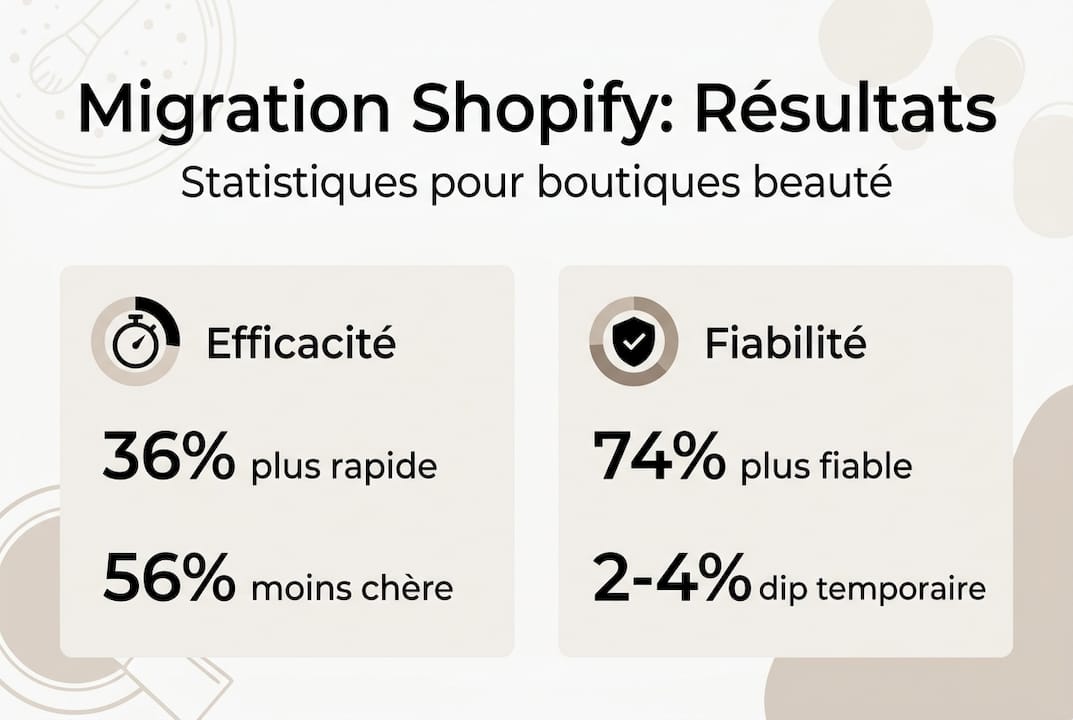
The numbers speak for themselves: a Shopify migration is 36% faster, 56% cheaper, and 74% more reliable on schedule than custom development. Discover the Shopify migration methods available depending on your original platform.
| Method | Speed | Reliability | Cost |
|---|---|---|---|
| Manual (CSV) | Slow | Medium | Low |
| Application | Fast | Good | Medium |
| Agency partner | Optimized | Excellent | Variable |
If you are migrating from WooCommerce, our guide on WooCommerce migration details the specificities to anticipate. To project yourself into market developments, consult our analyses on beauty trends on Shopify.
“A well-prepared migration is not a risk; it's a strategic investment for your brand.”
Pro tip: Plan your migration outside of peak business periods (sales, holidays, launches). You'll reduce pressure and have more time to correct unforeseen issues.
Preserving SEO and performance after migration
A successful migration isn't just about the technical aspects: business visibility also depends on SEO. This is often where brands lose ground due to lack of anticipation.
The absolute priority is URL mapping. Identify the pages that generate the most traffic and revenue, and ensure they all have a 301 redirect to their new equivalent. URL mapping and 301 redirects are critical: traffic recovers in a few weeks to several months depending on the quality of the work done.
Standard Shopify supports up to 100,000 redirects, and Shopify Plus up to 20 million. For most beauty stores, the standard limit is more than sufficient.
Here are the SEO vigilance points not to neglect:
- Title tags and meta descriptions: check that they are properly transferred and optimized
- Internal links: rebuild the link structure between your product pages, categories, and blog articles
- Structured data: ensure that rich snippets (reviews, prices, availability) work correctly
- Loading speed: Shopify naturally improves performance, but optimize your images before migration
- Indexing: submit your sitemap to Google Search Console as soon as it goes live
“The essential thing is to monitor post-migration indexing and act quickly on 404 errors.”
A temporary dip of 2 to 4% in revenue is common in the first few weeks. With good SEO management, recovery is quick. Our guide on Shopify migration SEO optimization gives you all the keys to minimizing this impact.
Frequent pitfalls and specific cases for beauty stores
Now that the global best practices are clear, let's focus on the errors and situations to anticipate in the cosmetic sector.
The first, often underestimated, pitfall: customer passwords do not migrate. Your customers will need to reset their access. Prepare clear and proactive communication to avoid frustration and loss of active accounts.
Another critical point: shade variants and HD images are at the heart of the beauty experience. A poorly displayed swatch or a degraded image can be enough to drive a buyer away. Shopify limits to 100 variants per product, which can be a problem for brands with very extensive ranges.
Here are the most common pitfalls to anticipate:
- Complex variants: beyond 100 options, consider third-party applications like Infinite Options
- High-resolution images: compress without losing quality (WebP format recommended)
- Ingredient pages: verify regulatory compliance (INCI, FDA mentions if exporting to the USA)
- Return rate: cosmetic products are often non-resalable; integrate this management into your Shopify logistics
- Loyalty: LTV (customer lifetime value) is high in beauty; set up your loyalty programs and post-purchase emails from the start
Pro tip: Create a personalized password reset page and send an automatic email to all your existing customers as soon as you launch. It's a simple gesture that preserves your customer relationship.
To learn more about growth after migration, discover our strategies to increase your beauty sales on Shopify.
Expected results: post-migration performance in cosmetics
After avoiding pitfalls, it's time to project the actual results observed in the sector.
The figures from actual migrations are telling. Dermalogica recorded +44% speed, +45% conversion, and +119% revenue after its migration to Shopify. Cos Bar also saw its revenue and average order value increase significantly.
Other brands confirm this trend:
- Salon Supplies: +293% transactions, doubled revenue, +48% conversion rate
- Himalayan Makeup: +47% site performance, +28% conversion, and a 32% reduction in operational costs
- UX improvement: smoother navigation, reduced loading times, optimized mobile experience
- Strengthened loyalty: native integration of email, SMS, and loyalty program tools
These results are not by chance. They stem from a well-prepared migration, a store designed to convert, and a loyalty strategy activated from launch. Consult our Shopify cosmetic benchmarks to position yourself against market standards in 2026.
A website must perform as well as it attracts. On Shopify, these two requirements are no longer contradictory.
Entrust your migration project to Shopify beauty experts
Ready to take the plunge? At Tamara Agency, we have been supporting beauty and cosmetic brands in their migration to Shopify since 2018. Each project is handled with the same high standards: complete audit, secure migration, UX optimization, and post-launch monitoring to maximize your sales performance.

Our industry expertise allows us to understand your aesthetic codes, regulatory constraints, and conversion challenges. We don't just deliver a functional store: we build an experience that helps your brand grow. Discover our offer dedicated to your beauty migration on Shopify, explore our Shopify training program to enhance your skills, or entrust us with your entire project through our Shopify store creation support service. Let's talk about your project.
Frequently asked questions about Shopify migration
How long does a migration to Shopify take?
According to Shopify, migration is on average 36% faster than custom development, taking from a few days to a few weeks depending on the size and complexity of your store.
Can everything be migrated, including customers, orders, and beauty variants?
Yes, but certain fields require specific handling: customer passwords do not migrate, and some complex variants must be remapped manually to match the Shopify structure.
Will Shopify migration affect my SEO and revenue?
A temporary dip of 2 to 4% is common, but traffic recovers in a few weeks to a few months thanks to proper management of 301 redirects and indexing monitoring.
What technical limitations should I anticipate during a beauty/cosmetic migration?
Shopify limits products to 100 variants and automatically filters certain parametric URLs, two points to anticipate for brands with very extensive shade ranges.
What results can I expect quickly after migration?
Beauty brands like Dermalogica recorded +44% speed, +45% conversion, and +119% revenue after their migration, results achievable with a well-structured migration.