


Digital Merchandising: Key to Boosting E-commerce Sales
TL;DR:
- Digital merchandising optimizes product presentation in real time, increasing sales by 20 to 30%.
- It relies on prioritization, personalization, and behavioral analysis to create a consistent experience.
- A solid catalog structure and an iterative approach are essential before deploying advanced personalization.
Good digital merchandising can increase sales by 20 to 30%, yet most e-commerce managers still reduce it to simply highlighting their best products. This is a costly strategic error, especially in the beauty sector where aesthetic requirements and the uniqueness of the user experience make all the difference. Digital merchandising goes far beyond that: it structures, personalizes, and optimizes every touchpoint to transform a curious visitor into a loyal customer. In this guide, we provide a precise definition, successful techniques, and essential nuances to master.
Table of Contents
- What is digital merchandising?
- The pillars of digital merchandising: key techniques and levers
- Why is digital merchandising essential for beauty?
- Challenges, difficulties, and limitations of digital merchandising
- Effective digital merchandising: what many overlook
- Take action: beauty e-commerce success starts here
- Frequently Asked Questions
Key Points
| Point | Details |
|---|---|
| Key Definition | Digital merchandising optimizes the presentation and discovery of products online to boost sales. |
| Major Techniques | Strategic presentation, AI personalization, and behavioral analysis are the pillars for e-commerce performance. |
| Beauty Specificity | The beauty sector particularly benefits from virtual trials, immersive visuals, and personalization. |
| Challenges to Overcome | Avoid over-complexity, prioritize fundamentals, and adapt strategy to the majority of anonymous traffic. |
What is digital merchandising?
After outlining the impact of digital merchandising, let's clarify its essential contours.
Digital merchandising, also known as e-merchandising, encompasses all techniques to optimize the online presentation of products. Specifically, it involves arranging, prioritizing, and personalizing all visible elements on your store, from category pages to product sheets, as well as internal search results and automatic recommendations.
Confusion with physical merchandising is common. In a store, you move a display, you change a window display once a week. Online, everything changes in real time, according to each visitor's behavior, the time, the season, or stock availability. It's an entirely different logic, more agile but also more complex to manage.
To understand how digital merchandising works, you need to integrate three dimensions: visual presentation, algorithmic logic, and behavioral data. These three pillars work together to create a consistent and high-performing experience.
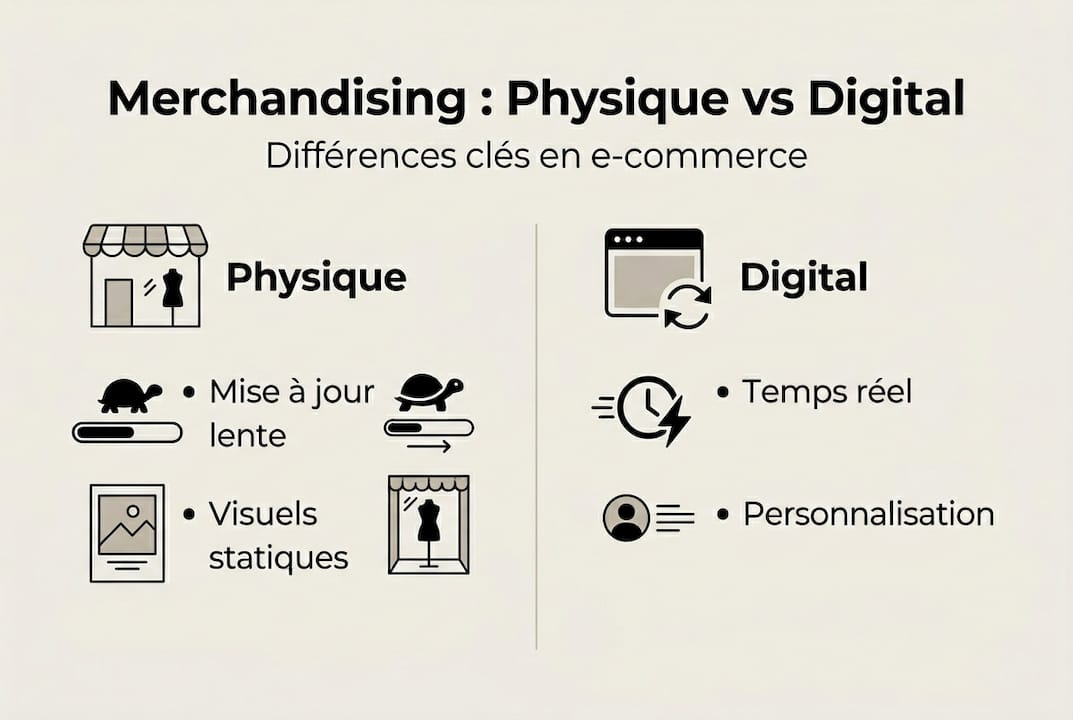
Here's a comparative overview of the two approaches:
| Criterion | Physical Merchandising | Digital Merchandising |
|---|---|---|
| Update | Manual, weekly | Automatic, real-time |
| Personalization | Impossible per individual | Possible by segment or profile |
| Available Data | Limited, declared | Behavioral, precise |
| Scalability | Space-constrained | Unlimited |
| Adaptation Cost | High | Low once configured |
A figure often underestimated: between 90 and 98% of online store visitors are anonymous. They don't have an account, no known history. Your digital merchandising must therefore perform without personal data, relying on behavioral signals captured in real time.
In the beauty sector, this issue is particularly strong. Expectations are high, product ranges are complex, and purchases are often emotional. A high-performing beauty website must both attract and convince. That's why optimizing beauty UX becomes inseparable from a successful digital merchandising strategy.
“Digital merchandising is not a staging option, it is the invisible commercial architecture of your online store.”
The pillars of digital merchandising: key techniques and levers
Once the definition is established, let's delve into the essential concrete pillars.
The main mechanisms include: strategic product presentation, behavioral analysis, artificial intelligence personalization, and cross-touchpoint optimization, i.e., across all user contact points.

Here's how these techniques translate concretely into the beauty sector:
| Technique | Description | Beauty Impact |
|---|---|---|
| Smart sorting and filters | Allows the user to navigate based on their skin type, need, or routine | Reduced bounce rate |
| Rich visuals and videos | Textures, before/after results, integrated tutorials | Trust and conversion |
| AI recommendations | Associated products, routine complements | Increased average cart value |
| Behavioral segmentation | Differentiated display according to profile and history | Relevance and loyalty |
| Search results merchandising | Highlighting products based on popularity and margin | Optimized profitability |
To launch or structure your digital merchandising, here are the steps to prioritize in order:
- Categorize and prioritize the catalog: each product must be in the right place, with the right attributes and the right filters.
- Optimize product pages: visuals, descriptions, reviews, clear benefits.
- Set sorting rules: popularity, novelty, margin, available stock.
- Activate automatic recommendations: cross-sell, up-sell, associated routines.
- Deploy AI personalization: dynamic recommendations based on behavior.
- Continuously analyze and iterate: A/B tests, monitoring conversion rates per page.
Pro tip: First invest in catalog categorization and structure before deploying AI personalization. A powerful algorithm does not compensate for a faulty product architecture. Best beauty UX practices confirm that navigation clarity always precedes technological sophistication.
A French cosmetic brand specializing in natural skincare restructured its catalog according to these steps. Result: a 23% increase in conversion rate in three months, without changing its advertising budget. The difference? Intelligent categorization and filters adapted to the real needs of its customers. Your beauty e-commerce branding guide can help you lay these foundations consistently.
Why is digital merchandising essential for beauty?
After discussing the universal pillars, let's see why the beauty sector benefits even more.
Mobile now accounts for the majority of beauty traffic. Consumers explore, compare, and purchase from their smartphones, often in just a few minutes. A poorly designed mobile experience, with slow visuals or confusing navigation, will inevitably drive customers away. The impact of mobile on beauty conversion rates is documented and significant.
Visuals play a central role in beauty purchasing decisions. Unlike other sectors, the texture of a cream, the finish of a lipstick, or the transparency of a serum must be perceptible on screen. Virtual trials using augmented reality, such as those developed by L’Oréal using data and AR, help reduce hesitation and product returns.
Key figure: For beauty brands, AI personalization generates +47% revenue and doubles the average cart value according to sector benchmarks.
Here are the visual and technical levers to prioritize in this sector:
- High-definition photos from multiple angles, with functional zoom
- Short application videos integrated directly on the product page
- Interactive skin diagnostics guiding users to suitable products
- Personalized recommendations based on declared preferences or past behaviors
- Trust badges: certifications, key ingredients, eco-responsible commitments
Skin diagnostics represent an underutilized lever. They collect first-party data, personalize the journey, and create a strong bond with the brand. The beauty e-commerce trends 2026 confirm that this consultative approach is becoming a standard expected by consumers.
In beauty, purchases are rarely purely rational. Trust, the feeling of being understood and guided, the aesthetics of the store: everything contributes to the decision. Digital merchandising, when well executed, builds this trust at every step of the journey.
Challenges, difficulties, and limitations of digital merchandising
After demonstrating the power of digital merchandising in beauty, let's address the obstacles and solutions.
The first trap is wanting to automate everything too quickly. Entrusting product highlighting entirely to an algorithm without clear editorial rules often leads to aberrant results: an out-of-stock product in the first position, a premium range drowned in entry-level products, or recommendations without semantic coherence.
The difference between physical and digital merchandising is fundamental: digital is dynamic and potentially infinite in personalization, but it requires rigorous governance to remain relevant. Without human oversight, AI optimizes short-term metrics at the expense of brand image.
“Data without an editorial strategy is power without direction. Humans remain the conductors.”
Here are the most common mistakes and how to avoid them:
- Over-regulating sorting rules: too many manual rules hinder the algorithm's agility. Set guardrails, not straitjackets.
- Neglecting anonymous visitors: with 90% of traffic being anonymous, contextual segmentation (device, time, source) is essential. The e-commerce merchandising nuances detail these approaches.
- Copying physical merchandising online: in-store layout logics do not directly translate to a website.
- Ignoring post-deployment analysis: without tracking performance by page and segment, no learning is possible.
- Sacrificing brand consistency for conversion: aggressive merchandising that breaks the visual codes of your beauty universe harms customer loyalty.
Pro tip: Before investing in an advanced personalization tool, audit your catalog. Incomplete product attributes or poorly structured categories will render any algorithm ineffective. To boost beauty conversion, start with the fundamentals. The most effective beauty sales solutions are based on this basic discipline.
Effective digital merchandising: what many overlook
We regularly observe the same pattern among ambitious beauty brands: a rush towards total personalization, even before their catalog is properly structured. This is counterproductive. The real impact rarely comes from technological sophistication. It comes from clarity, consistency, and intelligent product prioritization.
Too many managers invest in expensive AI personalization tools, while their navigation filters are faulty and their product attributes are incomplete. A visitor who cannot find what they are looking for in three clicks will not be saved by an algorithmic recommendation.
What we advocate is a rigorous test-and-learn approach. Test a modification, measure its real impact on conversion, adjust. Optimizing beauty UX is not a one-time project, it's a continuous process. Agility and listening to user feedback are your best assets for sustainable progress.
Take action: beauty e-commerce success starts here
You now have a clear vision of the levers, pitfalls, and priorities of digital merchandising in the beauty sector. The next step is to move from understanding to execution.

Since 2018, we have been supporting ambitious beauty and cosmetic brands in creating Shopify beauty stores, optimizing their performance, and structuring their user experience. Whether you want to redesign your existing store, accelerate your conversion, or improve your skills through our Shopify training, we have the right solutions. Discover how to optimize your Shopify store with tailor-made support, designed for your universe and your ambitions.
Frequently Asked Questions
What is the difference between digital and physical merchandising?
Digital merchandising is dynamic and adapts in real time to each user, while physical merchandising is static and cannot be personalized individually.
What results can be expected from AI personalization in beauty e-commerce?
According to industry benchmarks, AI personalization generates +47% in additional revenue and can double the average cart value for beauty brands that implement it correctly.
Should everything be automated with AI in digital merchandising?
No. It's better to first optimize merchandising basics like catalog structure and filters, then gradually deploy AI personalization where it provides measurable value.
How does digital merchandising help sell to anonymous visitors?
With 90 to 98% anonymous visitors on most stores, contextual and behavioral segmentation allows for personalizing the experience without personally identifiable data, by relying on signals captured in real-time.