


Maximizing Shopify Conversion: The Key Role of Mobile First
TL;DR:
- Mobile traffic accounts for 70 to 78% of the total, but conversion is twice as low.
- A mobile-first site optimizes the experience from design to increase sales.
- Innovations like sticky add-to-cart and AR try-on significantly improve conversion rates in beauty.
The majority of traffic to beauty stores comes from mobile. However, sales do not follow. This gap between traffic and conversion represents thousands of euros lost every month for cosmetics brands on Shopify. The explanation is simple: having a site "that displays on mobile" is not the same as having a site designed to convert on mobile. In this guide, we show you why mobile-first has become the most underutilized growth lever in beauty, and how to take concrete action to improve your e-commerce performance.
Table of Contents
- Why Mobile-First is Essential in Beauty E-commerce
- Mobile-First Principles: Design, UX, and Shopify Requirements
- Mobile-First Boosters and Innovations for Beauty on Shopify
- Deploying Mobile-First on Your Shopify Beauty Store: Methodology and Roadmap
- Our Point of View: Why Mobile-First Remains Underutilized in Beauty
- Boost Your Mobile Conversion with Shopify Beauty Experts
- Frequently Asked Questions
Key Points
| Point | Details |
|---|---|
| Mobile dominates traffic | The majority of beauty customers access your store via smartphone but purchase less on this medium. |
| Mobile-first reduces the gap | Adopting a mobile-first approach can dramatically increase conversion rates and revenue. |
| High-impact innovations | Sticky add-to-cart, AR try-on, and routines concretely boost mobile conversion for beauty on Shopify. |
| Proven methodology | A thorough audit, followed by targeted optimizations and continuous measurement, is the true key to mobile success. |
Why Mobile-First is Essential in Beauty E-commerce
The behavior of beauty consumers has profoundly changed. They discover new products on Instagram, watch tutorials on TikTok, read reviews on their phone, and finalize their purchase… sometimes still on mobile. The beauty customer journey is now predominantly mobile, from the first contact to the payment page.
Despite this, a chasm persists. Mobile generates 70 to 78% of global e-commerce traffic, but converts twice less than desktop. It's not a problem of desire to buy: it's a problem of experience.
In the beauty sector specifically, the mobile conversion rate does not exceed 2.5%, with losses of several thousand euros per month for brands whose store is not optimized. For a store generating 50,000 euros in monthly revenue with 70% mobile traffic, closing only half of the mobile gap can represent several thousand euros in additional revenue without increasing the advertising budget.
The reasons for this delay are known:
- Product pages that are too heavy, slow to load on mobile networks
- CTAs drowned in the scroll, difficult to reach with the thumb
- Purchase funnels not adapted to small screens
- Visuals not optimized for mobile resolution
- Complex menus inherited from a desktop design
"A site must perform as well as it attracts. On mobile, every second of loading and every friction in the journey costs sales."
Brands that have taken the problem seriously are seeing concrete results. Some beauty stores have recorded gains of more than 34% on their mobile conversion rate after a redesign focused on the mobile experience, with a direct increase in revenue. To learn more about the dynamics of mobile and beauty e-commerce, there are many accessible levers. Today, Shopify beauty sales solutions allow for precise action on each point of friction.
Mobile is no longer a secondary channel to "adapt". It is the main channel, where most of your conversions happen.
Having set the context, let's concretely understand what a mobile-first design means and its decisive impacts on the customer journey.
Mobile-First Principles: Design, UX, and Shopify Requirements
Mobile-first is not just about responsive layout. It is a design philosophy that starts from the smallest screen to go to the largest, and not the other way around. The difference is fundamental.
A responsive site adapts a design initially thought for desktop. A mobile-first site is designed from the outset to offer the best experience on a smartphone, then enriched for larger screens. On Shopify, responsive design, content parity, and an LCP below 2.5 seconds are essential criteria for mobile conversion.
| Criterion | Desktop-first | Responsive | Mobile-first |
|---|---|---|---|
| Starting point | Large screen | Adapted large screen | Small screen |
| Mobile performance | Often poor | Variable | Optimized |
| Touch UX | Ignored | Partial | Priority |
| Loading speed | Not prioritized | Partial | Structurally fast |
| Mobile conversion rate | Low | Medium | High |
Specifically, here are the UX principles to apply to your Shopify store:
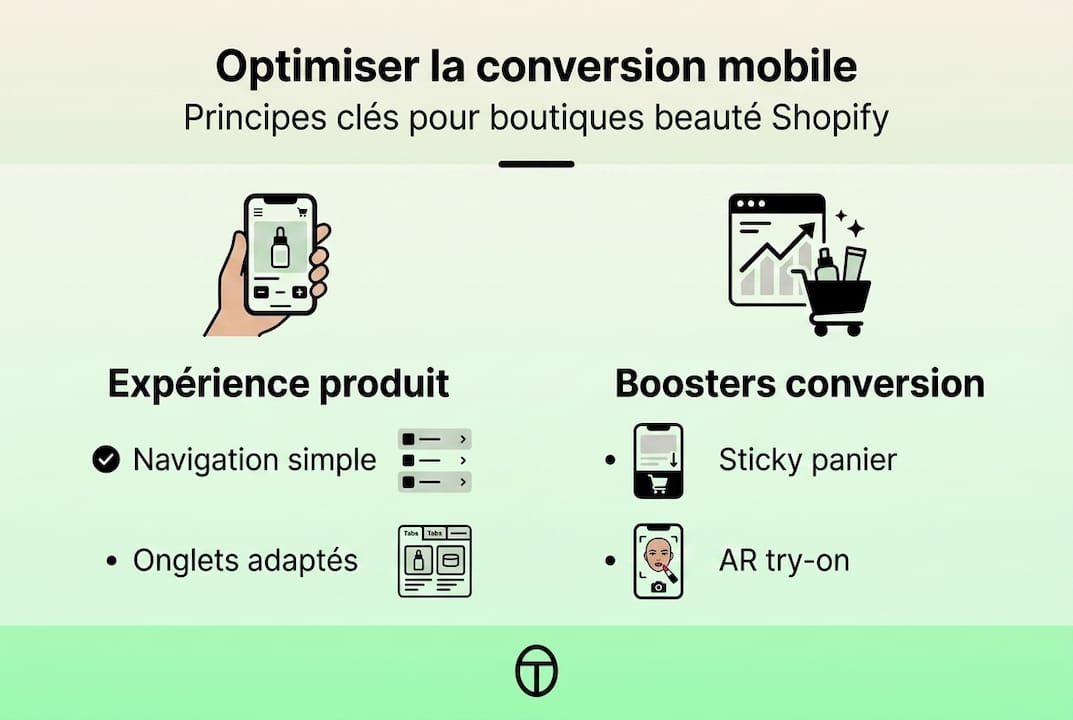
- Always visible CTAs: the "Add to cart" button must remain accessible without scrolling. A sticky add-to-cart is often the most effective solution.
- Simplified navigation: a well-structured hamburger menu, with clear categories accessible in a maximum of two taps.
- Fast LCP: images must be compressed, fonts loaded first, and non-essential scripts deferred.
- Reduced forms: fewer fields, auto-completion enabled, one-click payment possible.
- Tests on real devices: simulators are not enough. Testing on iPhone and Android remains essential to identify real frictions.
The best beauty UX practices show that visual elegance and technical performance are not contradictory. On the contrary, a clean design promotes speed. To go further, optimizing UX/UI on Shopify involves a systematic review of each step of the journey.
Pro Tip: When reviewing mock-ups or updating themes, always start by validating the mobile display before the desktop. This simple inversion of priority radically changes the design decisions made.
Consulting the Shopify performance design checklist allows for systematic verification of each criterion before any deployment.
Having laid the foundations, let's identify which concrete actions generate the best results for improving mobile conversion in beauty.
Mobile-First Boosters and Innovations for Beauty on Shopify
The most successful beauty brands on Shopify don't just rely on a clean design. They activate specific levers that transform mobile browsing into a smooth and engaging shopping experience.
Here are the innovations that show the best results:
- Sticky add-to-cart: keeping the purchase button visible at all times generates between 8 and 14% uplift in conversion rate, depending on the stores and product segments.
- AR try-on (augmented reality virtual try-on): allowing a customer to virtually try on a lipstick or foundation increases CVR by 20 to 30%, while reducing returns related to wrong shade choices.
- Routine bundling: offering product associations in consistent bundles (serum + cream + eye contour) boosts the average cart by 25 to 45%.
- Intuitive shade selector: shade-related returns account for 35 to 50% of beauty returns. A mobile-friendly visual selector significantly reduces this figure.
The case of FloraSoul is emblematic: +41% mobile conversion rate after a redesign focused on the mobile experience. The levers activated included a sticky CTA, streamlined navigation, and product sheets restructured for mobile.
| Innovation | Impact on CVR | Impact on AOV |
|---|---|---|
| Sticky add-to-cart | +8 to 14% | Neutral |
| AR try-on | +20 to 30% | Reduction in returns |
| Routine bundling | +10 to 15% | +25 to 45% |
| Visual shade selector | +5 to 10% | Reduction in returns |
Long product sheets, typical of cosmetics (ingredient list, application tips, customer reviews), must be rethought for mobile. The use of tabs, accordions, and micro-animations guides the eye without weighing down the page. Mobile-first merchandising plays a central role here. An effective Shopify beauty conversion strategy also integrates Shopify micro-interactions to strengthen trust and encourage purchase.
Also pay attention to cosmetic formulation compliance: regulatory information must be accessible on mobile without overloading the product sheet.
Pro Tip: Test each new feature directly on a real mobile device before any deployment. Focus your A/B tests on the product page and the purchase funnel: these are the two areas where gains are fastest and most measurable.
It remains to convert good practices into a realistic action plan: where to start to deploy mobile-first on your Shopify beauty store?
Deploying Mobile-First on Your Shopify Beauty Store: Methodology and Roadmap
Moving from a "mobile-compatible" store to a truly mobile-first store doesn't happen by chance. It requires a clear method, appropriate tools, and precise indicators to measure progress.
Step 1: Complete Mobile Audit Analyze speed (LCP, FID, CLS via Google PageSpeed Insights), UX (navigation, CTA, scroll), mobile/desktop content parity, and drop-off rate at each stage of the funnel. Separate your analytics by device: aggregated data hides the mobile gap.

Step 2: Prioritize Quick Fixes Start with major frictions: invisible purchase button, slow images, broken menus, unoptimized payment forms. These corrections alone can generate immediate gains.
Step 3: Redesign Product Pages for Mobile Restructure product sheets with tabs, accordions for technical details, and compressed visuals. Test on several real devices, not just on simulators.
Step 4: Activate Boosters Integrate sticky add-to-cart, AR try-on if your catalog allows, and routine bundles. Launch A/B tests to validate gains before global deployment.
Step 5: Continuous Monitoring Track the evolution of mobile vs. desktop conversion rate each month. Testing on real devices and separating analytics by device helps identify new friction points as they arise. Also, monitor the impact of a free shipping bar on the average order value.
Recommended tools for tracking and testing:
- Google PageSpeed Insights and Lighthouse for technical performance
- Hotjar or Microsoft Clarity for heatmaps and mobile session recordings
- Shopify Analytics with device segmentation
- BrowserStack for testing on a wide range of real devices
To build a high-performing beauty site, every technical decision must be validated with a mobile perspective. Custom cosmetic solutions show that the demand for quality applies as much to the product as to its digital casing.
Pro Tip: Set a quantifiable goal for reducing the mobile gap from the outset: for example, increasing mobile CVR from 1.8% to 2.8% in three months. A precise goal mobilizes the right decisions and provides clear direction for each iteration.
Once this approach is underway, it's time to grasp the mobile-first philosophy more deeply so as not to trivialize anything.
Our Point of View: Why Mobile-First Remains Underutilized in Beauty
Since 2018, we have been assisting ambitious beauty brands in redesigning their Shopify stores. And what we observe is a surprising reality: even the most experienced digital teams maintain a desktop-first mental posture. Mock-ups are created on large screens, visual decisions are made on desktop, and mobile is validated last, often hastily.
The lack of testing on real devices is perhaps the most frequent blind spot. A simulator does not reproduce the slowness of a 4G network, nor the clumsiness of a thumb on a too-small button.
Mobile is also often relegated to the background during budget arbitrations. Investment goes into content creation, into advertising, but rarely into the mobile experience itself. Yet, that's where most sales are lost.
Our conviction is strong: integrating mobile data into every monthly performance review is no longer optional. It is the indicator that most accurately reveals the true state of your store. The most effective mobile UX in beauty does not come from a trend; it comes from an obsession with data and testing.
Boost Your Mobile Conversion with Shopify Beauty Experts
You now know where your friction points are hidden and how to correct them. But moving from theory to action requires time, resources, and precise technical expertise. That's exactly where we come in.

Since 2018, Tamara Agency has been assisting beauty and cosmetic brands with the creation of beauty Shopify stores designed to perform on mobile from day one. Whether you need targeted Shopify store optimization or comprehensive Shopify support, we work with you to build a mobile-first strategy tailored to your challenges, industry, and growth ambitions. Contact us for a mobile audit of your store.
Frequently Asked Questions
What is the average mobile conversion rate in beauty on Shopify?
The mobile conversion rate in beauty is between 1.5% and 2.5%, significantly lower than desktop, which generally exceeds 3.5%.
Where do I start to optimize my mobile beauty store on Shopify?
Start by testing on a real mobile device, identify slowdowns on the product page and checkout funnel, then make your CTAs always visible with a sticky add-to-cart.
What innovative tools help increase mobile conversion?
AR try-on virtual trials boost CVR by 20 to 30%, sticky add-to-cart generates an 8 to 14% lift, and bundling routines significantly increases average order value.
Why does mobile generate a lot of traffic but fewer sales?
The majority of traffic is mobile, but the mobile shopping journey is often less fluid than on desktop, creating a mobile conversion gap of 40 to 50% that directly impacts revenue.