


Data at the service of e-commerce beauty on Shopify
TL;DR:
- Data is essential for increasing conversion and loyalty in the beauty sector.
- Brands that fully leverage their Shopify analytics have a significant competitive advantage.
- Integrating tools like Shopify Analytics, GA4, and heatmaps optimizes the data-driven strategy.
Beauty brands that personalize using data make their customers 75% more likely to buy, yet most e-commerce managers only exploit a fraction of their Shopify analytics. This gap between the potential of data and its actual use represents a considerable opportunity for ambitious brands. In this article, we will clarify why data has become indispensable in the beauty sector, what industry benchmarks you need to know, how to collect and interpret your key indicators, and how all this concretely translates on Shopify to accelerate your conversion and loyalty.
Table of Contents
- Why data is vital for beauty e-commerce
- Which indicators to monitor and how to use them
- Methods for collecting, unifying, and leveraging data on Shopify
- Data, personalization, and growth: practical application
- What experts rarely notice: data is nothing without human context
- Take action: optimize your beauty store with Tamar Agency
- Frequently asked questions about using data in beauty e-commerce
Key Points
| Point | Details |
|---|---|
| Key industry benchmarks | For beauty/cosmetics, the average conversion rate is 2.1% and the LTV:CAC ratio must exceed 3:1. |
| Data for personalization | Using data and AI to personalize the customer experience increases conversion by 75%. |
| Unified data vision | Combining Shopify Analytics, GA4, and A/B tests offers a comprehensive understanding of the beauty customer. |
| Loyalty through data | Cohort analysis and data-driven loyalty programs maximize retention. |
Why data is vital for beauty e-commerce
The beauty and cosmetics sector exhibits particularly rich purchasing behavior signals: ingredient comparisons, tutorial consultations, detailed customer reviews, repeated purchases of specific treatments. Each interaction leaves an exploitable trace. Ignoring this data means flying blind in a market where competition is constantly intensifying.
Data-driven decisions via Shopify Analytics and GA4 enable continuous optimization of every performance lever, whether it's merchandising, pricing, promotions, or user experience. This is not an option for brands that want to last. It is a condition for survival.
Industry benchmarks to know
Here are the reference figures that every beauty e-commerce manager should keep in mind:
| Indicator | Industry average | Top performers |
|---|---|---|
| Conversion rate | 2.1% | 4.5% and higher |
| AOV skincare | 55 to 80 € | 100 to 120 € |
| Repeat customer rate | 25 to 40% | 50%+ |
| LTV / CAC | 3:1 minimum | 5:1 and higher |
According to CRO reference data for Shopify beauty, the average conversion rate in the beauty sector is around 2.1%, with the best stores reaching 4.5% and beyond. These differences are not due to chance. They reflect strategic decisions based on solid data.
The real impact of mobile on your conversion
Mobile/desktop distribution is one of the first analyses to conduct. Mobile generates the majority of traffic in beauty, but its conversion rate remains structurally lower: approximately 1.5% versus 3% on desktop. This asymmetry is a call to action, not a fatality.
Data doesn't tell you what to do. It tells you where to look. The quality of your analysis determines the quality of your decisions.
To boost Shopify conversion, you need to understand exactly when mobile users abandon, why, and how the journey can be redesigned. This is where data becomes a strategic tool in its own right.
Brands that invest in best UX practices for mobile see significant conversion gains. It's not just about making the site "responsive," but about rethinking the entire purchase journey based on actual browsing behaviors. Analyzing customer data also allows you to segment beauty customers with precision, to deliver the right messages to the right segments, at the right time.
In summary, data in the beauty sector is vital because it transforms every business decision, from the selection of featured products to the structure of promotions, through the optimization of product pages and the personalization of post-purchase communications.
Which indicators to monitor and how to use them
Having justified the strategic value of data, let's detail the indicators to monitor and interpret to optimize the performance of your beauty store on Shopify.
Essential KPIs for beauty e-commerce
Here are the four pillars of your analytics dashboard:
| KPI | What it measures | Alert threshold |
|---|---|---|
| Conversion rate | Effectiveness of the purchase funnel | Below 2% |
| AOV (average order value) | Value per transaction | Stable or decreasing |
| CAC (customer acquisition cost) | Profitability of marketing channels | LTV:CAC ratio below 3:1 |
| LTV (customer lifetime value) | Long-term potential per customer | Below 3x AOV |
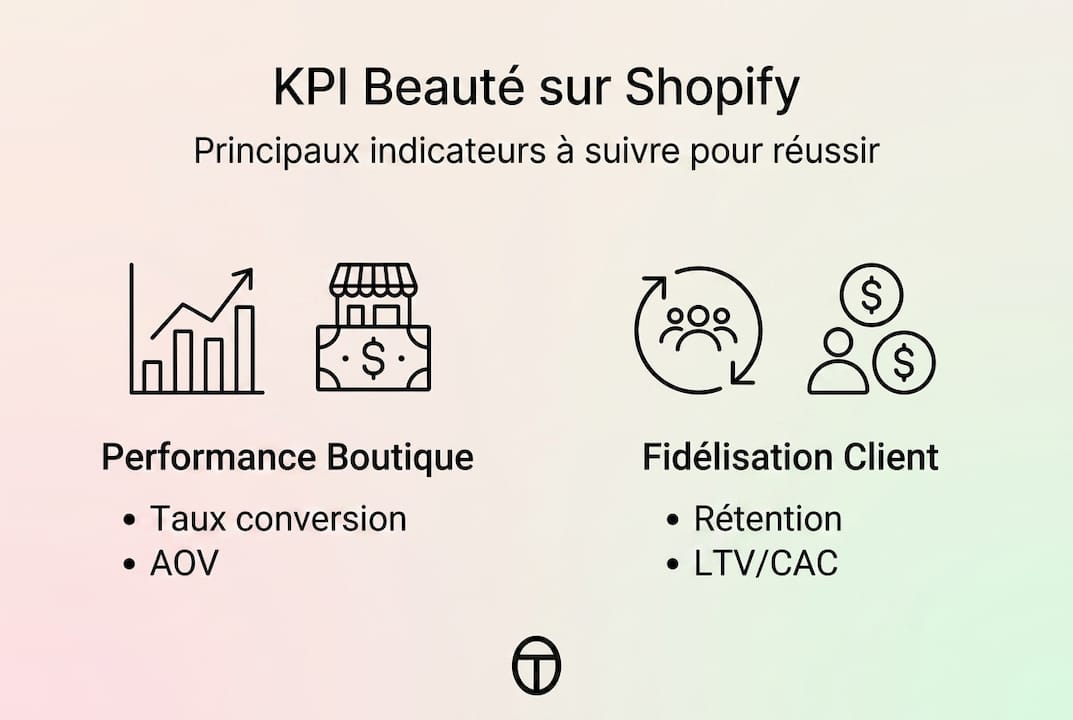
In-depth cohort analysis reveals the true health of your business. Healthy retention in beauty translates to 25-40% repeat customers, a repurchase rate of 20-30% within 90 days of the first purchase, and an LTV representing 3 to 5 times the AOV. If your numbers are below these, data will show you exactly where to intervene.
How to interpret these figures in practice
Here's how we advise you to use these KPIs daily:
- Monitor the conversion rate by product segment: a sunscreen and an anti-aging serum do not have the same purchasing cycle or repurchase dynamic. Analyze each category separately.
- Calculate the LTV:CAC ratio by acquisition channel: a customer who came via an influencer recommendation may have a lifetime value (LTV) twice as high as a customer who came via a generic advertisement.
- Analyze cohorts by season: in beauty, behaviors vary greatly between summer (sun care, lightness) and winter (intensive care, comfort). Your analyses must reflect this seasonality.
- Measure the impact of bundling: beauty e-commerce benchmarks show that bundling skincare routines increases AOV by 30-45%. This is considerable.
- Identify your "loyalty champions": thanks to cohorts, identify customers who return fastest and most often. Their profile should guide your acquisition strategy.
Pro tip: Don't settle for global averages. Break down your conversion rate by product type, traffic source, and device. It's in these cross-sections that your real growth opportunities lie.
Subscriptions represent a particularly strong opportunity in beauty, potentially accounting for 25 to 40% of revenue for well-positioned brands. To leverage these figures, Shopify UX conversion analysis becomes an indispensable step. And if you're starting from scratch, discover our recommendations for creating a high-performing Shopify beauty store from the outset.
Caring for your skin begins with understanding your clientele, much like understanding the INCI ingredients you formulate: each piece of data has a precise role in the overall formula.
Methods for collecting, unifying, and leveraging data on Shopify
Once the indicators are identified, let's move on to the practical collection and exploitation of data on Shopify. Having the right tools is one thing. Knowing how to combine them intelligently is another.

Recommended data ecosystem
The most effective method relies on a combination of complementary tools. Shopify Analytics and GA4, used together, offer a complete view of the customer journey, from acquisition to loyalty:
- Shopify Analytics: Sales data, customer behavior, inventory levels, integrated cohort reports. This is your native business dashboard.
- Google Analytics 4: Browsing behavior, multi-touch attribution, conversion funnels. GA4 excels at understanding the "why" behind the numbers.
- Heatmaps and session recordings (Hotjar, Microsoft Clarity): Visualize where visitors click, scroll, and abandon. Essential for product pages and checkout funnels.
- A/B Tests (Optimize or native Shopify tools): Validate each hypothesis before deploying it at scale. A product page title, a button color, a photo order can all have a measurable impact.
- Quizzes and enriched forms: Tools like Typeform or Octane AI allow capturing declared data (skin type, concerns, preferences) that is very valuable for personalization.
The attribution trap to absolutely avoid
One of the most frequent and costly biases in beauty e-commerce is last-click attribution. This model attributes the entire value of a sale to the last channel touched before purchase. Result: you systematically underestimate the contribution of awareness channels like organic content, tutorial videos, or influencer recommendations.
In beauty, the purchasing journey is rarely linear. A customer might discover your serum on Instagram, read a comparative article, watch a YouTube review, receive a promotional email, and then finally purchase via a direct Google search. If you only measure the last click, you cut the budget for the channels that actually triggered the purchase intent.
Pro tip: Activate the "data-driven" attribution model in GA4. It uses machine learning to realistically distribute conversion credit across all touchpoints of the customer journey.
The integration of unified data is also the essential prerequisite for leveraging AI. Without clean, consolidated, and consistent data, recommendation or personalization algorithms cannot deliver their full potential. Follow the 2026 beauty e-commerce trends to stay at the forefront, and understand precisely the impact of mobile on conversion to prioritize your technical investments.
Data, personalization, and growth: practical application
Finally, let's look at the direct link between data, personalization, and growth in beauty e-commerce. This is where strategy comes to life.
Personalization as a conversion driver
Beauty brands that use data to personalize the shopping experience see spectacular results. Statistics on beauty personalization are eloquent: 75% of beauty consumers are more likely to buy from a brand that offers them personalized recommendations. This figure illustrates a profound reality: beauty is an intimate category, and every customer wants to feel understood.
Here are the most effective personalization levers:
- Diagnostic quizzes: a "what is your skin type" or "which routine suits you" quiz collects declared data while creating an engaging experience. Skincare quizzes then allow segmenting product recommendations and fueling email/SMS campaigns with much higher engagement rates.
- Product recommendations based on history: "you might also like" or "frequently bought together" algorithms work better when fed with real customer data, not just simple manual rules.
- Smart loyalty programs: Sephora Beauty Insider is often cited for a reason. This program accumulates valuable behavioral data with each transaction, allowing the brand to continuously refine its offers and communications.
- Routine bundling: offering "morning routine" or "repairing routine" kits based on frequently purchased products significantly increases AOV. Your Shopify store data tells you exactly which combinations work.
- Email and SMS automations: email and SMS channels account for 22 to 32% of revenue for beauty brands that use them well, provided the content is personalized based on behavioral data.
Pro tip: Start by analyzing product associations in your existing Shopify orders. You'll discover natural combinations you hadn't imagined, and these insights immediately become actionable in merchandising or email automation.
Data-driven personalization also changes how you design your beauty e-commerce solutions, from catalog architecture to landing page structure. Every design or content decision can and should be validated by data. To deepen your approach, the strategies that transform Shopify beauty stores offer a complete operational framework for moving from intention to execution.
For example, natural alternatives in cosmetics illustrate how customer interest data can guide the development of new product lines, by identifying what your audience is actively looking for even before you offer it.
What experts rarely notice: data is nothing without human context
We have been working with beauty brands of all sizes since 2018, and we have observed one constant: e-commerce managers who achieve the best results are not those who read the most dashboards. They are those who know how to contextualize figures with a real understanding of their customers.
A 72% cart abandonment rate may seem alarming. But if you know that your customers often browse multiple times before buying because your product is premium and requires consideration, this figure becomes strategic information, not a technical emergency. Raw data never tells the whole truth.
That's why we always integrate qualitative signals into our analyses: customer review verbatims, results of post-purchase satisfaction surveys, customer service feedback, observations of recorded sessions. This cross-referencing of quantitative data and field feedback is what transforms a technically correct store into a high-performing Shopify beauty site that attracts as much as it converts. Brand storytelling, the tone of product descriptions, visual staging: all of this influences conversion in ways that KPIs alone cannot capture. The hybrid data/human interpretation is our deep conviction, and it is what makes the difference between optimizing a store and growing a brand.
Take action: optimize your beauty store with Tamara Agency
Applying an effective data strategy on Shopify requires technical, sectoral, and analytical expertise that few internal teams master alone. This is exactly what we have been doing at Tamara Agency since 2018.

Whether you want to rethink your analytics architecture, improve your conversion rate, or review your store's user experience, we intervene at every step. Our services cover Shopify store redesign, custom Shopify store creation, and Shopify training to empower your teams. Our beauty and cosmetics sector expertise guarantees solutions designed for your customers, your constraints, and your ambitions. Let's talk about your project.
Frequently asked questions about data usage in beauty e-commerce
What are the most important indicators for a beauty store on Shopify?
Conversion rate, AOV, customer retention, and LTV/CAC ratio are the main KPIs to track. Shopify analytics and GA4 allow you to centralize them and aim for an ideal LTV:CAC ratio of at least 3:1 to ensure profitability.
How to improve mobile conversion in the beauty sector?
Optimize mobile UX, adapt purchasing journeys, and analyze specific cohorts. The mobile beauty conversion rate is around 1.5% compared to 3% on desktop, which represents considerable optimization potential for brands that seize it.
What data collection methods are recommended for beauty/cosmetics?
Combine Shopify Analytics and GA4 for behavioral and transactional data, and enrich them with quizzes and loyalty programs. This multi-source approach is what makes personalization via AI truly effective.
How does data promote loyalty in beauty e-commerce?
Data helps identify high-potential customers, personalize offers, and manage loyalty programs with precision. Rigorous cohort analysis shows that healthy retention translates to 25 to 40% repeat customers and a repurchase rate of 20 to 30% within the first 90 days.