

E-commerce upsell types: maximize your beauty sales
TL;DR:
- Upselling in beauty must align with perceived value and the customer segment.
- Key formats include larger sizes, enriched routines, accessories, subscriptions, and gift sets.
- Limiting options to 2–4 and testing them are essential to maximize conversion and customer satisfaction.
Increasing average order value without compromising the customer experience is one of the most complex challenges in beauty e-commerce. Too many poorly calibrated upsells, and the customer leaves. Too few, and you leave considerable revenue on the table. The challenges of beauty e-commerce are particularly demanding: beauty customers are well-informed, attached to their rituals, and have little tolerance for misplaced offers. This article provides a comparative overview of the available types of upsells, with clear selection criteria, concrete examples, and recommendations that can be applied directly to your store.
Table of Contents
- How to select the right upsell for your beauty e-commerce store
- The main types of upsells in beauty e-commerce
- Comparison of key upsell types for beauty and wellness
- Tips and mistakes to avoid for effective upselling
- Why successful upselling requires a nuanced industry-specific approach
- Move to effective upselling with Tamara Agency
- Frequently asked questions about e-commerce upselling
Key Points
| Point | Details |
|---|---|
| Strategic choice | Upselling success depends on analyzing customer needs and average order value, and choosing the right timing. |
| Tailored formats | From larger sizes to enriched routines, each type of upsell offers benefits for beauty and cosmetics. |
| Avoid overload | Limiting the number of options and aligning the offer with perceived value optimizes the acceptance rate. |
| Measurable impact | A successful strategy can increase AOV by 10% to 30% and boost incremental revenue. |
| Industry-specific approach | Adapting upselling to beauty logistics, branding, and customer experience is key. |
How to select the right upsell for your beauty e-commerce store
Before choosing a type of upsell, it is important to clarify two concepts that are often confused. Upselling involves offering a superior or more premium version of a product the customer is considering buying, increasing the transaction's unit value. In contrast, cross-selling offers complementary products to the main purchase, increasing the number of items in the cart. These two mechanics are complementary, but they occur at different times and for different reasons.
In the beauty sector, nuance is essential. A customer looking for a premium hydrating serum does not want to be offered just any cream as a complement. She wants to be offered the right cream, the one that complements her routine. This is why knowing how to segment your customer base is a prerequisite even before deploying any offer.
The key criteria to consider when choosing the right type of upsell are as follows:
- Perceived value: the offer must seem logical and advantageous, never opportunistic.
- Customer segment: a fan of natural organic products will not have the same expectations as a luxury cosmetics customer.
- Timing of the offer: the product page, cart, checkout, or post-purchase stage each has a different conversion potential.
- Cognitive overload: too many options kill decision-making. Clarity always comes first.
- Brand consistency: a brand positioned around exclusivity cannot offer a basic upsell without damaging its image.
"Too many options slow down and discourage purchase decisions. The rule of 2 to 4 maximum proposals is a recognized standard for maintaining conversion without paralyzing the customer."
Pro tip: Never offer an upsell that costs more than 25% of the original item's price. Beyond that, the acceptance rate drops significantly, regardless of the offer's quality.
The main types of upsells in beauty e-commerce
The beauty sector offers particularly fertile ground for upselling, provided you know the formats that really work. Here are the main types to master, along with their specific characteristics and concrete use cases.
1. Upselling a larger size
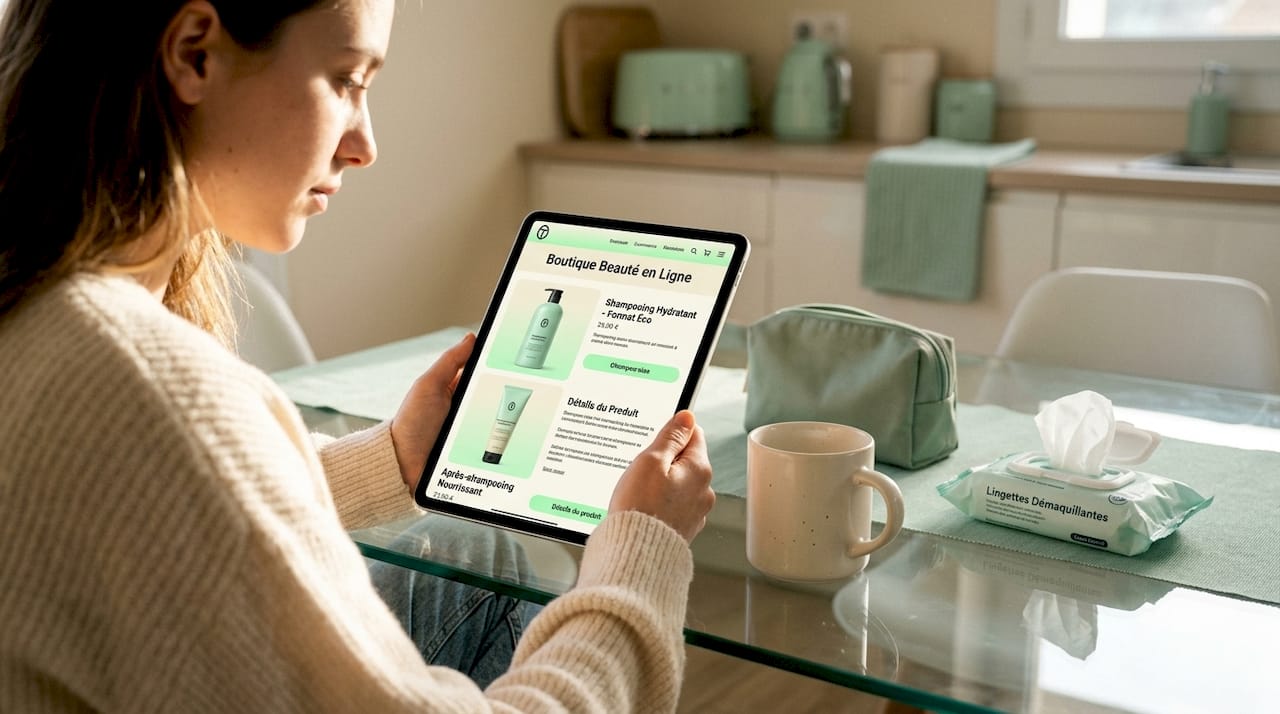
This involves offering a larger package of the same product. For example: a 250 ml shampoo that is also available in a 500 ml version or professional size. In beauty and cosmetics, offering a larger bottle or an enriched routine is one of the most natural and least intrusive approaches. The main advantage is its seamlessness: the customer does not have to compare different products, only quantities. The risk is minimal if the price difference remains reasonable.
2. An enriched routine or beauty bundle
Offering a complete routine (cleanser + toner + moisturizer) instead of a single product is a very powerful mechanic in beauty. It is an upsell disguised as expert advice. The customer perceives real added value: time savings, consistent active ingredients, and the promise of better results. The most effective beauty e-commerce strategies systematically include this bundle format on the product page or at checkout.
3. A complementary accessory (upsell-oriented cross-selling)
A facial brush offered with the purchase of a cleansing gel, or a silicone applicator suggested with a body cream. These proposals fall somewhere between upselling and cross-selling, but they directly increase the value of the product experience. They also enhance the brand's perception of expertise.
4. A premium version or subscription
Offering the organic, clean beauty, or premium version of a lotion sold in a standard version is a highly effective upsell for brands positioned around premiumization. Subscription offers (monthly delivery of a serum, exclusive VIP club access with a discount) build customer loyalty while increasing customer lifetime value.
5. Gift sets and limited editions
A seasonal "Winter Glow Ritual" gift set offered with the purchase of a day cream creates urgency and exclusivity. This type of upsell is particularly effective during Christmas, Mother's Day, or the beauty back-to-school season. It plays on the product's scarcity and emotional value.
All solutions for boosting sales depend on a deep understanding of these formats and their placement in the customer journey.
Pro tip: The effectiveness of upsells varies depending on the stage of the customer journey. Routine bundles work best on the product page. Larger sizes convert more at checkout. Seasonal gift sets are ideal post-purchase via email.
The average upsell acceptance rate is between 4% and 8%, with peaks of 8% to 15% pre-purchase and 3% to 8% post-purchase. When well-designed, an upsell program can generate an AOV (average order value) increase of 10% to 30%.
Comparison of key upsell types for beauty and wellness
To choose effectively, nothing beats a comparative overview. Here are the main types of upsells compared according to the criteria that really matter for a beauty or wellness brand.
| Upsell type | Key moment | Estimated acceptance rate | Impact on AOV | Implementation complexity | Risk of customer irritation |
|---|---|---|---|---|---|
| Larger size | Product page / checkout | 6% to 12% | Medium | Low | Very low |
| Enriched routine / bundle | Product page | 5% to 10% | High | Medium | Low |
| Complementary accessory | Checkout / cart | 4% to 8% | Medium | Medium | Low to medium |
| Premium version / subscription | Product page / post-purchase | 3% to 7% | Very high | High | Medium |
| Gift set / limited edition | Post-purchase / email | 4% to 9% | High | Medium | Very low |
Effective methodologies target RFM (recency, frequency, monetary) or LTV (lifetime value) segments, trigger offers based on precise behavioral signals (high cart value, browsing behavior), and systematically use A/B testing to refine results.
One critical point that is often underestimated: cognitive overload. Limiting options to 2 or 4 maximizes conversion. Offers exceeding 25% of the original price convert significantly less. And if an upsell is declined, a downsell offer (a cheaper version or trial size) can recover 10% to 20% of hesitant customers.
The most common mistakes to absolutely avoid are:
- Offering too early: an upsell pop-up as soon as a customer arrives on the product page is perceived as aggressive.
- Lack of consistency: offering a perfume when a customer purchases hair care creates confusion, not value.
- Ignoring mobile: more than 60% of beauty purchases are made on smartphones. A comparison table that is not mobile-friendly destroys conversion.
- Forgetting to test: what works for a luxury brand may not work for an affordable clean beauty brand.
Careful work on digital merchandising and beauty UX optimization is essential to ensure these proposals integrate seamlessly and naturally into the user experience.
Tips and mistakes to avoid for effective upselling
Theory is useful, but implementation makes the difference. Here are the concrete steps to deploy an effective upsell program in beauty and cosmetics.
- Analyze your current average order value before any deployment. Identify the best-selling products and those with the greatest potential for upgrades or bundles.
- Define your customer segments precisely. A customer accustomed to 80-euro orders is not the same target as a new visitor making a first purchase of 25 euros.
- Choose the right time and channel. Checkout for larger sizes, post-purchase email for subscriptions, and the product page for routine bundles.
- Write benefit-oriented copy, not price-oriented. “Complete your evening ritual” converts better than “Add this product at 15% off.”
- Always limit options to 2 or 4 to avoid decision paralysis.
- A/B test each proposal before rolling it out generally. Your customers' behavior is your best guide.
- Measure the impact on AOV, acceptance rate, and product return rate to validate its effectiveness.
Revenue from upselling and cross-selling accounts for 10% to 30% of e-commerce revenue. Amazon generates 35% from it. When combined intelligently, they can generate up to 22% in incremental revenue on an optimized store.
To boost beauty conversion, do not overlook post-refusal scenarios. This is often where beauty brands leave the most value on the table.
Pro tip: Set up automated email sequences for customers who declined an upsell at checkout. Offer them the same offer 48 hours later, with a trial size or a small discount. This post-purchase scenario recovers an average of 10% to 20% of lost conversions.
Why successful upselling requires a nuanced industry-specific approach
This is what we regularly observe among beauty brands that contact us after trying to deploy upselling tactics from other industries: they applied generic formulas and obtained disappointing results, sometimes even negative customer feedback.
Upselling in beauty is not the same as upselling in tech or food. The relationship between a woman and her skincare products is emotional, ritualized, and often very personal. Offering her a product that does not match her routine or values (naturalness, luxury, affordability) creates dissonance that damages trust in the brand.
For beauty and wellness, skincare routine bundles and premium subscriptions work particularly well, but on one condition: logistics must deliver on the promise. If a customer orders a complete routine before an event and the delivery fails, the upsell becomes a major point of friction, not an advantage.
We advocate an approach where beauty branding strategy guides upsell choices as much as data does. The numbers say how much, but they do not always say why a customer accepts or declines. It is this qualitative understanding, informed by field feedback, testing, and industry expertise, that truly makes the difference.
Criticizing “one size fits all” approaches is not a luxury. It is a necessity in an industry where brand image is often more valuable than immediate margin. A poorly positioned upsell can cost far more than a missed sale: it can erode trust built over several years.
Move to effective upselling with Tamara Agency
You now have a clear view of the available types of upsells, selection criteria, and mistakes to avoid. But concrete implementation is where many beauty brands struggle: how to integrate these mechanics into a Shopify store without breaking the user experience or brand identity?

At Tamara Agency, we have been helping beauty, cosmetics, and wellness brands since 2018 create and optimize Shopify stores designed to perform. Our Tamara Agency services cover the strategic integration of upsell and cross-sell mechanics, from UX design to technical configuration. Whether you want to join our Shopify e-commerce training to gain independence or entrust the beauty store creation to our team, we have the right solution for your level and ambitions.
Frequently Asked Questions About E-commerce Upselling
What is the difference between upselling and cross-selling in e-commerce?
Upselling involves offering a superior or premium version of a product, while cross-selling recommends a product complementary to the one selected, increasing the number of items in the cart.
When should an upsell be placed in the customer journey?
The best times according to behavioral signals are checkout, the cart page, or just after purchase, targeting specific segments such as high-cart-value customers or loyal profiles.
What is the average upsell acceptance rate?
The average rate is between 4 and 8%, with peaks reaching 8 to 15% before payment and 3 to 8% in a post-purchase sequence, for an AOV impact of 10 to 30%.
How many upsell options should be offered to avoid losing the conversion?
Limiting to a maximum of 2 or 4 options is the rule to avoid cognitive overload and maintain an optimal conversion rate throughout the entire journey.