

Transparency in e-commerce: guide for beauty brands
TL;DR:
- Transparency in beauty e-commerce is a performance driver that builds trust and enhances brand value. Proactively managing customer reviews, ensuring ingredient traceability, and using blockchain strengthen credibility and differentiation. Adopting honest, authentic communication fosters long-term loyalty and significantly improves profitability.
Many beauty and wellness brands view transparency as a risk. Disclosing ingredients, displaying mixed reviews, revealing their supply chain—these decisions can seem to expose vulnerabilities. The exact opposite is true. Understanding why transparency in e-commerce is now a performance driver requires a paradigm shift: it doesn't weaken your image; it builds it. This guide provides practical keys to turning it into a measurable competitive advantage.
Table of Contents
- The impact of transparent customer reviews on trust and sales
- Supply chain transparency: a key criterion for beauty brands
- Blockchain as a transparency tool and innovation driver
- Managing negative reviews transparently: a loyalty driver
- Comparative summary: key challenges and benefits of transparency
- Why a transparent ecosystem goes beyond mere regulatory requirements
- Discover our services for a transparent and high-performing beauty e-commerce store
- Frequently asked questions about transparency in beauty e-commerce
Key Points
| Point | Details |
|---|---|
| Essential transparency | Consumers demand strong transparency to trust online beauty brands. |
| Crucial customer reviews | Transparent customer reviews strongly influence purchasing decisions and revenue. |
| Supply chain | Product traceability and origin are major criteria for avoiding greenwashing and justifying prices. |
| Review responses | Responding honestly to reviews, especially negative ones, builds trust and boosts conversions. |
| Innovative blockchain | Blockchain offers tamper-proof transparency that humanizes the brand and enhances its supply chain. |
The impact of transparent customer reviews on trust and sales
Social proof is not optional in 2026. It is the foundation of every online purchasing decision, especially in the beauty and wellness sectors, where the sensory experience of the product is absent. Your customers cannot smell your serum or test your moisturizer before ordering. They therefore rely on the experiences of others.
The figures speak for themselves: 93% of French people read customer reviews before making an online purchase, and 83% abandon their cart due to negative reviews, according to the Ifop study for Guest Suite in January 2026. This is not a trend; it is a structural reality of online commerce.
93% of French consumers read customer reviews before buying online. Social proof has become the leading decision factor in beauty.
What is less often said: the direct financial value of a review. Each positive review generates an average of €7 to €11 in additional revenue, while an unaddressed negative review can cost up to €12. Managing your reviews is therefore an investment, not an administrative burden.
What beauty consumers are really looking for in reviews:
- A variety of experiences: dry, combination, and sensitive skin, different skin types
- Concrete details: texture, absorption, longevity, compatibility with other skincare products
- Visible negative reviews, proof that the brand does not censor feedback
- Brand responses, which attest to an active and sincere customer relationship
The classic mistake is to publish only perfect ratings. However, the most effective Shopify beauty e-commerce solutions incorporate review systems that display the full picture. A rating of 4.2/5 with 200 varied reviews converts much better than a rating of 5/5 with 12 unanimously positive reviews. Buyers no longer believe in perfection. They believe in authenticity.
To go even further in your beauty digital strategy, consider working with digital marketing agencies in Courbevoie specializing in online reputation management.
Supply chain transparency: a key criterion for beauty brands
Beyond customer reviews, supply chain transparency enhances your brand's credibility and perceived value. This dimension is often underestimated, yet it is becoming a leading purchasing criterion.
Consumers scrutinize the carbon footprint and origin of products, which has become critical for avoiding greenwashing in beauty. This term, greenwashing, refers to any misleading environmental communication. Beauty and wellness customers in 2026 have developed a highly attuned radar for detecting it. A vague claim such as "natural formula" without concrete proof does more harm than good.
The data that should convince even the most skeptical: 73% of consumers are willing to pay more for products with transparent origins. This gives you a direct argument to justify a premium positioning.
What you can concretely display on your store:
- The geographic origin of each main ingredient
- The name of your suppliers or agricultural partners, along with their story
- The certifications (Ecocert, COSMOS, Cruelty-Free) with links to the certifying bodies
- Your packaging policy: recycled materials, refillable, zero waste
- The clinical or dermatological tests conducted, along with their results
For brands that do this work, traceability becomes a marketing argument in its own right. It is no longer a generic "About Us" page; it is brand storytelling. The challenges of ethical e-commerce for beauty brands go far beyond compliance: they shape your identity.
Pro tip: On your Shopify store, create a page dedicated to your "ingredient transparency" with an interactive map showing the origin of your raw materials. It is one of the best-performing pages for natural search rankings for queries related to beauty e-commerce challenges, and it builds strong trust on the first visit.
For brands looking to deepen their local or sector-specific SEO approach, SEO agencies in Beauvais can help improve your visibility for niche queries.
Blockchain as a transparency tool and innovation driver
To go further, let's discover how technology is transforming transparency into a real commercial strength. Blockchain is not reserved for cryptocurrencies. In beauty, it represents the most reliable tool for ensuring tamper-proof traceability, from the botanical source to the package delivered to your customer.
The Clarins case is exemplary. The brand uses blockchain to trace 120 plants and more than 100 formulas, ensuring 90% of shipments in less than 24 hours thanks to a fully transparent supply chain.
"Supply chain transparency is no longer a plus; it is a brand promise that consumers verify."
What this approach concretely produces:
- Enhanced trust: each customer can check the origin of an ingredient in a few seconds from the product page
- Competitive differentiation: very few mid-market beauty brands in France have crossed this threshold
- Reduced complaints: when information is accessible, doubts evaporate before they even become objections
- Loyalty driver: customers who understand your process become natural brand ambassadors
For smaller brands, there is no need to deploy a full blockchain from the start. A gradual approach based on beauty e-commerce data allows you to structure product information rigorously before considering advanced technological traceability.
What you can do right now:
- Document each ingredient precisely with its source and role
- Integrate a QR code on your product pages linking to a traceability page
- Adopt a supply chain management tool that centralizes this data
- Highlight this approach in your beauty e-commerce branding to create a consistent brand identity
Managing negative reviews transparently: a loyalty driver
After exploring technology, it is crucial to master customer relationships via reviews to maximize the impact of transparency. A negative review visible on your store is not an admission of failure. It is proof of honesty.
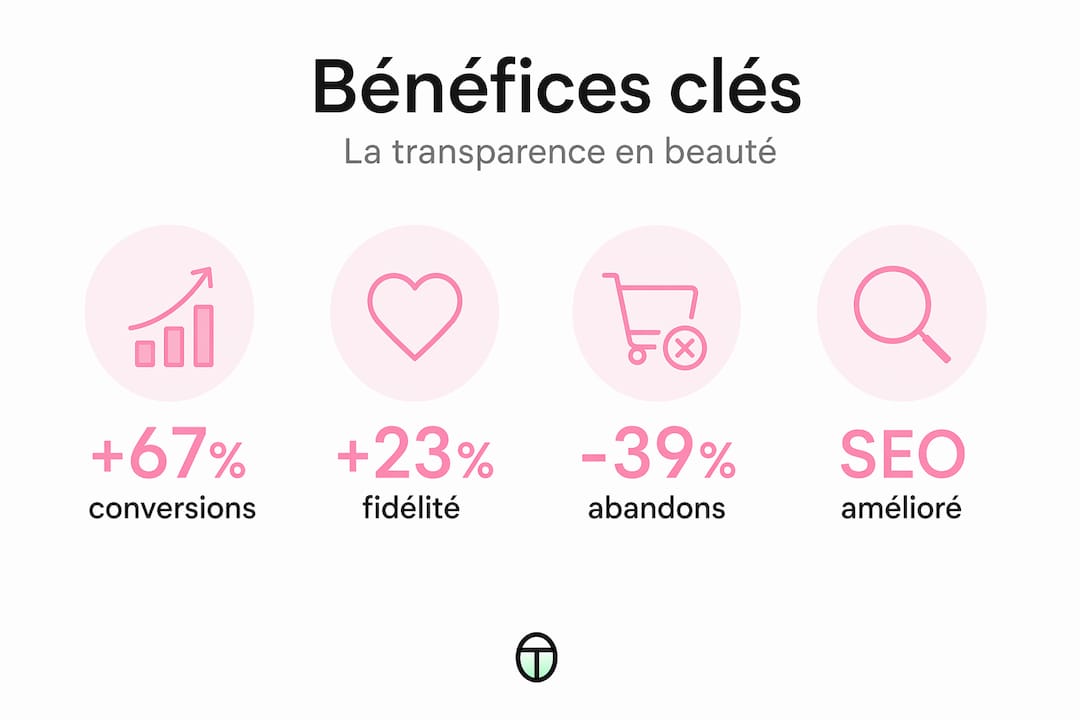
The data that changes everything: responding to 75% of reviews, prioritizing negative ones, boosts conversions by up to 67%. And 91% of buyers check the brand's responses before making their final decision.

Managing negative reviews is your customer service showcased publicly. Every response you write is not only addressed to the dissatisfied customer. It speaks to all those who read the reviews before buying.
How to respond to a negative review transparently:
- Respond within 48 hours: responsiveness shows the brand's commitment
- Name the problem without downplaying it: avoid hollow phrases such as "We are sorry for your experience"
- Explain what happened if relevant, or frankly acknowledge the shortcoming
- Offer a concrete solution: refund, exchange, direct contact
- Conclude positively without forcing it, by showing that the feedback improves your practices
Pro tip: On Shopify, integrate an automatic alert system to be notified as soon as a review under 3 stars is published. Addressing these reviews quickly in the first few hours maximizes their positive impact on conversion. Beauty e-commerce UX also includes how reviews are displayed: a well-thought-out design highlights brand responses and strengthens the perception of a caring customer relationship.
This active management is part of the Shopify beauty strategies that transform an ordinary store into a trusted brand.
Comparative summary: key challenges and benefits of transparency
With these keys in hand, here is a summary vision to help you prioritize actions. Transparency impacts all marketing, logistics, and customer relationship levers in beauty and wellness. It is not an isolated action; it is a system.
| Transparency dimension | Main impact | Measurable benefit |
|---|---|---|
| Visible and varied customer reviews | Trust and conversion | +67% conversions with active responses |
| Ingredient traceability | Perceived value and premium pricing | 73% willing to pay more |
| Responses to negative reviews | Loyalty and reputation | Up to €12 in avoided loss per addressed review |
| Blockchain and supply chain | Differentiation and innovation | 90% of shipments in under 24 hours (Clarins) |
| Greenwashing-free communication | Credibility and brand image | Long-term reputation protection |
What transparency produces beyond the numbers:
- It tells a consistent brand story, not just a product catalog
- It reduces customer service inquiries, thus operational costs
- It improves your natural search ranking, as pages rich in real and verifiable content are favored by Google
- It creates a lasting emotional bond with your customers, who become brand ambassadors
To understand how all this translates to your bottom line, explore reflections on beauty e-commerce profitability and the key beauty e-commerce challenges specific to your sector.
Why a transparent ecosystem goes beyond mere regulatory requirements
Here is what we have observed after years of supporting beauty and wellness brands on Shopify: brands that treat transparency as a regulatory constraint do the bare minimum. Those that experience it as an ethical positioning build something infinitely more powerful.
Transparency addresses post-marketing distrust by rebalancing information asymmetry and aligning purchases with consumers' ethical values. In other words: your customers know they are subjected to constant advertising pressure. When you offer them clarity instead of promises, they trust you differently. More deeply.
What most articles don't say: transparency also improves your natural search engine ranking. A well-documented "Our Ingredients" page, a product page with detailed reviews, a clear return policy: all of this generates unique, verified content that Google values significantly more than generic text.
The real question is not "how much does it cost to become transparent?" but "what is the cost of not being transparent?" In a saturated market where every beauty brand claims to be natural, effective, and committed, e-commerce ethics and transparency are what separate brands that last from those that fade away.
Integrating transparency into your branding and transparency means deciding that your brand has something true to tell. And that is something no algorithm can replace.
Discover our services for a transparent and high-performing beauty e-commerce store
Implementing real transparency on your store cannot be done overnight. It requires a UX architecture designed for trust, technical integrations adapted to reviews and traceability, and a brand identity consistent with your commitments.

At Tamara Agency, since 2018, we have supported demanding beauty and wellness brands in the creation and redesign of their Shopify stores. Our services cover the entirety of your project: from strategy to launch, including UX/UI and technical development. Whether you want to launch your Shopify store creation or build your skills through Shopify training, we have the right solution. Contact us for a personalized audit of your e-commerce store.
Frequently asked questions about transparency in beauty e-commerce
Why has transparency become essential in beauty e-commerce?
Beauty consumers today want to ensure the origin, quality, and sincerity of brands before buying. 73% of them are willing to pay more for products whose origin is clearly communicated, making transparency a driver of perceived value and lasting loyalty.
How do customer reviews influence online sales?
Transparent and varied customer reviews build confidence in the purchasing decision and reduce cart abandonment. 83% of French people abandon a purchase after reading negative reviews, which shows the importance of actively managing them rather than ignoring them.
Why should you respond to negative reviews?
Responding to negative reviews directly improves the perception of your brand and turns dissatisfied customers into loyal buyers. Responding to 75% of negative reviews can increase your conversions by up to 67%, making it one of the most profitable actions in your e-commerce management.
How is blockchain useful for transparency in beauty?
Blockchain allows for reliable and tamper-proof traceability, reassuring consumers who doubt marketing claims. Clarins, for example, traces 120 plants and more than 100 formulas thanks to this technology, guaranteeing a fully transparent supply chain from the field to the customer.
How to improve transparency without harming the brand image?
Adopting honest communication, displaying varied customer reviews, and highlighting the traceability of your ingredients strengthens your credibility rather than weakening it. A site that displays critical reviews inspires more trust than a site with uniformly perfect ratings, because buyers know how to distinguish authenticity from marketing talk.