

Online fashion trends: boost your Shopify store
TL;DR:
- Adopting online fashion trends allows you to anticipate seasonal demand and optimize sales on Shopify.
- It is crucial to filter these trends to strengthen brand positioning and avoid saturation.
Adopting online fashion trends is not just about offering the right colors or the right cuts for the season. It is an e-commerce performance lever that is often poorly exploited, sometimes even underestimated by the most experienced Shopify store managers. Yet, AI-based demand forecasting directly guides the optimization of Shopify stores, adapting inventory to trends to maximize seasonal sales. This article provides you with concrete keys to transform your trend monitoring into a real growth engine.
Table of Contents
- Why online fashion trends are essential in e-commerce
- Trend analysis: data, AI, and reality on the ground
- Shopping styles, mobile, and dominant platforms: grasping the nuances
- From monitoring to application: best practices to stay relevant
- Our perspective: why following trends is not enough (and how to go further)
- Optimize your fashion & beauty Shopify store with tailored support
- Frequently Asked Questions
Key Points
| Point | Details |
|---|---|
| Trends, performance driver | Fashion trends structure demand and make it possible to optimize the offer and conversion on Shopify. |
| AI and data, key allies | AI integrated into Shopify simplifies monitoring and forecasting to act quickly and better. |
| Mobile experience priority | Capturing the majority of customers today requires a mobile-focused strategy. |
| Selection and agility | Not all trends are equal: you must choose, test, and constantly adjust. |
Why online fashion trends are essential in e-commerce
Fashion trends are not just aesthetic phenomena. They structure demand, guide purchases, and above all, they follow a precise seasonal logic that every e-commerce manager can anticipate. A color that emerges on the runways in January appears in Google searches in March and in shopping carts in May. This cycle is predictable. And this predictability is a massive competitive advantage.
The evolution of purchasing behaviors further amplifies this issue. Generation Z and millennials are today the dominant buyer profiles online. They consume fashion information in real time, via social networks, micro-influencers, and streaming platforms. Their purchasing decision cycle is short, sometimes impulsive, always connected. Meeting their expectations requires a responsiveness that only structured trend monitoring can guarantee.
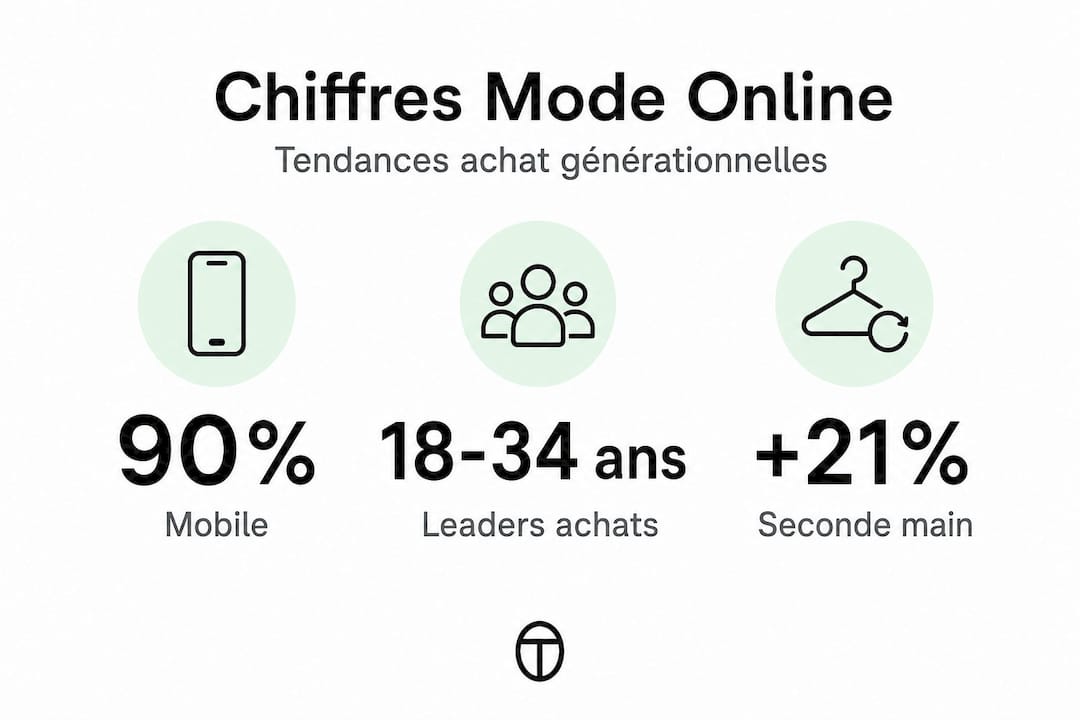
The Fevad 2025 benchmarks are telling: online fashion sales are growing by +1.5% over 9 months, digital now represents 30.7% of clothing consumption, and 18 to 34 year olds account for 34.7% of online purchases. These are not just statistics: they draw a precise map of opportunities to seize.
The virtuous circle is simple but powerful:
- Anticipate trends thanks to data and weak market signals
- Adapt the product offer upstream, before the competition
- Improve conversion by offering exactly what your audience is looking for
- Build loyalty by becoming the reference in your segment
“A site must perform as much as it seduces.” This conviction, we translate for each client into a concrete strategy: understand trends to better transform them into sales.
The influence of beauty trends follows exactly the same logic, just like the beauty e-commerce challenges which share with fashion a strong dependence on seasonality and image. The fashion aesthetic approach also confirms that visual codes and purchasing behaviors are closely linked in these sectors.
Trend analysis: data, AI, and reality on the ground
After having identified why trends are crucial, let's look at the tools and data that make them usable on a daily basis. Because between observing a trend and effectively integrating it into your product and commercial strategy, there is a gap that many brands do not cross.

Shopify has considerably strengthened its analytical capabilities in recent years. According to the Shopify AI features, the platform now integrates several intelligent modules: Shopify Magic for the automatic generation of SEO-optimized product descriptions, and Sidekick, an AI assistant that analyzes your performance data and gives you insights on current trends in your sector. Demand forecasting, meanwhile, relies on algorithms capable of anticipating consumption peaks with increasing precision.
Concretely, here is how a fashion e-commerce manager can use these tools on a daily basis:
| Tool | Main use | Concrete gain |
|---|---|---|
| Shopify Magic | Product description generation | Writing time savings, optimized SEO |
| Sidekick | Trend and performance insights | Data-based inventory decisions |
| AI demand forecasting | Anticipation of seasonal peaks | Reduction of stockouts and overstock |
| Integrated Google Trends | Real-time monitoring | Increased responsiveness to new trends |
A practical case to illustrate: a women's ready-to-wear brand that notices via Sidekick an increase in searches around “floral maxi dresses” as early as February can anticipate its restock for March, create editorial content in advance, and launch a targeted email campaign at the right time. Result: it captures demand before its competitors react. This is exactly the type of agility we help our clients build.
The use of beauty data follows the same principle: analyze weak signals to make quick and relevant offer decisions. Beauty sales solutions also rely on these same continuous optimization logics.
Pro tip: Activate the demand forecasting feature in Shopify now, even if your catalog is still limited. The more historical data the tool collects, the more reliable its forecasts will be. Start early to benefit from a real advantage from the next key season.
Shopping styles, mobile, and dominant platforms: grasping the nuances
After seeing how AI and data fuel the exploitation of trends, it turns out essential to nuance according to channels and generations. Because the same trend is not consumed in the same way depending on whether the buyer is on mobile, on a marketplace, or on your Shopify store.
The Eskimoz barometer reveals a contrasting reality: fashion searches are down 2% in 2025, but Vinted captures 24% of market share and Zalando 22%. Ultra fast-fashion embodied by Shein continues to disrupt the traditional market. Faced with this concentration of usage on a few dominant platforms, Shopify brands must find their uniqueness and not try to play on the same field.
Here are the priorities to remember by channel for your Shopify strategy:
- Mobile as an absolute priority: 90% of fashion searches are done on mobile. Your store must be flawless in this format, not just “responsive” but truly designed mobile-first.
- Instagram and TikTok as trend sources: These platforms precede purchases. A product that does well on TikTok generates searches on Google 48 to 72 hours later.
- Marketplace vs. own store: Vinted and Zalando attract by price and volume. Your Shopify store must attract by experience, storytelling, and customer relationship.
- Second-hand as a background trend: It represents today a significant part of online fashion sales, especially among women. To be integrated into your positioning thinking.
| Channel | Market share / Usage | Priority for Shopify |
|---|---|---|
| Mobile | 90% of fashion searches | Essential UX optimization |
| Vinted | 24% of fashion traffic | Differentiation by experience |
| Zalando | 22% of fashion traffic | Possible complementarity |
| TikTok/Instagram | Trend precursors | Monitoring and responsiveness |
Generational contrasts are also decisive. 18 to 34 year olds, overrepresented in online fashion purchasing, expect fluidity, speed, and visual consistency. They compare in a few seconds. A slow product page or an outdated design is enough to make them leave. Conversely, 35 to 50 year olds value trust, clarity of information, and quality of customer service more.
The mobile dominance in beauty e-commerce follows exactly the same dynamics. And the Shopify cosmetic trends 2026 confirm that the mobile-first requirement is imposing itself as a non-negotiable standard in these sectors.
From monitoring to application: best practices to stay relevant
The fine understanding of channels and buyer profiles allows you to go further. Now, let's move to concrete action on Shopify. Identifying trends is one thing. Translating them into quick and effective operational decisions is another, often more complex.
Here are the practices we recommend to our clients to maintain an effective and actionable trend monitoring:
- Automate your monitoring with Google Trends, fashion keyword alerts, and Sidekick weekly reports. The goal is to reduce the detection time of an emerging trend to less than 48 hours.
- Integrate social listening into your routine. Tools like Mention or the native analytics of TikTok and Instagram allow you to capture signals before they become mainstream trends.
- Set up an agile content calendar: do not plan everything 3 months out. Keep 30% of your editorial capacity to react to trends in real time.
- Test new formats: social commerce (buying directly via Instagram or TikTok), augmented reality for virtual try-on, and limited edition capsule collections are all levers to test according to your audience.
- Monitor your Core Web Vitals continuously. The technical performance of your Shopify store directly conditions your mobile visibility and your conversion rate.
The recommendations of online shopping trends from Shopify are clear for fashion and beauty leaders: prioritize AI forecasting integrating Google Trends and social data to optimize your safety stock and automate replenishment. Brands that have adopted this approach reduce their stockouts by 30 to 40% during high seasonality periods.
Pro tip: Do not treat trend monitoring as a side task delegated to an intern. Integrate it into your monthly decision process, on par with the sales report. Trend insights should directly feed your purchasing, content, and merchandising decisions.
The beauty digital strategy follows exactly this principle: monitoring and continuous adaptation are the pillars of sustainable e-commerce performance.
Our perspective: why following trends is not enough (and how to go further)
At Tamara Agency, we have been working with fashion and beauty brands since 2018. And one of the mistakes we most often observe in brands that stagnate is following the crowd. Mechanically reproducing what works for market leaders is a strategy that exposes you to two major risks: saturation and loss of identity.
When a trend is already everywhere, it is already dying. Brands that copy it arrive too late, with too little uniqueness, and find themselves in direct competition with players who have far superior resources. It is a battle lost in advance.
What we have learned is that brands that really perform do not follow trends: they filter them. They know which trend speaks to their specific audience, which one strengthens their positioning, and which one is just a mass effect without relevance for their brand territory. This selection ability is a strategic skill, not an innate talent.
There is also a local dimension often neglected. A trend that explodes in the United States or Asia can take 6 to 12 months to reach the French market. And sometimes, it never really reaches it. Knowing the cultural specificities of your target market is therefore just as important as following global trends.
Finally, brands that build sustainable performance on Shopify adopt a permanent test-and-learn posture. They test a new content format on a limited collection, measure engagement, adjust, then deploy. They do not bet everything on a single trend. They build an adaptation capacity that is worth much more than a good seasonal intuition.
The Shopify cosmetic e-commerce trends 2026 clearly illustrate it: the brands that progress are those that combine a strong aesthetic vision and operational agility. Not those that run after every novelty.
Optimize your fashion & beauty Shopify store with tailored support
After this perspective, support your strategy with expert partners capable of translating trends into concrete results. Understanding trends is one thing, embodying them in a high-performing, elegant, and optimized Shopify store is another.

At Tamara Agency, we support ambitious brands in creating fashion Shopify stores and beauty Shopify stores, with an approach that integrates trend, conversion, and mobile experience logic from the design stage. We do not deliver generic stores: we build custom experiences, designed for your audience and your positioning. If you would like a personalized assessment of your Shopify store and concrete recommendations to align your offer with the trends that truly matter for your market, contact us.
Frequently Asked Questions
What AI tools are available on Shopify to detect fashion trends?
Shopify Magic, Sidekick, and AI-powered demand forecasting allow you to identify and capitalize on trends in real time, directly from your Shopify dashboard.
Why is mobile essential for fashion and beauty e-commerce?
Mobile accounts for 90% of fashion searches, making a flawless mobile experience absolutely essential to effectively capture and convert your visitors.
Is second-hand a truly profitable trend on Shopify?
Yes, second-hand represents 18% of online fashion sales (21% among women), confirming the real potential of this segment for brands that want to expand their offer or attract new types of buyers.
How to adapt your inventory based on seasonal trends on Shopify?
Integrating AI data and demand forecasting allows you to anticipate consumption peaks and readjust your offer just-in-time, well before stockouts impact your sales.
Should you follow all fashion trends or select some?
Selecting the trends relevant to your target audience and positioning yields much better results than adopting them all: your brand's uniqueness is strengthened, and your offer remains consistent and desirable.