

Beauty digital strategy: boost Shopify conversion and sales
TL;DR:
- Digital performance relies on an omnichannel strategy and an optimized user experience on Shopify.
- Key drivers include subscriptions, bundling, UGC, social commerce, and AI to increase sales and retention.
- Sustainable growth requires balancing technology, customer relationships, and differentiation by using first-party data.
A good product is no longer enough. The beauty brands dominating their market in 2026 owe this not only to their formulas or packaging. They have understood that commercial performance relies on a rigorous digital strategy, and that Shopify is now the best platform to deploy it. With an average conversion rate of 2.2 to 3.5% for beauty stores on Shopify, the difference between an ordinary brand and a high-performing brand often lies in the details of the digital experience. Here is the strategic roadmap we apply with our clients to turn interest into sales and buyers into brand ambassadors.
Table of Contents
- Understanding the challenges and trends of digital in beauty
- Pillar 1: Optimizing the user experience for beauty on Shopify
- Pillar 2: Conversion strategies: bundles, subscriptions, and UGC
- Pillar 3: Growth and acquisition: influence, campaigns, and data
- Our take: where most beauty brands get digital wrong
- Accelerate your digital growth with Tamara Agency
- Frequently Asked Questions
Key Points
| Point | Details |
|---|---|
| Growing market | Beauty e-commerce is worth over $580 billion, and the online share is exploding thanks to personalization. |
| Decisive user experience | A fast, mobile-first, and personalized site can double the conversion rate, according to top Shopify players. |
| Advanced conversion methods | Bundles, subscriptions, UGC, and AR are proven drivers to boost average order value and repeat purchases. |
| Effective multichannel acquisition | Influence, Audience campaigns, and data-driven personalization scale acquisition with measurable ROI. |
| Think long-term | The future lies in mastering your data, building loyalty, and a human-technology mix that adapts beauty to new consumers. |
Understanding the challenges and trends of digital in beauty
The beauty sector is one of the most dynamic in global e-commerce. The online beauty market exceeds $580 billion, and subscriptions already represent 25 to 45% of the revenue of the most advanced skincare brands. This is not an anecdotal trend. It is a structural transformation of the relationship between brands and their customers.
Today's beauty consumers are demanding, informed, and mobile. They expect transparency about ingredients, personalization in recommendations, and a frictionless shopping experience. According to data, 71% of consumers expect personalization in their digital journey. Ignoring this expectation is leaving the door open to your competitors.
Here are the major trends reshaping the sector:
- Clean and inclusive beauty: customers want brands that reflect them and stand by their values
- Social commerce: TikTok Shop, Instagram Shopping, and live commerce are becoming major acquisition channels
- Subscriptions and routines: recurring revenue is the new holy grail of profitability
- AI and augmented reality: virtual try-on and personalized recommendations reduce purchase hesitation
- Omnichannel: customers move from mobile to computer, from Instagram to the physical store without wanting to lose the thread
"A site must perform as much as it seduces." This has been our conviction since 2018, and beauty market figures confirm it more and more every year.
For brands looking to go further, our beauty e-commerce solutions on Shopify incorporate these trends from the design phase. And if you want to strengthen your brand identity at the same time, our approach to beauty branding strategy will give you a solid foundation. For brands that also have a physical presence, local visibility for institutes remains a complementary lever not to be overlooked.
| Trend | Impact on revenue | 2026 priority |
|---|---|---|
| Skincare subscriptions | +25 to 45% of revenue | High |
| Social commerce | +20% new customers | High |
| AI personalization | +15 to 30% conversion | Medium to high |
| AR try-on | Reduced returns, +20% CVR | Medium |
Pillar 1: Optimizing the user experience for beauty on Shopify
UX (user experience) is the primary conversion driver. Even before talking about marketing or acquisition, your store must be fast, clear, and pleasant to browse on mobile. This is non-negotiable.
The numbers speak for themselves. After migrating to Shopify, Dermalogica recorded a +45% conversion rate. The French brand La Rosée, meanwhile, obtained +53% CVR, +88% purchases, and a 40% reduced loading time. These results are not a matter of chance. They stem from a methodical approach to optimization.
Here are the critical points to master:
- Mobile-first: more than 70% of beauty visits are done on smartphones. Every element must be designed for this format first
- Loading time under 2.5 seconds: beyond that, the abandonment rate rises sharply
- Intuitive navigation: clear category hierarchy, relevant filters, visible sticky cart
- Micro-interactions: light animations, visual confirmations, smooth transitions that reinforce trust
- Images optimized via CDN: maximum visual quality without sacrificing speed
- Simplified checkout: fewer steps, more conversions
"Beauty is also what the customer feels when browsing your site. One friction, and she leaves."
Pro tip: Use Shopify Flow to automate abandoned cart reminders, stock alerts, and post-purchase emails. These automations free up time while improving the customer experience without additional effort.
To go further, our guide on beauty e-commerce UX optimization details the best Shopify practices. You can also consult our high-performance design checklist before any audit. And if your current store accumulates technical hurdles, a beauty Shopify redesign can quickly change the game.
Pillar 2: Conversion strategies: bundles, subscriptions, and UGC
Once the user experience is solid, you need to activate the mechanics that increase the value of each order and encourage repeat purchases. This is where the highest-performing beauty brands widen the gap.
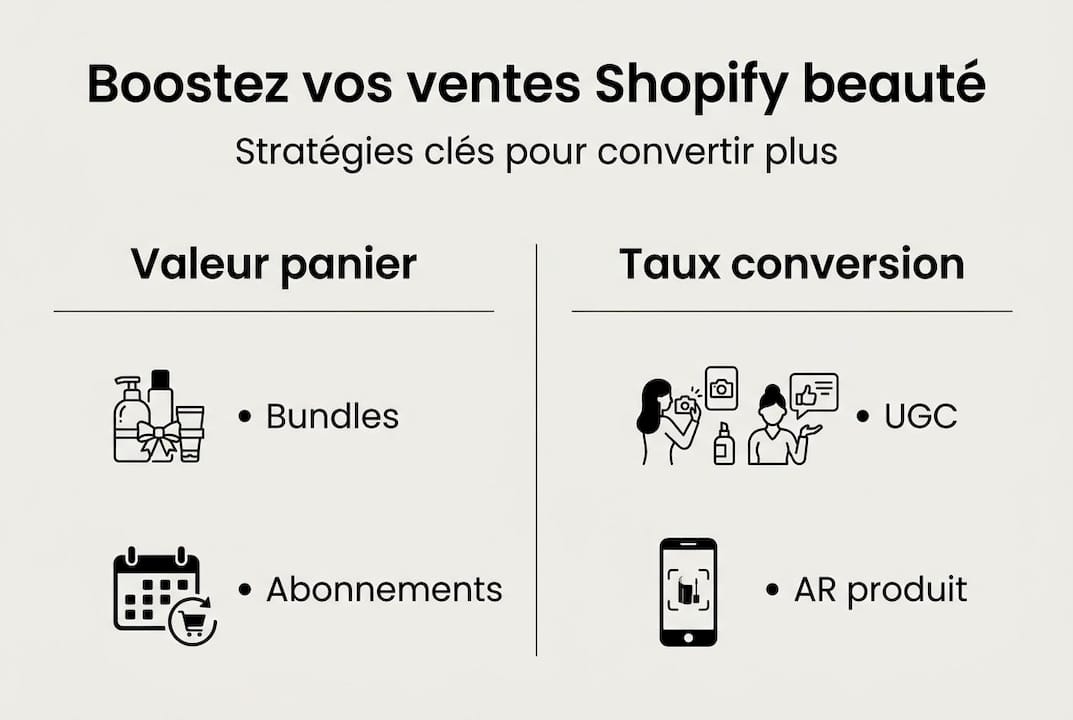
Routine bundling is one of the most effective drivers. By offering coherent sets (cleanser + serum + cream), you guide the customer toward a complete use of your range. Result: bundling increases AOV by 30 to 45%, and reduces dependence on aggressive promotions.
Subscriptions turn a one-time purchase into a lasting relationship. Wild, the natural cosmetics brand, achieved 8% CVR and 40 to 50% of its revenue via subscriptions, for a turnover of 65 million pounds sterling. This model brings predictability and retention, two pillars of long-term profitability.
Here are the drivers ranked by impact:
- Bundles and routines: immediate AOV increase, better product discovery
- Subscriptions: recurrence, high LTV, revenue predictability
- UGC (user-generated content): reviews, before/after photos, customer videos. UGC improves conversion by 30 to 45% on product pages
- AR try-on (augmented reality): allows virtually trying a product and increases CVR by 20 to 30% while reducing returns
| Driver | AOV Impact | CVR Impact | Complexity |
|---|---|---|---|
| Routine bundles | +30 to 45% | Moderate | Low |
| Subscriptions | Stable | +8% CVR | Medium |
| UGC | Moderate | +30 to 45% | Low |
| AR try-on | Moderate | +20 to 30% | High |
Pro tip: Integrate UGC directly on product pages via dedicated Shopify apps. Photos of real customers convert better than studio visuals, because they answer the question all buyers ask themselves: "Does it really work on me?"
To go deeper into these mechanics, explore our techniques to increase Shopify sales and discover how micro-interactions for conversion can amplify each of these drivers.
Pillar 3: Growth and acquisition: influence, campaigns, and data
A well-optimized store without qualified traffic remains an empty store. The scalable growth of a beauty brand relies on three engines: influence, data-driven campaigns, and personalization.
Influence is the number one discovery channel in beauty. The 67% of beauty discoveries are done via influencers, and micro-influencers (between 10,000 and 100,000 followers) generate the best return on investment. Why? Because their community trusts them. Their recommendation looks like a friend's advice, not an advertisement.
Live commerce and social commerce (TikTok, Instagram Reels) accelerate this phenomenon. A live demonstration of a treatment or makeup can generate immediate sales spikes and create a natural sense of urgency.
On the paid campaigns front, Shopify Audiences and Shop Campaigns are game changers. La Rosée recorded a 15% CAC decrease, a 6% ROAS increase, and a 140% revenue growth thanks to these native tools. These results show that first-party data (proprietary data collected directly from your customers) is a major strategic asset.
Key points for profitable acquisition:
- Prioritize micro-influencers for the quality/cost ratio
- Activate Shopify Audiences to target profiles similar to your best customers
- Deploy personalization quizzes to collect data and recommend the right products
- Use AI recommendations to increase LTV (customer lifetime value) at every visit
+140% revenue in three months thanks to Shopify Shop Campaigns. This is not an exception. This is what a well-calibrated acquisition strategy allows.
If you are considering changing platforms to benefit from these tools, our guide on beauty store migration accompanies you step by step.
Our take: where most beauty brands get digital wrong
We have been supporting beauty brands since 2018, and we always observe the same mistakes. The most frequent? Believing that a single optimization is enough. A graphic redesign without data work. An influence campaign without a retention system. A beautiful site without a subscription or repurchase strategy.
The truth is that sustainable performance relies on a balance between three dimensions: technology, customer relationship, and differentiation. Brands that underestimate their first-party data lose a gold mine. They do not know who is really buying, why, or when to follow up.
The other mistake that few articles dare to name: neglecting the human element. Shopify tools are powerful, but what builds loyalty with a beauty customer is also the way you talk to her, the consistency of your universe, and the feeling of belonging to a community. Technology amplifies a strategy. It does not replace it.
Our clients who get the best results on beauty e-commerce performance are those who invest as much in their value proposition as in their technical stack.
Accelerate your digital growth with Tamara Agency
You now have a clear vision of the drivers that make the difference for a beauty brand on Shopify. But knowing the roadmap and implementing it are two very distinct things.

Since 2018, we have been supporting ambitious beauty and cosmetic brands on Shopify, from strategy to execution. Audit of your current store, creation or redesign of a beauty Shopify store, or Shopify conversion optimization targeted at your friction points: we build with you a store that performs as much as it seduces. Each project is custom-made, each decision is guided by data and the aesthetic requirement specific to your universe. Let's talk about your brand.
Frequently Asked Questions
What is the average conversion rate for a beauty store on Shopify?
The Shopify beauty conversion rate varies between 2.2% and 3.5% depending on the segments, with skincare leading at 2.5 to 3.5%. This figure can be significantly improved thanks to optimized UX and tailored conversion mechanics.
How to increase AOV and the repeat rate for my brand?
By creating routine bundles and offering subscriptions, you can increase AOV by 30 to 45% and encourage repeat purchases from the first few weeks of deployment.
Do UGC and augmented reality really boost conversion?
Yes: UGC improves conversion by 30 to 45% on product pages, and AR adds 20 to 30% to CVR while measurably reducing product returns.
Why do micro-influencers offer a better ROI in beauty?
Micro-influencers generate a better ROI because their community is more engaged and their recommendation is perceived as authentic, for an activation cost much lower than that of major celebrities.
Which Shopify apps or features maximize beauty performance?
Shopify Flow, Audiences and Shop Campaigns, AR try-on apps, personalization quizzes, bundles and subscriptions are the most effective features to boost conversion and retention in beauty.
Recommendation
- Boost your beauty sales: Shopify e-commerce solutions – Tamara Agency
- Increase your Shopify sales: proven beauty techniques – Tamara Agency
- Optimize beauty e-commerce UX: Shopify best practices – Tamara Agency
- Optimize Shopify conversion in 2026 thanks to micro-interactions – Tamara Agency
- How to rank your salon on Google Maps for more clients