

Beauty social selling: keys to convert and retain customers
TL;DR:
- Social selling in beauty involves building a relationship of trust by identifying intent signals before the sale. It prioritizes a strategic and structured approach, integrating visual content, testimonials, and personalized interactions. The key to success lies in consistency between social networks, sales tools, and long-term performance measurement.
Many beauty brands post every week on Instagram, accumulate likes and enthusiastic comments, and then wonder why their online sales are stagnant. The reality is that social media management and social selling are two fundamentally different disciplines. Social selling starts long before the sales pitch: it captures intent signals, builds a relationship of trust, and links every interaction to a measurable sales goal. This article shows you, step by step, how to transform your social presence into a real conversion engine for your beauty brand.
Table of Contents
- Definition and principles of social selling in beauty
- The role of visual content and social proof
- The key steps to structure your beauty social selling
- Connecting social selling, conversion, and e-commerce tools
- What most beauty brands overlook in social selling
- Take action: boost your beauty social selling with Tamara Agency
- Frequently asked questions about social selling in beauty
Key Points
| Point | Details |
|---|---|
| Social selling ≠ simple brand awareness | Social selling starts before the sale and links every social interaction to a measurable conversion. |
| Visual proof = accelerator | Demos, reviews, and product tags are the drivers of conversion in beauty. |
| Step-by-step strategy | Plan presence, targeting, interactions, then measure the impact: the key to structuring beauty social selling. |
| Sales tools connection | Linking social selling, CRM, landing pages, and analytics transforms engagement into revenue. |
Definition and principles of social selling in beauty
The term “social selling” is often wrongly used to describe any commercial activity on social networks. Yet, it refers to a precise and structured approach. A social selling strategy differs fundamentally from awareness-oriented social media: it starts earlier in the customer journey, looks for real intent signals, and links every interaction to sales and conversion goals.
In the beauty sector, this takes on a particular dimension. Consumers are not just looking for a product. They are looking for a transformation, a routine, a community. Beauty social selling precisely exploits these emotional expectations to build a relationship of trust even before proposing a purchase.
The stakeholders involved
Social selling does not only concern marketing teams. It mobilizes:
- Social media teams, who identify intent signals in comments, mentions, and shares
- CRM teams, who qualify prospects and personalize follow-ups
- E-commerce teams, who optimize product pages in line with the messages broadcast on social networks
- Content creators and influencers, who amplify social proof among targeted communities
Social selling vs. classic brand awareness: comparison table
| Criterion | Classic brand awareness | Social selling |
|---|---|---|
| Main goal | Visibility, reach | Conversion, sales, loyalty |
| Starting point | One-off campaign | Continuous customer journey |
| Metrics tracked | Impressions, likes | Leads, opportunities, sales |
| Relationship with the prospect | Broadcast | Personalized interaction |
| Timeframe | Short term | Long term, cumulative |
“Beauty social selling starts where brand awareness ends: in the individual relationship, in active listening, in the ability to transform a comment into a sales opportunity.”
Pro tip: Before launching a social selling campaign, audit your posts from the last three months. How many generated clicks to your store? How many sparked questions that you answered in a personalized way? These two questions immediately reveal the gap between social media management and strategy.
Social proof plays a central role in this process. An authentic customer review, an “before/after” shared in a story, a video testimonial: these elements are not just visual ornaments. They are trust drivers that accelerate the purchase decision and reduce conversion friction.
The role of visual content and social proof
The beauty sector is visually demanding. A blurry or poorly framed photo can be enough to drive away a potential customer. But visual content in social selling goes far beyond aesthetics. In beauty, social selling relies heavily on visual content (skincare, demos, before/after, routines) and social proof to transform inspiration into purchase intent, notably through platforms like Instagram and TikTok.

The formats that really convert
Short video is today the most effective format for triggering purchase intent. A Reel showing the application of a serum with visible skincare results generates much more purchase actions than an isolated product photo. Live shopping, still underutilized by many brands, combines real-time demonstration, direct interaction, and an immediate purchase link.
Here are the formats ranked by their impact on conversion:
| Format | Engagement | Conversion impact | Production effort |
|---|---|---|---|
| Reel / TikTok tutorial | Very high | High | Medium |
| Live shopping | High | Very high | High |
| Story with poll/quiz | Medium | Medium | Low |
| Customer review in story | Medium | High | Very low |
| Product photo alone | Low | Low | Low |
Interactive formats deserve special attention. A beauty quiz in a story (e.g., “Which skincare routine suits your skin type?”) creates a personalized micro-interaction. It reinforces the feeling that the brand understands the customer, which then facilitates a targeted product recommendation.
The social proof levers to activate
- Product tags in posts: allow moving from inspiration to purchase in a single click
- Reposting UGC testimonials (User Generated Content): customers who share their results become involuntary brand ambassadors
- Ratings and reviews directly integrated in stories or profile bios
- Micro-influencer collaborations in highly targeted beauty niches (Black skin, mature skin, sensitive skin)
“A well-presented customer review is often worth more than an expensive advertising campaign: it says what the brand cannot say itself.”
Pro tip: Create a “customer testimonial” story template with your visual identity. Ask your best customers to send you their feedback by message. Systematically repost these testimonials with the corresponding product tag. In two months, you will have a recurring stream of authentic social proof.
To go further on creating impactful beauty content, we recommend exploring editorial approaches adapted to the codes of your sector.
The key steps to structure your beauty social selling
An effective social selling strategy is not improvised. Social selling can be structured in recurring operational steps: credible presence, searching for prospects and ideal customers, interaction before promotion, then measurement via precise metrics like engagement, leads, and opportunities.
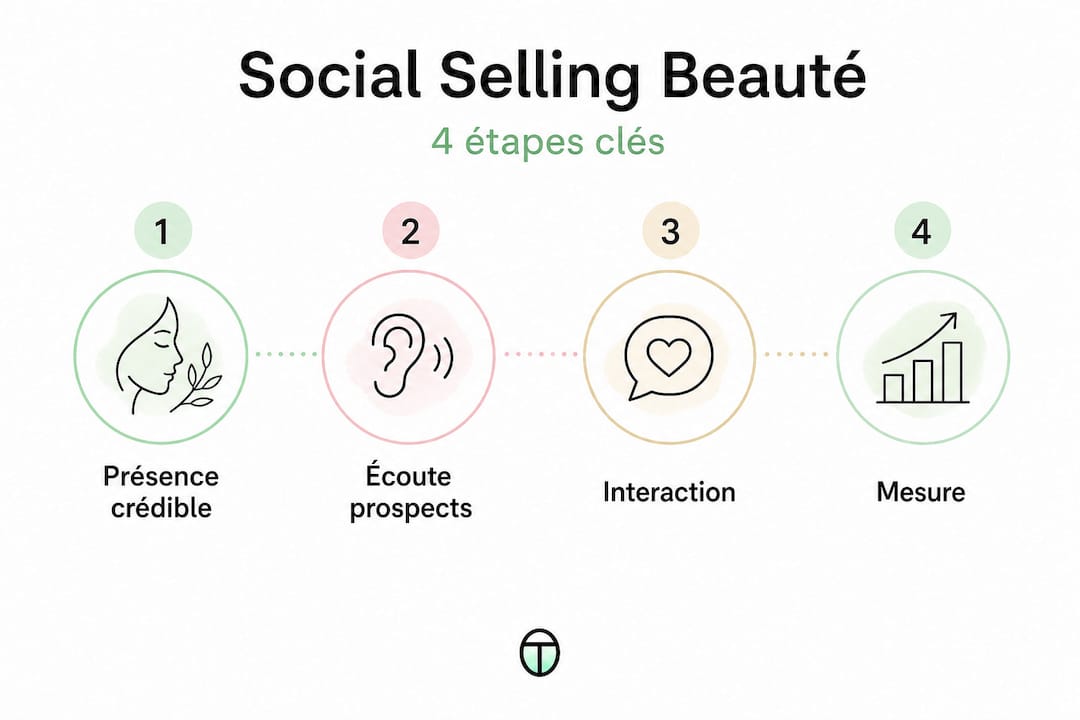
Here is the process we recommend to beauty brands to structure their approach.
Step 1: Build a credible presence
Your profile is your first showcase. Before interacting with prospects, check:
- The visual consistency of your feed (color palette, typography, photo style)
- The clarity of your bio (who you are, what you offer, where to buy)
- The quality of your Instagram or TikTok pins (your best content highlighted)
- The publication frequency (consistency > volume)
A poorly maintained profile instantly breaks trust. Conversely, an elegant and consistent profile gives credibility to every message you send afterwards.
Step 2: Identify and listen to your ideal prospects
Targeting in social selling is active listening before it is prospecting. Use the advanced search functions of Instagram, TikTok, or LinkedIn (for B2B beauty) to identify:
- Accounts that comment on posts similar to yours
- Hashtags used by your target customers
- Recurring questions asked in your niche (e.g., “natural anti-aging routine”, “adult acne treatment”)
This data gives you a precise map of your potential customers' concerns, long before they have heard of your brand. For concrete examples, explore beauty partnership examples that illustrate how to rely on existing communities.
Step 3: Interact before promoting
This is the step most brands skip. Before pitching your product, start a conversation:
- Answer questions in your comments with free personalized advice
- Participate in discussions in the comments of complementary accounts (without spamming)
- Send direct thank-you messages to customers who share your products
- Create educational content that directly answers the problems of your target audience
This preliminary relationship phase considerably reduces friction during conversion. A customer to whom you have already rendered a free service is infinitely more inclined to buy. An inspiring skincare workflow can also serve as an educational framework to structure your content for this phase.
Step 4: Measure and adjust
Without precise metrics, you are navigating blindly. Define your KPIs from the start:
- Engagement rate by content type
- Number of clicks to your store via links in bio or product tags
- Qualified leads generated via direct messages or forms
- Conversion rate of social traffic on your e-shop
Regularly review your beauty conversion strategies to align your social actions with the performance of your online store.
Connecting social selling, conversion, and e-commerce tools
Generating engagement on social networks is one thing. Transforming this engagement into measurable sales is another. Linking social selling and conversion mechanisms (social commerce, landing pages, CRM) is essential: without this connection, you remain on brand awareness without a measurable sales lever.
The links to forge between networks and store
Message consistency is the first point of vigilance. If your Instagram story highlights a dark spot treatment with an educational and caring tone, the corresponding product page must use exactly the same language. A break in tone between the network and the store breaks the purchasing dynamic at the most critical moment.
Here are the technical connections to set up:
- UTM tags on all your social links to precisely identify where the converted traffic comes from
- CRM integration to qualify and segment contacts generated via social networks
- Dedicated landing pages per social selling campaign, aligned with the message of the social content
- Email/SMS automations triggered by social behaviors (e.g., someone who clicks but does not buy)
Pro tip: Create a specific landing page for each major social selling campaign. Use the same visual, the same message, and the same promise as the content that generated the click. This total consistency can increase the conversion rate by 30 to 50% compared to a redirection to the generic product page.
Identifying customer intent signals
An intent signal is a behavior that indicates that a person is close to purchasing. In beauty social selling, these signals include:
- Saving a product post
- Asking a precise question about formulation or delivery
- Comparing two products in the comments
- Returning several times to the same content
Training your team to spot and respond to these signals in real time radically transforms your performance. A personalized response within 30 minutes following a strong signal can double the conversion rate on this prospect.
To go further, our approach to targeted digital strategy systematically connects social actions to e-commerce drivers. Our beauty e-commerce solutions are designed so that every visitor from social media immediately finds what they are looking for, with an experience that captivates as much as it converts. And if your beauty e-commerce branding lacks consistency between your social networks and your store, that is often where you lose your conversions.
What most beauty brands overlook in social selling
After years of supporting ambitious beauty brands, we have observed a recurring pattern. Brands invest in content creation, sometimes significantly, but they confuse social engagement with a conversion strategy. These are two budgets, two teams, and two different logics.
The first mistake: treating social selling as a campaign. Social selling is a permanent, cumulative, and relational process. It is not “launched” like a promotional operation. Its effects are built over time, thanks to consistent useful interactions and the quality of the relationship established long before any sales pitch.
The second mistake: ignoring intent signals. Brands look at their reach and overall engagement statistics. Very few analyze who saves their posts, who asks specific questions, who returns to the same content twice. These behaviors are gold mines that are left untapped.
The third mistake, and perhaps the most costly: not connecting social networks to sales tools. Without UTM tracking, without a CRM, without aligned landing pages, it is impossible to prove the profitability of social selling. This lack of measurement inevitably leads to under-investing in what works or maintaining what does not convert.
Finally, we see too many brands staying in a “product push” logic: publishing product photos hoping that will be enough. The transformative beauty strategies we support work differently. They start with the customer's problem, provide value upfront, and offer the product as an obvious solution, not as an interruption.
Effective social selling requires patience, rigor, and a true culture of measurement. It is not spectacular in the short term, but it is what builds a loyal customer base and sustainable growth.
Take action: boost your beauty social selling with Tamara Agency
Structuring high-performing beauty social selling involves much more than good content. It requires a Shopify store that converts at the level of your social acquisition, landing pages aligned with your messages, and precise tracking to drive your growth with rigor.

Since 2018, Tamara Agency has been supporting ambitious beauty and cosmetic brands in the creation and redesign of their Shopify stores. We combine UX/UI expertise, technical development, and strategic vision so that your site performs as much as it captivates. Whether you are looking to optimize your product pages, create landing pages dedicated to your social selling campaigns, or structure your conversion tracking, we are here to support you. Contact us for a custom consultation and make every social interaction a concrete sales driver.
Frequently asked questions about social selling in beauty
When to launch a beauty social selling strategy?
As soon as your brand seeks to link social presence and commercial results, it is time to structure your approach: social selling starts before any direct contact, with the building of trust and the capture of early interest signals.
Which platforms are most effective for beauty social selling?
Instagram and TikTok are the priority platforms thanks to their interactive visual formats: beauty social selling relies on Reels, Stories, lives, and product tags to transform inspiration into purchase intent.
How to concretely measure the impact of social selling on beauty sales?
By combining engagement, qualified leads, created opportunities, and social traffic converted on your store: the key indicators to track also include the quality of targeting and the consistency of touchpoints throughout the customer journey.
Should social selling be used only for direct sales?
No. Social selling first aims to build trust and generate intent signals: according to Sprinklr, interaction and advice always precede the triggering of the sale, which naturally follows.