

The Role of Animated Visuals in E-commerce in 2026
TL;DR:
- Animated visuals, such as shoppable videos and 3D, significantly increase e-commerce conversions. Their strategic integration, focused on flagship products, reduces customer uncertainty and strengthens the perception of modernity. These formats optimize engagement, improve the experience, and durably position the brand in quality.
Marketing managers who still underestimate the role of animated visuals in e-commerce are missing out on a major conversion lever. The numbers are clear: visitors who interact with a shoppable video show a conversion rate of up to +500% compared to passive visitors. This is not an emerging trend, it is already the standard expected by your customers. This article breaks down the animation formats that perform, the psychological mechanisms that make them effective, and concrete practices to integrate them into your strategy right now.
Table of Contents
- Key Points
- Types of Animated Visuals and Their Uses
- Impact of Animations on Conversion and Engagement
- Psychology and User Experience: Why It Works
- Integrating Animated Visuals into Your Strategy
- Competitive Advantages and Brand Positioning
- My View on Animation in E-commerce
- Take Action with Tamaragency
- FAQ
Key Points
| Point | Details |
|---|---|
| Increased Conversion | Shoppable videos increase the conversion rate by an average of up to 33% and up to 500% for active visitors. |
| Journey-Adapted Formats | Choosing the right format (3D, GIF, overlay, video feed) according to the stage of the conversion funnel maximizes impact. |
| Buying Psychology | Animations reduce cognitive load and create a sense of control that strengthens customer confidence. |
| Prioritize Best Sellers | Focusing animations on your flagship products generates a measurable ROI quickly, before deploying on a larger scale. |
| Metrics to Monitor | Tracking the click-through rate, add-to-cart rate, and product return rate reveals the real effectiveness of your animations. |
Types of Animated Visuals and Their Uses
The term “animated visual” covers very different realities. Before investing in production, you need to know which format answers which objective. Here are the four formats currently dominating high-performing e-commerce.
-
Shoppable video. This is a video in which clickable purchase points are integrated directly. The user can add a product to the cart without leaving the content. This format is particularly effective at the top of the funnel, where attention must be transformed into purchase intent. The beauty e-commerce strategies that incorporate it report significant results on homepages and digital lookbooks.
-
3D animation and 360° view. This format allows the buyer to rotate the product, explore its details, and project themselves. It is the closest digital substitute to the physical in-store experience. Cosmetic products, accessories, and leather goods benefit particularly from this format, where texture and shape play a decisive role.
-
Animated overlays. These are animated badges (countdown, stock indicator, “New” label), flashing banners, and dynamic pop-ins. Discreet but powerful, they act on perceived urgency and direct attention to key conversion elements.
-
Micro-interactions. These are small animations triggered by user actions: a button that pulses on hover, a cart that visually fills, an animated add confirmation. They give immediate feedback and reduce anxiety related to online shopping. Micro-interactions on Shopify are receiving increasing attention in UX because they smooth the journey without weighing down the page.
-
TikTok/Reels-style video feed. Vertical format, autoplay, short duration. It integrates directly on product pages or category pages to present items in a real usage situation.
Each format has its place in the funnel. Shoppable videos and feeds capture attention at the top of the page. 3D animations convert on product sheets. Overlays and micro-interactions reduce abandonment at the bottom of the funnel.
Impact of Animations on Conversion and Engagement
The data available in 2026 makes the discussion on the “usefulness” of animations obsolete. The question is no longer “should we use them” but “which ones to deploy first”.
| Format | Measured Effect | Source |
|---|---|---|
| Shoppable video | +17 to +33% overall conversion | Whatmore, 2026 |
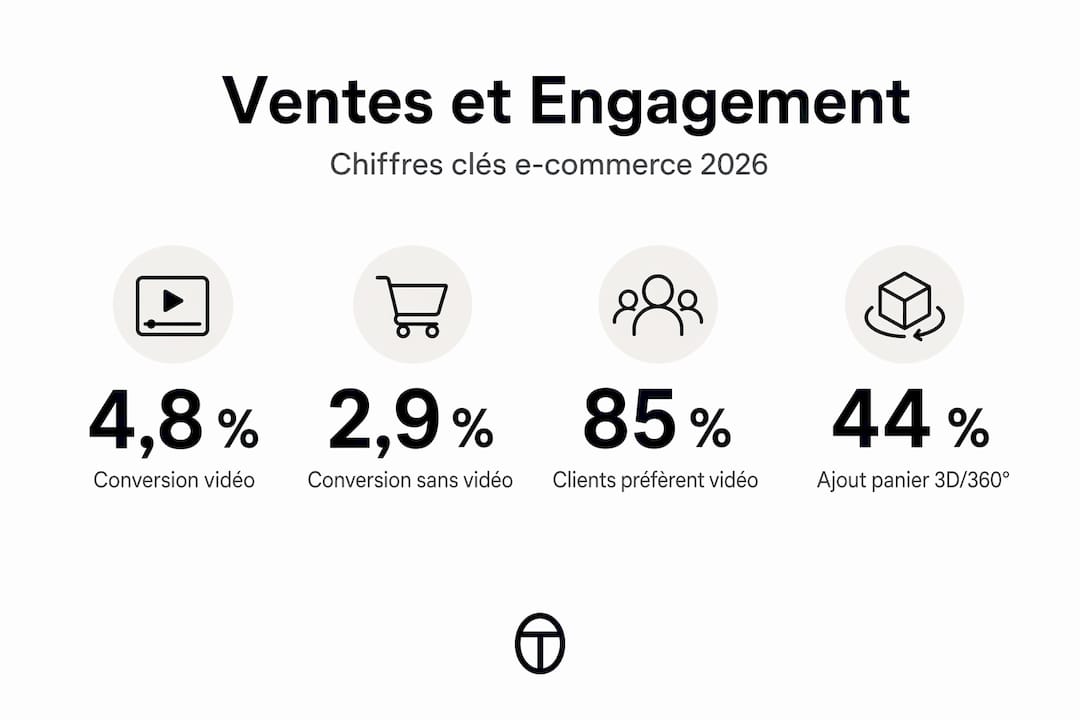
| 3D / 360° animation | +44% add-to-cart, +27% completed orders | Groove Jones |
| Product page with video | Conversion rate 4.8% vs 2.9% without video | Whatmore, 2026 |
| Animated overlays | Increase in click-through rate on targeted products | VideoEffect Vibe |
The figures on 3D are particularly striking. Interactive 3D visualizations increase the probability of adding to the cart by 44% and orders by 27%, with a valuable side effect: the reduction of product returns. When a customer has been able to examine an item from all angles, bad surprises upon delivery decrease significantly.
“41% of short shoppable video viewers make a purchase directly from the content.” — Shoppable Video Benchmarks 2026
Product pages with video show an average conversion rate of 4.8% compared to 2.9% without video, and 85% of consumers state they are more inclined to buy after watching a product video. This delta of 1.9 points represents, at an equal volume of traffic, a growth in revenue directly linked to a single visual lever.
What also changes the game is the reduction of friction. Allowing immediate purchase in the content transforms the passive visitor into an active buyer, without forcing them to navigate between several pages. It is a reduction of the cart abandonment rate by simplifying the journey, and not by additional promotions.

Psychology and User Experience: Why It Works
Understanding the mechanisms that make animations effective allows you to use them with precision, and not by imitation.
The Visual Halo Effect
When a store integrates quality animated visuals, the user does not only perceive a better presented product. They perceive a brand that cares about its experience, that invests in details. This positive halo effect strengthens the perception of modernity and reliability, and justifies a premium positioning. It is a signal of trust even before the purchase.
The Reduction of Cognitive Load
The human brain processes animated images 60,000 times faster than text. The video feed format reduces cognitive load by presenting information in a fluid, sequential, and engaging way. The user does not have to mentally reconstruct what the product gives “in real life”. They see it. This reduction of mental effort translates directly into confidence and a faster purchase decision.
“Video is now a conversational agent, answering objections in real time and humanizing the digital purchase journey.” — Percify
The Sense of Control
Interactive animations, particularly 3D and 360°, give the user a sense of mastery over their decision. They choose the angle, they explore at their own pace. This sense of control is a strong psychological factor in reducing purchase anxiety. Interactive videos with AI avatars take this logic even further, by answering objections in real time.
Pro tip: Add a subtle visual prompt (auto-rotation for two seconds, rotation icon) to signal that your 3D animation is interactive. A simple visual prompt significantly increases the engagement rate on 360° views, because many users do not spontaneously know they can interact with the image.
Integrating Animated Visuals into Your Strategy
Having the right formats is not enough. The implementation determines if the animation creates value or noise. Here is a practical five-step framework.
-
Identify your hero SKUs. Start with your top three to five best-selling products or those that generate the most returns. To maximize ROI, focus the animation on best sellers and products with a high return rate. Massive deployment without prioritization dilutes results.
-
Adapt the format to the device. On mobile, the vertical autoplay format is superior to any other. On desktop, the interactive 360° view and shoppable video perform better. The importance of mobile in e-commerce in 2026 makes this distinction non-negotiable.
-
Take care of technical performance. An animation that slows down the page cancels all its benefits. Use compressed video files (WebM, optimized MP4), lazy loading, and avoid sound autoplay. Loading speed remains an independent conversion factor.
-
Place overlays with intention. Animated badges “Limited stock” or countdowns only work if they are true. A false sense of urgency destroys trust. Reserve these elements for real promotions and imminent stockouts.
-
Measure the right metrics. Video watch rate, add-to-cart rate from a shoppable video, return rate before/after 3D integration. These metrics reveal what the overall conversion rate does not tell.
Pro tip: The animation format you choose impacts results more than the simple presence of a video. Floating and persistent formats (video widgets that follow the scroll) maximize engagement on long product pages.
| Common Error | Best Practice |
|---|---|
| Animating all products without prioritization | Focus on hero SKUs and products with a high return rate |
| Autoplay with sound on mobile | Silent autoplay with subtitles or embedded text |
| Slow or heavy animations | Systematic technical optimization (WebM, lazy load) |
| Manufactured urgency (fake timers) | Animated overlays only on real promotions |
Competitive Advantages and Brand Positioning
Beyond conversion figures, animated visuals produce a lasting effect on the perception of your brand. This is where their role goes beyond simple marketing tactic to become a positioning element.
-
Modernity signal. A store that uses quality animations sends a clear message: it invests in the customer experience. In the beauty, fashion, and wellness sectors where aesthetics is a purchase criterion, this signal is decisive.
-
Justification of a premium price. Animated visuals create a halo effect that strengthens perceived value. A product presented in interactive 3D in a polished environment seems intrinsically higher quality than a product illustrated by a static photo. This is not manipulation; it is value communication.
-
Reduction of cart abandonment rate. Animations that answer visual objections (texture, size, real rendering) reduce hesitation. Less hesitation means fewer abandonments, and therefore a more solid average order value.
-
Loyalty through experience. A customer who has experienced a fluid and visually engaging purchase experience returns. Quality visual content generates 94% additional views on pages that integrate it, and this positive memory directly influences repurchase behavior.
Brands that integrate these strategies into their digital DNA do not suffer from price competition. They bypass it through experience.
My View on Animation in E-commerce
I have been supporting ambitious brands on Shopify since 2018, and what I observe most often is a confusion between decoration and performance. Many marketing managers see animations as an optional embellishment that you add when the budget allows. It is a framing error.
What I have learned is that animated visuals are above all tools for reducing uncertainty. A customer who hesitates does not buy. Everything that allows them to better understand, visualize, and project themselves into a product reduces this uncertainty, and therefore increases the chances of conversion. Video, 3D, micro-interactions: these are answers to unstated objections.
What I systematically recommend to my clients is to start small and measure quickly. A single flagship product with a well-constructed shoppable video teaches a lot about the behavior of your buyers. It is this first test that validates the investment, not a complete catalog overhaul.
Animation does not replace a solid offer or a clear promise. But between two equivalent offers, the one that expresses itself better visually will almost always win. This is the reality of e-commerce in 2026.
— Tamara
Take Action with Tamaragency
You now know what animated visuals can do for your store. The next question is: where to start concretely on Shopify?

At Tamaragency, we help beauty, fashion, and wellness brands create and optimize Shopify stores designed to perform as well as they captivate. Our specialized Shopify training covers motion design applied to conversion, from shoppable videos to micro-interactions. If you prefer a turnkey approach, discover our creation and redesign services to integrate animations that turn your visitors into buyers. Every project we undertake starts with a precise understanding of your brand, your flagship products, and your conversion goals.
FAQ
What is an animated visual in e-commerce?
An animated visual in e-commerce refers to any dynamic visual content integrated into an online store: shoppable videos, 3D/360° animations, micro-interactions, animated overlays, or video feeds. These formats are designed to capture attention, reduce hesitation, and increase conversion rates.
Do shoppable videos really increase sales?
Yes, measurably. Shoppable videos increase the overall conversion rate by 17 to 33%, and visitors who interact directly with them show a conversion rate up to five times higher than average, according to Whatmore's 2026 benchmarks.
Which animation format should I choose for a product page?
For a product page, the 3D/360° view is the most effective format because it increases add-to-cart by 44% and reduces returns. Short autoplay video complements this setup by showing the product in a real-life usage scenario.
How to prevent animations from slowing down my site?
Use compressed video formats such as WebM or optimized MP4, enable lazy loading for off-screen animations, and disable sound autoplay on mobile. Technical performance and visual experience are not mutually exclusive, provided they are designed together from the start.
Which products should I start with for animation integration?
Start with your top three to five best-selling products or those that generate the most customer returns. Focusing animations on these hero SKUs allows you to quickly measure the impact and justify a broader rollout across the entire catalog.