

Fashion branding ideas to boost your Shopify store
TL;DR:
- A consistent visual identity, including logo, colors, typography, and overall brand universe, builds trust and loyalty.
- Effective strategies include minimalism, reusable packaging, community storytelling, and personalized Shopify assets.
- Branding must evolve with the brand, prioritizing strategic simplicity to maximize recognition and performance.
Standing out on Shopify in fashion and beauty has become a real challenge. Hundreds of new stores open every month, yet most stagnate for lack of a distinctive identity. Visual identity encompasses much more than a logo: it includes the color palette, typography, editorial tone, packaging, and overall visual universe. It is this cohesive whole that transforms a curious visitor into a loyal customer. Here are concrete ideas, industry benchmarks, and actionable recommendations to make your branding a real performance driver.
Table of Contents
- Defining the criteria for effective fashion branding
- Top 5 creative branding ideas for fashion and beauty
- Comparison: which ideas boost performance on Shopify?
- Recommendations for taking action (methodology and common mistakes)
- Why fashion branding on Shopify is above all a matter of evolving experience
- Need support to boost your fashion branding on Shopify?
- Frequently asked questions about fashion branding on Shopify
Key Points
| Point | Details |
|---|---|
| Foundations of strong branding | Logo, colors, typography, and storytelling align to create a memorable and effective brand. |
| Actionable ideas | Modular packaging, community UGC, and product storytelling make the difference in 2026. |
| Links to performance | Branding choices and consistency directly influence conversion rates and customer retention on Shopify. |
| Checklist to avoid mistakes | Testing ideas, staying consistent across all channels, and prioritizing scalable visual systems allows you to iterate and innovate without risking a "gimmicky" effect. |
Defining the criteria for effective fashion branding
To choose the right ideas to implement, you must first know what makes up a solid foundation. Effective branding in fashion and beauty cannot be improvised: it relies on a precise, tested, and documented architecture.
The 6 pillars of visual identity
A strong brand identity relies on six fundamental elements: the logo, color palette, typography, editorial tone and style, packaging, and visual universe. These elements must work together, both on your Shopify store, social media, and physical packaging. Ignoring any one of them creates visual friction that undermines customer trust.
Shopify recommends a 6-step methodology to structure this work: define your founding values, choose an evocative name, carry out the branding process, test it with your audience, create your graphic assets, and then formalize a style guide. This sequence prevents building an identity on vague foundations that will require an expensive redesign a year later.
Furthermore, our beauty branding guide illustrates how these steps translate into concrete actions in the cosmetics and wellness sectors, with examples of brands that have transformed their positioning.
The 7 steps to create a consistent brand
Beyond visual identity, Shopify details a 7-step methodology for creating a robust brand: from competitive analysis to defining the unique value proposition, including building storytelling and choosing communication channels. Each of these steps informs the others.
The mistakes to avoid are often the same:
- Choosing a color palette solely for its aesthetics, without considering industry standards
- Changing typography with every seasonal collection, which fragments brand recognition
- Neglecting consistency between the Shopify store and printed materials or social media
- Creating a visual universe inspired by a fleeting trend rather than a long-term vision
| Common mistake | Impact on performance | Recommended solution |
|---|---|---|
| Typographic inconsistency | Loss of trust, high bounce rate | Define a maximum of 2 fonts in a brand kit |
| Undefined palette | Dilution of brand image | Establish 3 to 5 official colors with HEX codes |
| Lack of style guide | Disparity across every channel | Write a brand book, even a minimalist one |
| Non-mobile-friendly visuals | Poor experience on 70% of traffic | Systematize responsive formats from the start |
View cosmetic visual inspirations to see how some brands build exemplary consistency between packaging, their website, and digital communication.
Pro tip: Create your brand kit directly in Figma or Canva by adding your color codes, fonts, and logo variations. Share it with all your service providers to ensure perfect consistency for every new creation.
Top 5 creative branding ideas for fashion and beauty
Once the criteria are set, let's explore truly distinctive ideas. These five ideas are directly applicable to a Shopify store and have proven themselves in the fashion and beauty sectors.
01. Minimalist and scalable visual identity
Minimalism is not a trend; it is a strategy. A reduced color system (two or three shades maximum) combined with a clear typographic hierarchy creates an immediately recognizable identity. Think of brands like Aesop or Glossier: their strength comes precisely from their visual restraint.
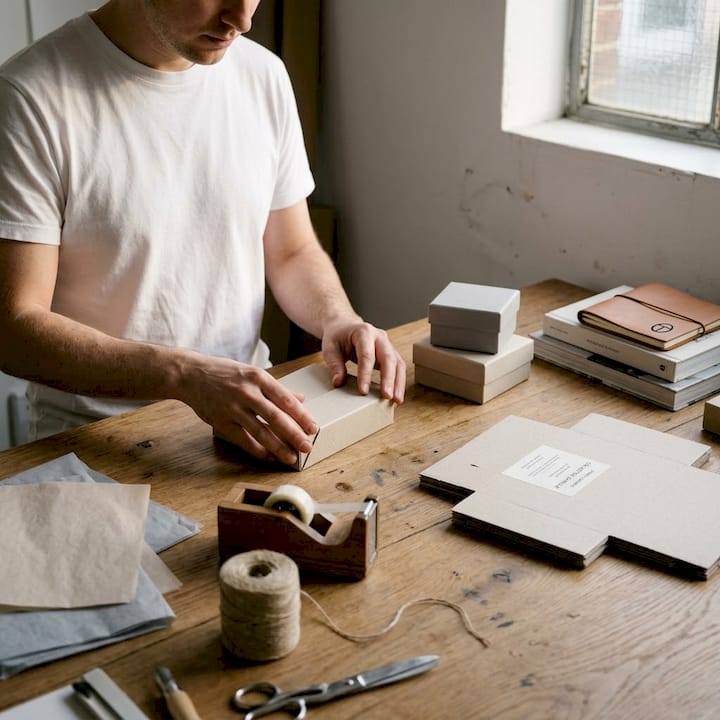
On Shopify, this translates to a clean theme, generous white space, and product visuals that breathe. Sobriety also makes it easy to adapt the identity to each new collection without betraying the brand's DNA.
02. Modular and reusable packaging
Packaging is often underestimated as a digital branding tool. Yet, unboxing videos generate millions of views on TikTok and Instagram. Modular packaging, designed to be reused or repurposed, generates organic engagement and strengthens perceived value.
Look at this packaging branding example to see how a design refined down to the smallest detail contributes to the overall brand experience. This type of attention transforms an ordinary purchase into a memorable moment.
03. Community storytelling and UGC (User Generated Content)
Brands that perform in 2026 no longer just talk about themselves: they let their customers speak. User-generated content, authentic ambassadors, and value-based loyalty programs create significantly higher retention than any advertising campaign.
"Avoid fleeting hype in favor of scalable systems, test with your audience, and bet on community and values for retention." Shopify Enterprise, Brand marketing e-commerce
Concretely, include a section dedicated to visual reviews on your product page. Highlight customer photos with a branded hashtag. This authentic content reassures new visitors much better than a perfectly executed studio photo.
04. Immersive product page storytelling
A product page is not just a catalog. It is a stage. The highest-performing brands build a narrative around each product: usage context, formulation story, expert testimonial, mood gallery. This approach increases time spent on the page and reduces purchase hesitation.
Our beauty e-commerce performance guide details how to structure these pages to maximize both engagement and conversion, with examples of Shopify stores that have achieved significant results.
05. Graphic elements and personalized Shopify assets
Custom sections in Shopify allow you to go far beyond standard themes. Subtle hover animations, custom-designed icons, interactive banners: every micro-detail contributes to the overall experience. Refer to our Shopify design checklist to ensure that every visual touchpoint is optimized.
Pro tip: Systematically test two versions of a key section (Hero banner, product page) using Shopify's native A/B testing tools or a dedicated app. Your customers' real data is worth more than any creative intuition.
Comparison: which ideas boost performance on Shopify?
But concretely, which branding strategy would improve your results the most? Industry figures provide valuable benchmarks to guide your choices.
Conversion benchmarks by sector
The average conversion rates on Shopify vary by sector: between 1.0% and 3.1% for fashion and apparel, and between 1.8% and 4.9% for beauty and personal care. These differences are not solely explained by traffic quality. Visual identity, brand credibility, and user experience quality play a decisive role.
It is important to qualify: the benchmarks vary depending on the traffic source. Email marketing has historically generated the best conversion rates, followed by organic traffic, then paid traffic. A store with a strong identity converts better on each of these channels, because brand recognition reduces hesitation.
| Branding strategy | Impact on CR | Impact on retention | Initial investment |
|---|---|---|---|
| Consistent minimalist identity | +0.5% to +1.2% | High | Medium |
| Premium and memorable packaging | +0.3% to +0.8% | Very high | High |
| UGC and active community | +0.8% to +1.5% | Very high | Low to medium |
| Immersive product pages | +1.0% to +2.0% | Medium | Medium |
| Personalized Shopify assets | +0.4% to +0.9% | Medium | Medium to high |
What really influences performance
Visual branding acts on several levers simultaneously. A consistent identity increases trust, which reduces cart abandonment. Well-designed packaging generates UGC, which reduces acquisition costs. Strong product storytelling increases the average order value (AOV, for Average Order Value, i.e., the average amount per order).
Key takeaways:
- Beauty displays the best conversion rates in e-commerce, but also more third-party services on each page, which can slow down the site
- Fashion, highly competitive, particularly benefits from strong visual branding to stand out
- Measuring the ROI (return on investment) of branding involves tracking the CR, customer return rate, and cart abandonment rate on your Shopify dashboard
Our techniques to increase Shopify sales combine branding and technical optimization for measurable results on both fronts.
Pro tip: Activate advanced reports in Shopify Analytics and track the conversion rate by traffic segment. You will quickly identify which channel benefits most from your branding investments.
Recommendations for taking action (methodology and common mistakes)
To put these ideas into place, here is the concrete step-by-step process. A good idea without a method remains an idea. Implementation determines everything.
5-step deployment methodology
-
Audit the existing: Make a complete inventory of all your current visual assets, logo, colors, fonts, email templates, social media visuals. Identify inconsistencies.
-
Define your brand kit: Formalize a simple document with your official colors (HEX and RGB codes), your two fonts, your logo variations, and your usage rules. Prioritizing visual consistency ensures instant recognition and strengthens customer loyalty.
-
Integrate on Shopify: Apply your brand kit in your Shopify theme settings: colors, fonts, borders, spacing. Personalize transactional email templates (order confirmation, delivery) so they reflect your identity.
-
Optimize technical performance: Studies show that optimizing only Shopify theme settings can significantly increase the conversion rate: responsive images with srcset, self-hosted fonts with preloading, persistent cart, trust badges, bundle offers. These adjustments do not require complex development.
-
Test and iterate: Plan revisions of your identity every six months. Compare metrics before and after each adjustment to objectify your decisions.
Checklist for multichannel consistency
Before publishing any new creation, check these points:
- Do the colors used exactly match the official codes in your brand kit?
- Are the fonts respected, including sizes and weights?
- Are the visuals optimized for mobile (format, file size, cropping)?
- Is the editorial tone (formal, casual, inspiring) consistent with your positioning?
- Do the Shopify assets (banners, icons, buttons) reflect the same aesthetic as your social media?
“Visual consistency is not a creative constraint; it is the foundation of brand recognition. A fragmented identity costs you twice: in lost customer confidence and in the need for a redesign.”
Our beauty e-commerce solutions and our approach to micro-interactions for Shopify conversion show how seemingly minor details can radically transform the user experience and business results.
Pro tip: Use Shopify’s saved sections to create reusable blocks (promo banner, testimonial block, UGC section). You’ll save valuable time with every new update to your store.
Why fashion branding on Shopify is primarily a matter of evolving experience
After these recommendations, let’s take a step back and look at the logic of high-performing, long-term branding. Here is what years of supporting fashion and beauty brands have taught us.
Most brands invest heavily in branding at launch, then freeze it. That is precisely where the problem begins. Effective branding is not a photograph; it is a film. It must evolve with your audience, your product ranges, and market expectations.
The visual identity rules that maintain brand momentum indicate that beauty brands suffer from an average of 31 third-party services per page, which slows down the experience. Fashion, meanwhile, benefits from strong visual branding to compensate for intense price competition. Multi-channel inconsistencies remain the main factor in losing momentum, even for well-established brands.
Our conviction, forged since 2018, is that the most powerful branding system is also the most understated. Two primary colors. Two typefaces. A graphic universe that can be adapted endlessly. This minimalism is not creative laziness: it is strategic discipline. It allows you to test, iterate, and listen to your community without starting from scratch with every pivot.
To support the Shopify transformation of ambitious brands, we consistently observe the same truth: the best performance comes from brands that have set clear visual rules for themselves and then lived with them boldly. Not brands that change everything every season, nor those that never dare to change anything.
Need support to boost your fashion branding on Shopify?
To go further and bring your branding to life, expertise makes all the difference between a project that stagnates and a store that performs.

Since 2018, at Tamara Agency, we have supported demanding fashion and beauty brands in creating and redesigning their Shopify stores. Our approach combines strategy, UX/UI design, and technical development for concrete, measurable results. Discover our Shopify branding services, explore our expertise dedicated to fashion store creation, or strengthen your autonomy with our Shopify training. Let’s talk about your project and build together an identity that performs as well as it captivates.
Frequently asked questions about fashion branding on Shopify
What are the essential elements for successful fashion branding on Shopify?
Successful fashion branding relies on a distinctive logo, a well-defined color palette, consistent typography, a strong graphic universe, and a polished customer experience at every touchpoint. These 6 key elements must be formalized in a brand kit applied across your entire Shopify store.
How can I measure the impact of my branding on Shopify sales?
Track the evolution of your conversion rate, customer return rate, and average order value after each visual identity change. Industry benchmarks indicate an average conversion rate between 1.8% and 4.9% in beauty, giving you an objective basis for comparison.
Why does visual consistency matter so much in beauty and fashion?
It enables instant brand recognition and reassures customers about the quality and professionalism of your offer, thus reducing purchase hesitation. Prioritizing this consistency is one of the most direct levers for improving long-term customer loyalty.
What technical settings speed up the performance of a store with a strong visual identity?
Optimize the file size and format of your images, choose a lightweight theme, limit third-party apps, and enable lazy loading for an LCP of under 2.5 seconds on mobile. A fast and beautiful store converts better than a beautiful but slow store.