

Leverage content to boost your beauty store
TL;DR:
- Content marketing generates three times as many leads as paid advertising at a lower cost.
- A structured content strategy significantly increases conversion rates and SEO visibility.
- The quality and relevance of content, especially buying guides and optimized product pages, are essential for performance.
Content marketing in beauty and wellness e-commerce remains one of the most underestimated and poorly utilized growth drivers. Many brands publish regularly without a clear strategy and are surprised by stagnant results. Yet, content marketing generates 3x more leads than paid advertising, at 62% less cost, and some buying guides convert up to 8 times more than generic blog posts. This guide provides practical keys to transform your content into a real growth engine on Shopify.
Table of Contents
- Why Content Drives Beauty and Wellness E-commerce
- The Different Types of Content That Transform Performance
- How to Organize and Optimize Your Content for SEO and Conversion
- Common Mistakes and Pitfalls to Avoid in E-commerce Content
- Our Perspective: Why Strategic Content Is Worth More Than Volume
- Need Support to Maximize the Role of Your Content?
- Frequently Asked Questions About Content in Beauty E-commerce
Key Points
| Point | Details |
|---|---|
| Strategy Before Volume | Focus on quality, relevance, and alignment with purchase intent rather than multiplying content. |
| Winning Content Types | Guides, AI-powered product pages, FAQs, and UGC are the types of content that maximize conversion and SEO visibility. |
| High-Performing SEO Structure | Organize your content into topical clusters to meet Google's E-E-A-T guidelines and address every stage of the customer journey. |
| Avoid Risky Content | Be careful with duplication and overproduction; prioritize authenticity and personalization. |
| Higher ROI Than Advertising | Properly executed content marketing is more affordable and effective than traditional advertising. |
Why Content Drives Beauty and Wellness E-commerce
Beauty and wellness are two sectors where trust, emotion, and education play a decisive role in the purchasing decision. Unlike an electronic product whose specifications are enough to convince, a face cream or dietary supplement requires an in-depth narrative, social proof, and impeccable educational content.
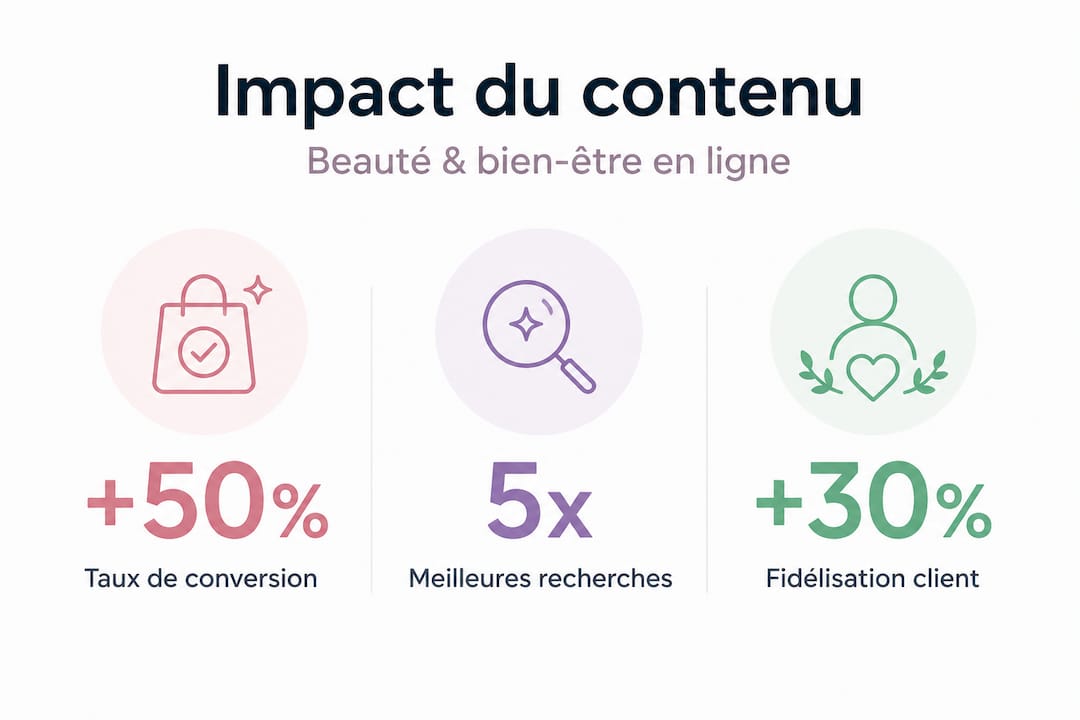
This is precisely where structured content makes the difference. It is not simply about feeding a blog or filling out product pages. It is about building a consistent brand narrative that guides the visitor from their first Google search to the “Add to Cart” button. A well-thought-out beauty digital strategy integrates each piece of content as part of a larger system.
The numbers speak for themselves. The beauty and wellness sector shows average conversion rates of 3.5 to 3.7%, significantly higher than the e-commerce average of around 2%. This is no coincidence. These brands invest heavily in high-value-added content, video tutorials, ingredient comparisons, personalized routines, and enriched customer reviews.
A telling example: La Rosée, a French natural cosmetics brand, recorded a 53% increase in its conversion rate and +88% in sales after focusing on personalization and redesigned product content. This type of result is not reserved for major houses. It is accessible to any brand that makes smart choices about its priorities.
“Well-targeted content transforms a curious visitor into a convinced customer. Quantity never replaces relevance.”
The most effective Shopify beauty sales solutions are based on this principle. Here are the concrete benefits of a structured content strategy in this sector:
- Increased organic visibility thanks to content optimized for search engines
- Reduced bounce rate because visitors find answers to their questions without leaving your store
- Higher average order value thanks to buying guides and cross-recommendations
- Enhanced customer loyalty through educational content that builds a long-term relationship of trust
Pro tip: Do not invest in all types of content simultaneously. First, identify the three key stages of your customers' journey, then precisely target the formats that influence each phase. Dispersion is the enemy of impact.
The Different Types of Content That Transform Performance
Not all content is equal. And depending on the stage of the purchasing journey, some formats far outperform others. Understanding this reality allows you to allocate your resources where they generate the most results.
The following table summarizes the main formats according to their ROI and their position in the conversion funnel:
| Content type | Funnel stage | Estimated ROI | Conversion impact |
|---|---|---|---|
| Buying guides | Consideration | Very high | Converts 5 to 8x more than a blog |
| AI-optimized product pages | Decision | High | +10 to 30% visibility |
| Email marketing | Retention | Very high | $42 return for every $1 invested |
| UGC (user-generated content) | Decision and retention | High | Strengthens trust and SEO |
| Short-form video | Awareness | +104% engagement | Ideal for social media |
Product pages deserve special attention. Too often copied from suppliers or written generically, they nevertheless represent the last barrier before purchase. A well-structured product description, which includes precise headings, well-organized ingredient lists, and an integrated FAQ, boosts visibility by 10 to 30% in generative search engines. This is an immediate gain, without an additional advertising budget.

Buying guides are often neglected in favor of classic blog posts. Yet, their ability to convert is incomparable. Why? Because they answer a specific intent: “Which serum should I choose for my sensitive skin?” or “Which vegetable oil for curly hair?”. These formats fit directly into the most effective beauty e-commerce strategies.
UGC, or user-generated content, enriched customer reviews, usage photos, and video testimonials, constitutes a powerful but underutilized lever. It combines social proof and fresh content for algorithms, which simultaneously improves trust and organic search ranking.
Here is how to choose the right format according to your development stage:
- Start with product pages: this is the foundation. Without quality product pages, everything else is less effective.
- Create 2 to 3 thematic buying guides covering your main categories. Think about search intent, not your products.
- Activate a UGC strategy: encourage photo reviews and integrate them on product pages.
- Launch targeted email marketing based on behavioral segments (first-time buyers, loyal customers, cart abandonments).
- Produce regular short videos to feed your social networks and integrate them on your site.
The best Shopify beauty UX practices recommend integrating these formats into the very architecture of your store, and not just in a separate blog.
“A documented content strategy generates three times as many leads as an ad hoc approach. Planning is not a luxury, it is a necessity.”
Pro tip: Prioritize depth over frequency. A detailed and well-illustrated buying guide, published once a month, consistently outperforms five superficial articles published every week. Your audience, like Google, rewards substance.
How to Organize and Optimize Your Content for SEO and Conversion
Having good content is not enough if your editorial architecture is chaotic. The structuring of your content directly conditions your SEO visibility, your credibility, and the fluidity of the user journey.
The topical cluster method is today the benchmark for high-performing content SEO on Shopify. It consists of creating a pillar page on a broad topic, for example “face care for combination skin”, then developing satellite articles or pages that deal with specific sub-topics, all linked together. This structure sends strong signals to Google about your expertise, authority, and reliability, which the algorithm calls E-E-A-T (Experience, Expertise, Authority, Trust).
A concrete example in beauty: imagine a pillar page on “natural skincare routines”. Around it, clusters revolve on double cleansing, essential active ingredients, homemade masks, and layering mistakes. Each page strengthens the others. This example of topical clusters illustrates how a product range can be organized to maximize understanding and purchase intent.
FAQs and customer reviews also play an often underestimated SEO role. Product pages enriched with FAQs increase visibility by 10 to 15% in search results, especially in rich snippets and AI-generated answers. It is a free and powerful lever.
Here are some quick tips to effectively structure your content:
- Organize your blog into clear categories corresponding to your product families and your audience's concerns.
- Systematically link your articles to the relevant product pages to shorten the path to purchase.
- Regularly update your existing content rather than only creating new content.
- Integrate questions/answers on product pages to capture voice queries and long-tail searches.
- Use enriched customer reviews with photos and mentions of perceived product benefits.
The e-commerce UX/UI guide we wrote highlights how much visual structure and information hierarchy directly influence reading and conversion. Excellent content poorly presented loses its value. Also think about micro-interactions and Shopify conversion to maximize the impact of each page.
Pro tip: Absolutely avoid copying supplier descriptions. This duplicated content penalizes your ranking and dilutes your brand identity. Write each page in your own voice, adding informative value that the manufacturer's page does not offer.
Common Mistakes and Pitfalls to Avoid in E-commerce Content
Knowing best practices does not fully protect against mistakes. In beauty and wellness, some pitfalls are particularly costly, both for SEO and for the customer relationship.
Duplicated content is the first hurdle. Many Shopify stores pull descriptions from their suppliers without adapting them. This copied content directly penalizes ranking and positions your store as interchangeable with dozens of others selling the same products with the same words.
AI is a powerful tool, but poorly managed, it becomes a risk. Automatically generated descriptions without serious review can contain misleading health claims, for example “certified anti-aging” promises or unproven therapeutic effects. In the beauty and wellness sector, this exposes your brand to real regulatory sanctions from control authorities.
Publication overload is another insidious pitfall. Producing content in large quantities without a strategy generates noise, not impact. The current attention crisis is real: consumers are exposed to thousands of messages a day and their filtering capacity is increasing. Publishing more does not guarantee being read more.
Here are the mistakes to absolutely banish:
- Copying supplier pages without rewriting or adding value
- Using AI to generate content without in-depth human review
- Publishing without an editorial calendar consistent with the highlights of your sector
- Neglecting legal notices on beauty and wellness product claims
- Ignoring negative reviews instead of responding publicly with professionalism
- Completely separating editorial content from transactional content, when they should feed each other
“Regulatory compliance in beauty and wellness is not optional. An incorrect product description can cost much more than a preventive content audit.”
Digital merchandising is also a lever that is often poorly utilized. Too many stores invest in editorial content without taking care of highlighting products on category pages and the home page. The two dimensions must move together.
Pro tip: Prioritize authenticity at scale. In-house videos, spontaneous customer reviews, and testimonials with real photos consistently outperform overproduced visuals. In 2026, consumers immediately spot what sounds fake and reward what sounds genuine.
Our perspective: Why strategic content is worth more than volume
After years of supporting beauty and wellness brands on Shopify, we have a strong conviction: the real differentiator is not the number of posts, but how well they are integrated into the shopping experience.
The best-performing brands don't necessarily publish more. They build cohesive content ecosystems where each product page is surrounded by an educational blog, supported by rich customer reviews, linked to relevant buying guides, and accompanied by a personalized follow-up email. Each piece of content reinforces the others.
We are also seeing a clear trend in 2026: stores that invest in interactive and personalized experiences—skin diagnostic quizzes, real-time routine recommendations, virtual consultations—show performance metrics well above average. It's not technology alone that makes the difference, but the relevance of the experience offered.
Our position on beauty branding strategies is clear: impactful, targeted content is worth far more than a plethora of scattered posts without a guiding thread. The question is not “how much?” but “why this content, for whom, and at what stage of the customer journey?”
The attention crisis is not a threat to brands that choose quality. It is an opportunity to stand out in a landscape saturated with generic content. Stores that dare to take the time to create something truly useful and sincere for their community build much more lasting loyalty than those chasing frequency.
Our final tip: surround each key product with a complete ecosystem. Optimized product page, thematic cluster, integrated UGC, enriched FAQ, targeted nurturing email. This is the ecosystem that transforms a store into a brand.
Need support to maximize the role of your content?
Moving from theory to execution requires technical and editorial expertise that few in-house teams fully possess. Structural content mistakes are costly, in lost time, missed traffic, and failed conversions.

At Tamara Agency, we have been supporting beauty and wellness brands since 2018 to build Shopify stores that perform as well as they impress. Our approach places content strategy at the heart of every project, from Shopify store creation to the optimization of an existing Shopify store. We also offer Shopify training sessions for teams that want to take ownership of their editorial strategy. Contact us for an audit of your current store, and together we will identify the fastest growth levers to activate.
Frequently asked questions about content in beauty e-commerce
What impact does content have on the conversion rate of a beauty/wellness store?
Personalized and well-structured content can increase the conversion rate on Shopify by more than 50%. The brand La Rosée recorded a +53% conversion rate and +88% sales thanks to a redesigned content and personalization strategy.
What types of SEO content should you choose for a beauty/wellness store?
Buying guides, optimized product pages, and FAQs are the most effective formats. Guides convert 5 to 8 times more than generic blogs, and AI-optimized product pages boost visibility by 10 to 30%.
What mistakes should you avoid when creating e-commerce content?
Duplicate content directly harms SEO, and AI-generated descriptions without review expose brands to serious regulatory risks. These mistakes cost brands millions every year.
Why doesn't the quantity of content guarantee success?
The attention crisis in e-commerce means that consumers actively filter out the noise. The depth and relevance of content determine its impact far more than its publication frequency.
What content budget should you plan for an optimal ROI in beauty/wellness?
Marketing content costs 62% less than paid advertising while generating three times as many leads, making it the most profitable long-term investment for a Shopify store in this sector.