

Shopify beauty design: boost your image and sales
TL;DR:
- Design influences 80% of purchasing decisions in cosmetics, reinforcing the importance of a consistent visual identity. On Shopify, thoughtful design builds trust, reduces frustration, and boosts sales performance. Immersive trends like augmented reality and AI are becoming essential for building loyalty and converting customers in 2026.
Eighty percent of consumers say that packaging influences their purchasing decision. This figure says everything about the power of design in beauty. But it's not just about the bottle or the box: on Shopify, your store's design plays exactly the same role. It reassures, entices, and convinces before the visitor has even read a single product description. This guide explains how design shapes your brand's sales performance and gives you concrete ways to make the most of it.
Table of Contents
- Why design is a strategic lever for beauty
- Product design and user experience: when form meets performance
- Design trends in beauty e-commerce 2026: immersion and personalization
- Measuring the impact of design: methods and key metrics for 2026
- Our point of view: creating high-performing and responsible beauty design
- Take action: optimize your beauty store design on Shopify
- Frequently asked questions about design in beauty
Key Points
| Point | Details |
|---|---|
| Design influences purchasing | Colors and packaging impact the purchasing decision of over 70% of beauty consumers. |
| Enhanced user experience | A well-designed applicator or store builds brand loyalty and preference. |
| Current digital challenges | Omnichannel, AI, and augmented reality are redefining beauty e-commerce standards. |
| Measure performance | Rationalize your design choices using tools like Marketing Mix Modeling. |
| Responsible design = longevity | Prioritizing consistency and responsibility in design promotes sustainable growth. |
Why design is a strategic lever for beauty
In the cosmetics world, design is never neutral. Every visual choice, color, typeface, bottle shape, or product page layout speaks to your customer before she reads a single word. It's not aesthetics for aesthetics' sake: it's strategy.
Packaging and store design strongly influence purchasing decisions in the cosmetics sector. Warm colors evoke energy and vitality. Neutral and matte tones signal understated luxury. Pristine white conveys clinical purity. Each of these codes triggers an almost immediate emotional response in your audience.
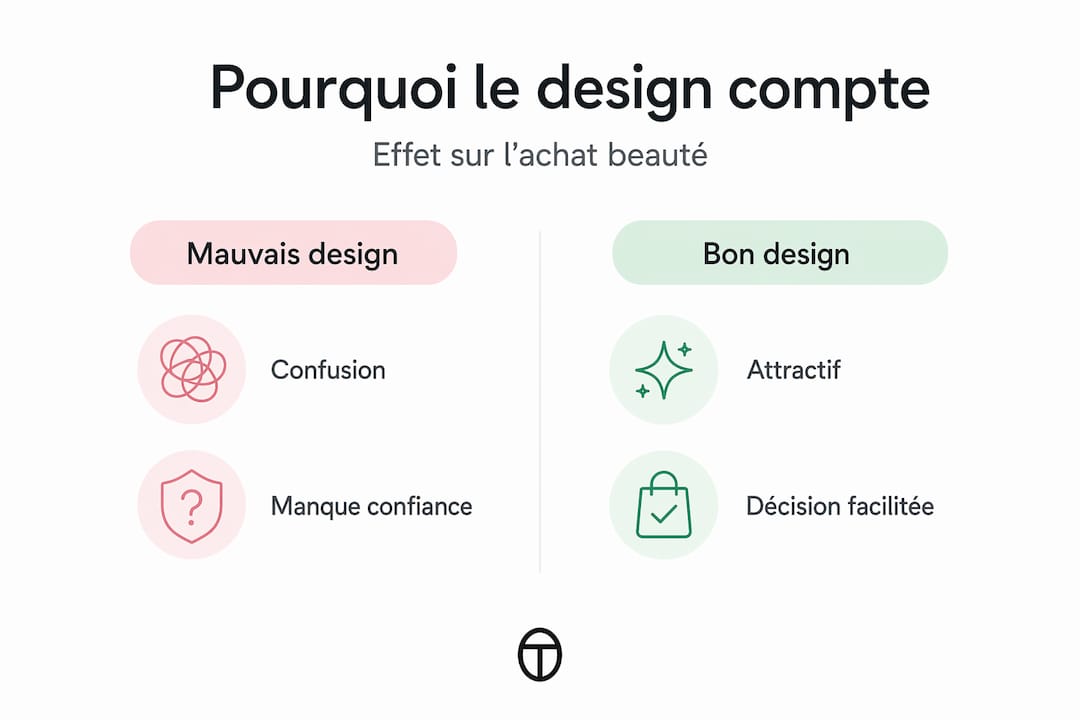
What design says about your brand without a word
Here are the signals your design constantly sends to your visitors:
- Visual consistency: a unified identity across product packaging, your Shopify store, and social media makes your brand more memorable.
- Price positioning: thoughtful design justifies a premium price and reduces purchasing friction.
- Product promise: the visuals must accurately reflect what the product promises (hydration, effectiveness, naturalness).
- Emotional response: sophistication, accessibility, avant-garde, well-being... every intention should be visible in every pixel.
| Design element | Impact on perception | Risk if inconsistent |
|---|---|---|
| Color palette | Positioning and emotion | Confusion about the target segment |
| Typography | Brand values (luxury, fun, natural) | Illegibility or tone mismatch |
| Product layout | Clarity and trust | High bounce rate |
| Photography | Desirability and credibility | Product returns and disappointment |
"Strong design doesn't just catch the eye: it aligns the brand promise with the consumer's experience."
Inconsistency is your worst enemy. When the design promises luxury and the product received looks like an entry-level item, customer disappointment is immediate and a product return is almost certain. Your beauty branding strategies must therefore ensure complete continuity across all touchpoints. Cosmetic products carry a unique emotional dimension that design should amplify, never contradict.
Product design and user experience: when form meets performance
Design doesn't stop at the first impression. It also shapes the everyday user experience, the moment of truth that determines whether your customer returns or not.
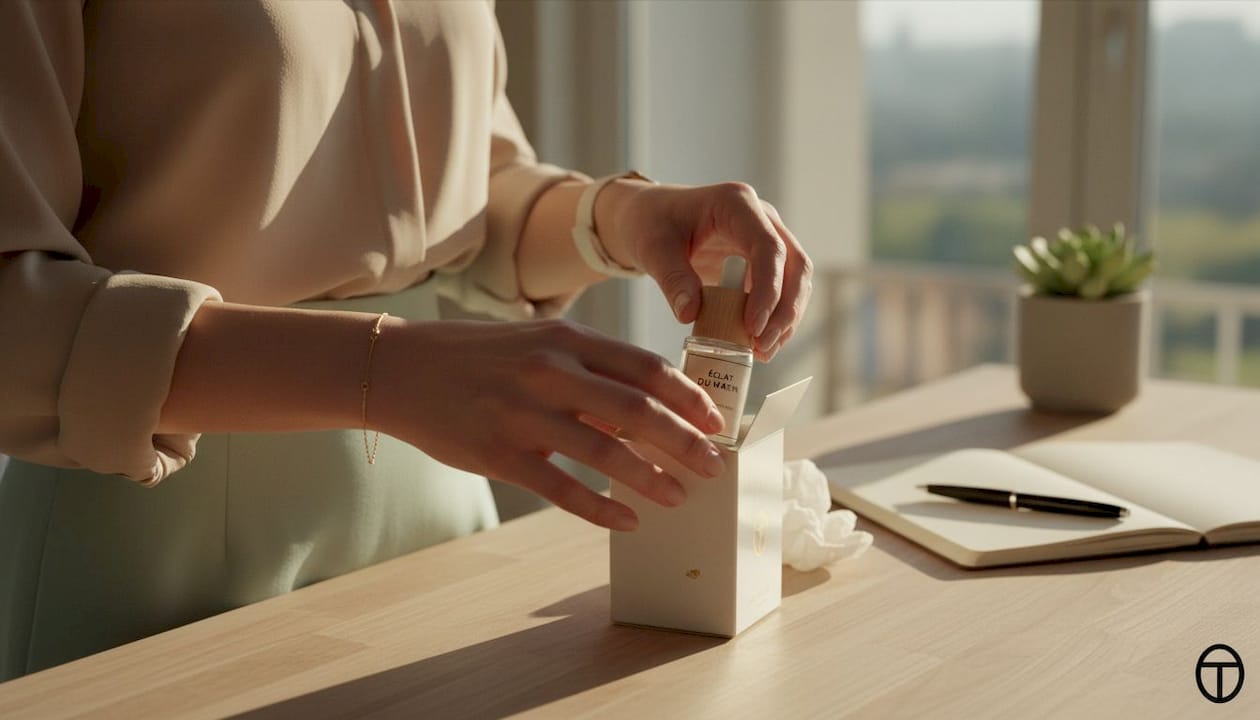
The ergonomics of applicators and packaging is a crucial factor that is often overlooked. A poorly designed applicator that is too rigid, too fluid, or difficult to control creates frustration and ruins the perception of quality. Conversely, ergonomics and application control are essential pillars of the user experience in cosmetics.
The four dimensions of high-performing product design
-
Functional ergonomics: the product must be easy to hold, dose, and apply. A serum with a well-calibrated dropper, a foundation with a precise applicator, or a cream in a jar with a one-handed lid: these details build loyalty.
-
Sensory experience: the feel of the material, the sound of the cap clicking, the resistance of the bottle under the fingers. These micro-experiences contribute to the perception of quality and the desire to reuse.
-
Usability clarity: the packaging must clearly communicate how to use the product, how often, and in what quantity. Confusing design leads to usage errors and unjustified returns.
-
Perceived durability: packaging that holds up well over time, does not yellow, scratch, or deform, reinforces its perceived value over time.
| Criterion | Standard design | UX-optimized design |
|---|---|---|
| Handling | Neutral | Ergonomic, designed for the hand |
| Dosing | Approximate | Precise and repeatable |
| Visible information | Basic | Hierarchical, readable at a glance |
| Material | Functional | Sensory and durable |
| Emotional response | None | Pleasure, trust, desire to recommend |
Pro tip: Test your packaging with real users before launch. Film their actions and listen to their feedback. You will spot friction points that your internal team might never have identified without a fresh perspective.
On Shopify, this logic translates directly. Your beauty e-commerce solutions must reproduce online what the product promises in real life: fluidity, elegance, precision. Navigation must be intuitive. Product photos must show the texture, application, and results. And the checkout page should never slow down the momentum. Your Shopify beauty digital strategy is best conceived as a natural extension of product design, not as a separate channel.
Design trends in beauty e-commerce 2026: immersion and personalization
The online beauty sector is undergoing a rapid transformation. Today's consumers are no longer satisfied with just browsing: they want to experience. And the brands that understand this are gaining a considerable lead.
According to benchmark data, integrating immersive digital experiences like augmented reality and artificial intelligence is becoming decisive in beauty e-commerce for 2026. It is no longer a competitive advantage reserved for giants: it is becoming a standard that your customers expect.
The major trends to integrate now
-
Augmented reality (AR): allowing your customers to virtually try on a lipstick, foundation, or eyeshadow directly from their phone reduces return rates and increases purchasing confidence.
-
AI-driven personalization: recommending the right product based on skin type, texture preferences, or purchase history is no longer reserved for multi-billion dollar platforms. Tools accessible on Shopify make this possible for mid-sized brands.
-
Immersive social shopping: integrating video demonstrations directly on the product page, application tutorials, or filmed reviews creates a depth of engagement impossible to achieve with text alone.
-
Ultra-fluid mobile journeys: your store must perform on smartphones above all. Beauty mobile optimization is no longer optional in 2026.
Key figure: Brands that integrate AR into their purchasing experience observe an average reduction of 25 to 40% in their return rates. The customer who has "tried" the product online buys with much more confidence.
Beauty and supplement trends 2026 also show that today's beauty consumer is more informed, more demanding, and more connected than ever. She compares, tests, and shares. Your digital design must live up to her expectations. To explore all the developments to anticipate, Shopify cosmetics e-commerce trends offer a complete overview of the ongoing transformations.
Pro tip: Before investing in AR or AI, start by auditing the quality of your visuals and the loading speed of your store. A slow site with beautiful immersive technologies remains a site that visitors leave. The technical foundation takes precedence over sophistication.
Measuring the impact of design: methods and key metrics for 2026
Investing in design without measuring its impact is like navigating without a compass. Yet, many beauty brands evaluate their design solely intuitively, based on qualitative feedback or social media engagement. This is not enough to drive an ambitious sales strategy.
"What cannot be measured cannot be improved. Beauty design, however intangible it may be, generates actionable data if the right tools are in place."
Marketing Mix Modeling (MMM) is today one of the most rigorous approaches to evaluating the effectiveness of a design investment in a multichannel context. MMM allows you to measure the effectiveness of design in a broader framework, by combining sales data, acquisition channels, and creative investments.
Concrete metrics to track
- Conversion rate: this is the direct barometer of your design. A well-designed store converts better, with equivalent traffic.
- Bounce rate per product page: a high bounce rate often signals a design problem, an unsuitable visual, or a confusing information hierarchy.
- Average order value: premium design encourages buying more in a single order.
- Return rate: frequent returns can reveal a visual promise not kept by the actual product.
- Net Promoter Score (NPS): loyalty and word-of-mouth are directly linked to the lived experience, and therefore to design.
| Metric | What it reveals about design | Tracking frequency |
|---|---|---|
| Conversion rate | Overall store effectiveness | Weekly |
| Bounce rate | Page attractiveness and clarity | Weekly |
| Order value | Design's ability to suggest | Monthly |
| Return rate | Design/product reality consistency | Monthly |
| Customer NPS | Overall satisfaction and loyalty | Quarterly |
Purchasing journeys in beauty are non-linear. A customer can discover your brand on Instagram, land on your store, leave without buying, be retargeted by an ad, and convert three weeks later. Design plays a role at every step. This is why creative retargeting, with consistent visuals adapted to the channel, is also a design lever in its own right. Our thoughts on ethical beauty e-commerce also show that the highest-performing brands are those that think of their design as an ongoing conversation with their customer, not as a static showcase.
Our point of view: creating high-performing and responsible beauty design
After six years of supporting beauty brands on Shopify, we have a strong conviction: lasting design is not the one that follows the trend, it is the one that is deeply consistent with what the brand is, what it promises, and what it delivers.
Too often, we see brands invest in a spectacular redesign, driven by a passing trend, only to find themselves a year later with an identity that no longer reflects them. Design is not a fad. It is a strategic infrastructure that must evolve with the brand, not blindly precede it.
The real challenge in 2026 is to simultaneously integrate several requirements: design must incorporate brand consistency, technical constraints, regulatory requirements, and sustainability to avoid dissonance. This is not a slogan: it is an operational roadmap that we apply to every project.
Environmental responsibility, for example, is no longer an option in beauty. Consumers immediately identify the brands that sincerely embody it in their design (materials, refillable formats, minimalist packaging) and those that merely slap it on the surface to look good. Sincerity shows. It is felt in the materials, in the typographic choices, in the way ingredients are discussed.
At Tamara Agency, our approach is based on tripartite collaboration: creative, marketing, and technical teams work together from the very first brief. This is not a luxury, it is a necessity. A beautiful design that slows down the store, or a responsive design that has no soul, misses the mark in both cases. Discover how this synergy comes to life in projects like our premium salon design redesign, where performance and uniqueness met.
Take action: optimize the design of your beauty store on Shopify
You now have a clear vision of what design can do for your beauty brand. The question is no longer “should we invest in design?” but “where do we start to maximize the impact?”.

At Tamara Agency, we have been supporting beauty and cosmetic brands since 2018 in the creation and redesign of their Shopify stores. Our teams know the aesthetic codes of the sector, your customers' purchasing behaviors, and the technical levers that make the difference between a store that attracts and a store that converts. A site must perform as much as it attracts: that is our compass on every project. Whether you want a complete Shopify beauty store creation, skill-building via Shopify beauty training, or an audit of your current e-commerce optimization services, we have the solution tailored to your ambition and stage of development.
Frequently asked questions about design in beauty
What influences the purchase decision in cosmetics the most: the product or the packaging design?
Packaging design often plays a decisive role: 80% of consumers state that packaging directly influences their purchase decision, sometimes even before testing the product.
How to concretely measure the effectiveness of an online beauty store design?
Marketing Mix Modeling (MMM) is the benchmark tool for measuring marketing effectiveness by linking design, digital channels, and business results such as conversion or customer loyalty.
Does responsible design have an impact on customer loyalty?
Yes, and significantly: a design consistent with the brand's values, including sustainability and regulatory requirements, generates lasting trust and reduces the risk of dissonance between promise and reality.
Augmented reality and personalization: gadgets or real design levers for selling online?
These are real performance levers: according to beauty e-commerce trends, the integration of immersive experiences via AR and AI is becoming a decisive standard for converting and retaining customers in 2026.