

Understanding e-commerce profitability: keys for beauty brands
TL;DR:
- E-commerce profitability is not limited to revenue; it is analyzed through several key margins, notably gross, operating, and net margins. It is essential to calculate the break-even point by incorporating actual costs, such as returns, discounts, and commissions, to avoid valuation errors. Adopting a strategy focused on customer loyalty, UX optimization, and concrete sales drivers can sustainably improve profitability on Shopify.
Generating revenue and being profitable are two radically different realities. Many beauty brands on Shopify experience sales growth, only to discover with surprise that their margins are rapidly eroding. E-commerce profitability measures the ability to turn revenue into real profit after deducting all costs. It is this gap, often invisible until it is too late, that makes the difference between a brand that grows sustainably and a store that operates at a loss despite its apparent successes. In this article, we clarify the essential indicators, calculation methods, cosmetic industry benchmarks, and concrete levers to optimize your profitability on Shopify.
Table of Contents
- E-commerce profitability definition: essential framework
- Profitability calculation and break-even point: methods and pitfalls
- Beauty e-commerce profitability benchmarks: what to really aim for?
- Optimizing profitability on Shopify: UX and sales levers
- What few beauty brands understand (and how to reverse the trend)
- Want to boost the profitability of your beauty e-commerce store?
- Frequently Asked Questions
Key Points
| Point | Details |
|---|---|
| Define your margins | Know and track gross, operating, and net margins to understand your real profitability. |
| Nuanced break-even point | Always adjust break-even calculations with actual returns, discounts, and commissions on Shopify. |
| Specific beauty benchmarks | Compare your results to industry ratios: net margin, average order value, beauty conversion rate. |
| Effective Shopify levers | Optimize profitability by combining UX, bundles, AI, UGC, and omnichannel strategies on your store. |
| Strategy before advertising | Place data-driven analysis and customer experience at the core to build sustainable profitability. |
E-commerce profitability definition: essential framework
E-commerce profitability is not limited to a single figure. It is read through three levels of margin, each revealing a different layer of your financial performance.
Gross margin represents what remains after subtracting the direct cost of goods sold (purchase, manufacturing, packaging). It is your first safety net. In the beauty sector, this margin varies considerably depending on whether you are a premium brand with proprietary formulas or a multi-brand retailer.
Operating margin goes further: it deducts all fixed costs (rent, salaries, software, Shopify platform fees, recurring marketing). This is where many brands lose heart, because advertising acquisition costs and logistics costs weigh heavily in cosmetics.
Net margin, finally, is the real profit after taxes and financial charges. It is the most honest indicator of your economic health.
| Indicator | Formula | Beauty target |
|---|---|---|
| Gross margin | (Revenue - Product cost) / Revenue × 100 | 50 to 75% |
| Operating margin | (Revenue - Fixed and variable costs) / Revenue × 100 | 15 to 30% |
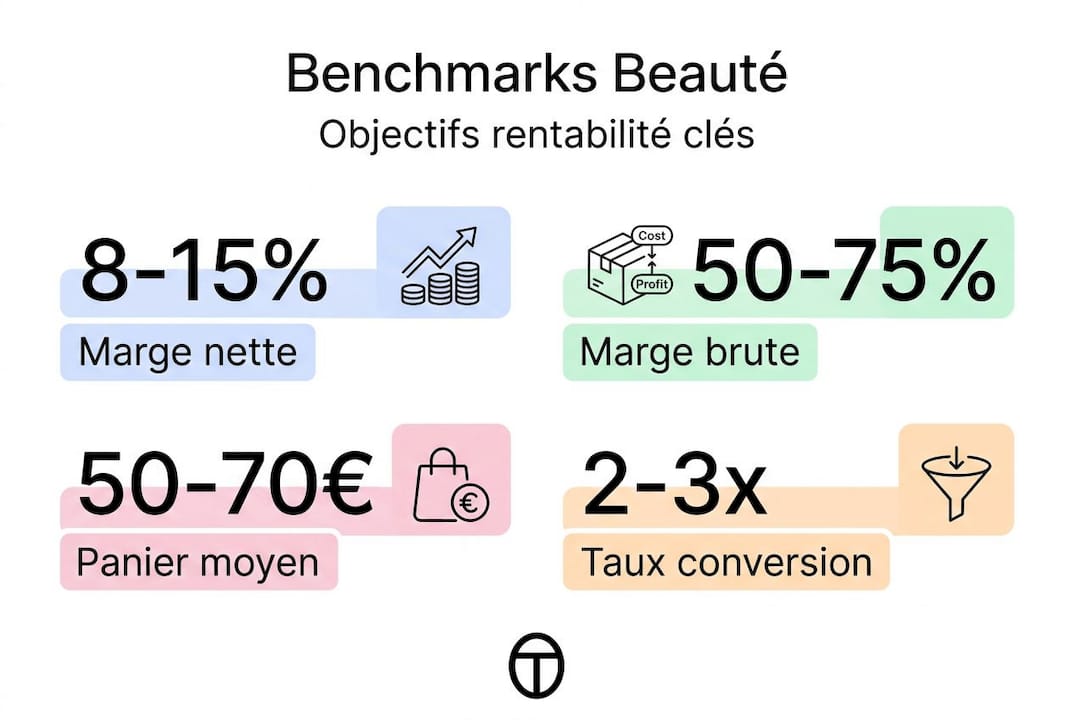
| Net margin | Net profit / Revenue × 100 | 8 to 15% |
| Conversion rate | Orders / Visitors × 100 | 1.5 to 3% |
Several factors specific to the beauty sector directly impact this real profitability. Product shelf life, cosmetic regulations (dermatological tests, INCI compliance), return costs, product photography costs, and influencer content investments are added to the usual charges of an e-commerce store. To build a high-performing e-commerce site, you must therefore incorporate these parameters from the design of your business model, not afterwards.
A classic pitfall: confusing a good month of sales with structural profitability. A peak in revenue in December linked to gift sets often hides margins compressed by promotions and stockouts. Profitability, on the other hand, is judged over time and regularity.
The main items that erode the margin in beauty e-commerce are:
- Customer acquisition costs (CAC): often underestimated, they include Meta, TikTok, Google campaigns, influencer promo codes
- Return and refund costs: between 10 and 20% depending on product categories
- Logistics costs: premium packaging, free shipping costs, preparation errors
- Platform and payment commissions: Shopify Payments, transaction fees, third-party apps
- Inventory write-offs: expired or unsellable products
Profitability calculation and break-even point: methods and pitfalls
Knowing your margins is good. Knowing at what sales level you become truly profitable is better. This is precisely what the break-even point calculation allows.

The fundamental formula is as follows: Break-even point (Revenue) = Fixed costs / Contribution margin ratio (CMR).
Here is how to apply it concretely for a beauty brand on Shopify:
- Identify your monthly fixed costs: Shopify subscription ($79 to $299 depending on the plan), salaries, rent, insurance, marketing software = for example $8,000/month
- Calculate your contribution margin ratio (CMR): if your average order value is $65 and variable costs (product + shipping + payment) = $25, then CMR = $40, or 61.5% CMR
- Apply the formula: 8,000 / 0.615 = $13,008 minimum monthly revenue to reach the break-even point
- Express in number of orders: 13,008 / 65 = approximately 200 orders per month needed
This figure is your theoretical floor. But the beauty e-commerce reality is more complex. Frequent special cases such as returns, refunds, promotional discounts, and marketplace commissions reduce the real CMR. If you sell on Amazon or Sephora at the same time, their commissions (15 to 30%) radically change your calculation. For ranges with heterogeneous contributions, use a weighted average.
Theoretical vs. real break-even comparison:
| Scenario | Theoretical CMR | Real CMR | Break-even impact |
|---|---|---|---|
| Direct site sale | 61.5% | 55% (8% returns) | +$1,450/month |
| Permanent 15% promo | 61.5% | 47% | +$3,800/month |
| Via marketplace | 61.5% | 38% (20% commission) | +$7,200/month |
Pro tip: Recalculate your break-even point every quarter by incorporating your real return rate, your average discounts granted, and your sales channel mix. An approach based on beauty e-commerce data allows you to adjust these parameters in real time and avoid unpleasant surprises at the end of the month.
Without this rigorous monitoring, you risk making investment decisions (new products, advertising campaigns, hiring) based on an obsolete break-even point that no longer reflects your operational reality.
Beauty e-commerce profitability benchmarks: what to really aim for?
The question every beauty brand founder eventually asks: are my numbers good? Here are industry benchmarks to position yourself honestly.
According to industry data, e-commerce cosmetic benchmarks indicate a net margin between 8 and 15%, an average order value of $40 to $120, and a conversion rate of 1.5 to 3% on your own site, which can reach 5 to 7% on marketplaces thanks to the higher purchase intent of visitors.
| Indicator | Low | Medium | High |
|---|---|---|---|
| Net margin | < 8% | 8 to 12% | > 12% |
| Average order value | < $40 | $40 to $80 | > $80 |
| Conversion rate (own site) | < 1.5% | 1.5 to 2.5% | > 2.5% |
| Acquisition cost (CAC) | > $35 | $15 to $35 | < $15 |
| LTV/CAC ratio | < 2 | 2 to 3 | > 3 |
These figures are not absolutes. They vary depending on your positioning (entry-level, masstige, luxury), your channel mix, and your development stage. A young brand in the acquisition phase with an acceptable LTV/CAC of 1.8 can still be on a healthy trajectory if its customer retention is progressing.
Key ratios to monitor and contextualize constantly:
- LTV (Lifetime Value): total value generated by a customer over their entire relationship with your brand. The higher it is, the higher a CAC you can afford
- Repeat purchase rate: in beauty, aiming for 30 to 45% recurring customers over 12 months is a good goal
- AOV (Average Order Value): your average order value is directly linked to your ability to bundle and upsell
- Cart abandonment rate: the e-commerce average is around 70%, but with good UX practices, you can get below 60%
To achieve these performances, user experience plays a central role. The best beauty UX practices on Shopify show that smooth navigation, immersive product visuals, and well-structured category pages can alone improve the conversion rate by 0.5 to 1 point. To go further, there are structured strategies to optimize your Shopify conversions specifically adapted to the codes of beauty.
Optimizing profitability on Shopify: UX and sales levers
Knowing your benchmarks is knowing where you are. Acting on the right levers is deciding where you are going. Here are the high-impact actions to concretely improve your profitability.
-
Bundles and group offers: creating themed sets (skincare routine, discovery kit) mechanically increases the AOV. According to industry data, bundles and upsells can generate between $15 and $35 of additional AOV per order. On Shopify, apps like Bold Bundles or Frequently Bought Together facilitate this setup without custom development.
-
UGC and influencer content: authentic customer reviews, before/afters, and usage videos increase trust and reduce purchase hesitations. A higher conversion rate without increasing your CAC directly improves your operating margin.
-
AI and personalized beauty diagnosis: skin analysis tools using artificial intelligence (skin quiz, AR try-on) reduce returns by helping the customer choose the right product. Fewer returns = real margin preserved. It is a technical investment that pays off in a few months.
-
Automated cart abandonment reminders: a well-designed email and SMS flow can recover 10 to 15% of abandoned carts. With Shopify Flow or Klaviyo, these automations are accessible to brands of all sizes.
-
Loyalty program: increasing LTV is often less costly than acquiring new customers. A points program, exclusive offers for subscribers, or a recurring subscription model (for daily skincare) transforms your economy in the long term.
-
BNPL (Buy Now Pay Later): Klarna, Alma, or Scalapay increase conversion on medium and high average orders, but their fees range between 2 and 8% depending on volumes. Integrate with discernment according to your existing gross margin.
"Profitability optimization is not done with a single lever, but through the coherent combination of customer experience, data, and margin strategy. A store that performs as much as it seduces is one that builds a lasting relationship with its customers."
Pro tip: Systematically analyze customer feedback from those who abandoned their cart (post-visit surveys, heatmaps, session recordings via Hotjar or Microsoft Clarity). Often, it is not the price that blocks, but a doubt about the product's compatibility with their skin type or a lack of reassurance (reviews, clear return policy). These insights are free and valuable. For specific beauty conversion strategies, a few targeted adjustments can transform your results. Also discover how to boost your beauty sales through concrete actions tested in our practice. For a structured overview, our guide on Shopify optimization covers all technical and commercial parameters.
What few beauty brands understand (and how to reverse the trend)
Since 2018, we have been supporting beauty and cosmetic brands on Shopify. And the same pattern comes back with disconcerting regularity: brilliant founders, excellent products, campaigns that generate traffic… and profitability that does not take off.
The problem is almost never the product. It is in the absence of a clear economic vision.
The first mistake: treating the break-even point as a fixed calculation. As we have seen, the theoretical break-even point is systematically more optimistic than operational reality, notably due to returns, discounts, and multi-channel fragmentation. Many brands discover too late that they are losing money on certain channels while believing they are profitable overall.
The second mistake: optimizing short-term advertising ROI while ignoring LTV. A 3x ROAS (Return On Ad Spend) may seem excellent, but if that customer only buys once and never returns, you have spent money for nothing in the long term. Truly successful brands do not chase advertising hype; they build a loyal customer base whose cumulative value justifies the initial investment.
The third mistake, perhaps the deepest: thinking that more traffic solves all problems. It does not. Driving 10,000 visitors to a store with a flawed UX, amateur visuals, or a confusing checkout funnel will only produce frustration and inflated acquisition costs. Brands that truly grow invest first in their foundation—that is, their store, their content, and their retention strategy—before scaling with advertising.
Our conviction, forged through dozens of projects: a data-driven strategy combined with a polished customer experience systematically outperforms an aggressive advertising strategy without a solid foundation. This is not an opinion. It is what we observe in our clients' data, quarter after quarter.
Looking to boost the profitability of your beauty e-commerce business?
Understanding the metrics is one thing. Turning them into concrete actions that sustainably improve your profitability on Shopify is another. At Tamara Agency, we support beauty and cosmetics brands that want to move beyond the "sales without margins" mindset and build a truly high-performing e-commerce model.

Whether you are starting from scratch or looking to revamp an existing store, we offer a tailored approach that integrates UX, sales performance, and brand vision. From strategy to technical execution, including monthly KPI tracking, our team is dedicated to growing your brand sustainably. Discover our full range of services on our services page, explore our solutions for optimizing your Shopify store, or get started with our Shopify store creation support.
Frequently Asked Questions
What is the difference between gross, operating, and net profitability?
Gross, operating, and net margins each measure a different level of cost deduction: gross margin subtracts the cost of goods, operating margin includes fixed costs, and net margin reflects the final profit after all expenses and taxes.
Which levers have the greatest impact on beauty e-commerce profitability?
Bundles, upsells, and abandoned cart reminders are among the most effective, with AOV increases of €15 to €35 per order, complemented by UGC, AI skin analysis, and loyalty programs to improve LTV.
Why does the actual break-even point often differ from the theoretical one?
Because returns, discounts, and marketplace commissions reduce the actual margin on variable costs compared to the initial assumptions of the calculation, sometimes significantly depending on the channel mix and promotional policy.
What are the profitability benchmarks for a cosmetics brand?
Cosmetics industry benchmarks indicate a target net margin of 8% to 15%, an average order value of €40 to €120, and a conversion rate of 1.5% to 3% on a brand's own website—benchmarks that should be contextualized according to your positioning and distribution channels.
Recommendation
- Beauty E-commerce: Definition, Challenges, and Key Levers – Tamara Agency
- Boost Your Beauty Sales: Shopify E-commerce Solutions – Tamara Agency
- Branding Strategies: A Guide for Beauty E-commerce – Tamara Agency
- Digital Merchandising: The Key to Boosting E-commerce Sales – Tamara Agency
- Positioning a Beauty Brand: Your Guide to E-commerce Success