

Shopify Audit: Boost Your Store's Performance
TL;DR:
- A Shopify audit reveals invisible barriers such as slowness or a lack of trust signals, which hinder conversion. It must cover SEO, technical, UX, performance, CRO, and analytics to provide concrete, prioritized recommendations. Trust signals are often underestimated but essential in sectors like beauty or fashion to transform the customer experience.
A visually polished Shopify store can easily drive visitors away without you realizing it. An elegant design does not guarantee conversion, and that is precisely where one of the most common blind spots lies for beauty, fashion, and wellness brands. Slow pages, missing trust signals, a poorly structured shopping journey: all these are invisible barriers that cost sales every day. A Shopify audit can reveal exactly these blockers, prioritize them, and enable you to take precise action. This guide explains the process, the expected results, and how to apply them concretely to your store.
Table of Contents
- Definition and objectives of a Shopify audit
- The main areas of analysis in a Shopify audit
- Benchmarks and maturity signals: what audits reveal
- How to apply the recommendations of a Shopify audit
- Why trust signals are the real forgotten lever
- Take action: optimize your store with Shopify experts
- Frequently asked questions about Shopify audits
Key Points
| Point | Details |
|---|---|
| Shopify audit: an essential tool | A structured audit helps unlock visibility and conversion on Shopify. |
| Trust signals are a priority | Trust (delivery, social proof, reassurance) impacts performance more than visual UX. |
| Benchmarks to guide action | Benchmark analysis reveals underutilized levers and priorities to address. |
| Tailored action | Every audit recommendation must be adapted to the brand's specificities and its audience. |
| Expert guidance | Specialized agencies facilitate the implementation of audits and optimizations. |
Definition and objectives of a Shopify audit
Before committing resources to changes, you must first understand what a Shopify audit really is and why it is essential for an ambitious brand in this sector.
A structured Shopify audit is a comprehensive review of your store covering SEO, technical, UX, performance, conversion (CRO), configuration, and analytics, with the goal of identifying what hinders discovery and, above all, purchases, and then providing actionable recommendations. It is not a simple aesthetic review. It is a multi-layered diagnosis that reveals problems often invisible to the naked eye.
An audit is not a judgment on your brand's visual identity. It is an objective analysis of what prevents your visitors from becoming your customers.
The Shopify site audit is not limited to aesthetics: Shopify recommends evaluating technical dimensions such as Core Web Vitals, as well as quality, UX, and organic search ranking. This means that even a store with a premium theme and beautiful product photos can suffer from critical technical or SEO issues.
The main objectives of a Shopify audit for a beauty or fashion brand are as follows:
- Identify conversion barriers: cart abandonment, slow pages, confusing shopping journeys
- Evaluate SEO visibility: URL structure, meta tags, internal linking, indexing
- Check technical health: loading speed, 404 errors, security, mobile compatibility
- Measure UX quality: navigation clarity, readability, visual hierarchy, accessibility
- Analyze analytics tracking: Google Analytics configuration, pixels, conversion events
To learn more about the impact of UX on your sales, our Shopify conversion UX analysis details how beauty brands can optimize every step of the customer journey. You can also consult our Shopify performance checklist for an overview of the points to check.
The main areas of analysis in a Shopify audit
After defining the audit, it is essential to understand the areas evaluated during this process. Each dimension has a direct impact on your store's commercial performance, and none should be neglected.
The Shopify site audit teaches that technical dimensions, such as Core Web Vitals, UX quality, and organic search ranking are all equally important. Here is how these areas are distributed in practice:
| Analysis area | Elements evaluated | Impact on beauty/fashion |
|---|---|---|
| Technical | Speed, Core Web Vitals, mobile, security | Bounce rate, mobile experience |
| SEO | URLs, tags, content, linking | Organic traffic, product visibility |
| UX/UI | Navigation, clarity, accessibility | Trust, ease of purchase |
| CRO | CTAs, trust signals, checkout tunnel | Conversion, revenue |
| Analytics | Tracking, events, pixels, goals | Informed decisions, measurable ROI |
The technical area is often the first to reveal surprises. A site that takes more than 3 seconds to load loses on average a significant portion of its visitors before they even see your products. For beauty brands that invest in beautiful high-resolution images, media optimization is often the first concrete recommendation of an audit. The best UX practices for beauty on Shopify show how to combine aesthetics and technical performance.

The UX area goes far beyond design. It is about measuring whether a visitor can intuitively find what they are looking for, understand your offer in a few seconds, and place an order without friction. A poorly structured navigation, missing collection filters, or incomplete product pages are classic UX problems that weigh down conversion. The Shopify page organization provides a good benchmark for the expected structure of a high-performing store.
The CRO area (conversion rate optimization) concerns everything that encourages or hinders the purchase. Call-to-action buttons, displayed guarantees, customer reviews, delivery information: every detail counts. The micro-interactions for Shopify conversion illustrate how small visual and functional adjustments can have a measurable impact on your revenue.
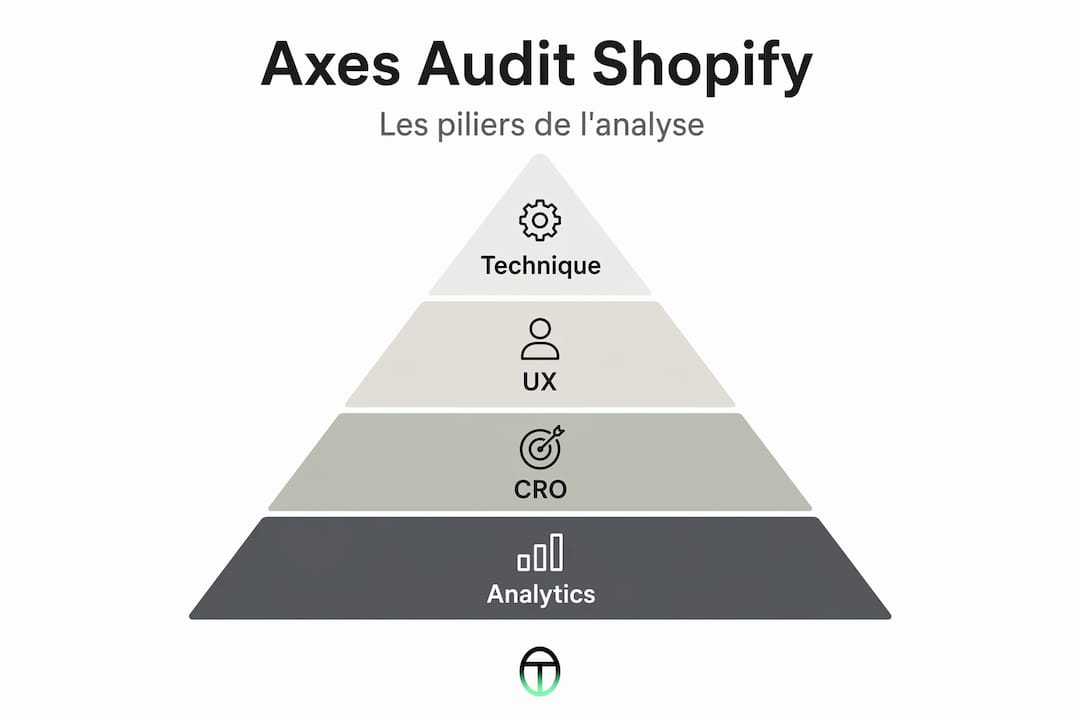
Pro tip: Always start with the technical area before investing in UX or CRO improvements. A slow or poorly indexed site will limit the effectiveness of all your other optimizations, no matter how carefully crafted. A high-performing Shopify beauty site is the foundation on which everything else rests.
The analytics area is often the most neglected. Without correctly configured tracking, you are flying blind. An analytics audit verifies that your conversion events are properly reported, that your pixels are working, and that your data is reliable for making good decisions. Many Shopify stores operate with partial or incorrect data without knowing it.
Benchmarks and maturity signals: what audits reveal
Once the audited areas are clarified, it is useful to rely on benchmarks to understand the maturity of your store and guide your priorities.
Shopify CRO benchmarks show that audits frequently use tool adoption and "stack" benchmarks (tracking, emails, reviews, etc.) as indirect signals of CRO maturity, as some levers are often underutilized. In other words, it is not only the design of your store that signals your performance level, but also the set of tools you have correctly integrated and configured.
What is the CRO "stack"? It is the set of tools that support your ability to convert: email marketing, customer review management, loyalty program, retargeting tools, chatbot, post-purchase upsell. The Shopify CRO benchmark data reveals the most frequent types of gaps in audited stores, with trust signals at the top of the list.
61% of audited Shopify stores have critical gaps in trust signals. This is the most frequently identified gap, even before technical or UX problems.
This figure is particularly telling for beauty and fashion brands. Why? Because in these sectors, the buyer makes an emotional decision as much as a rational one. They need to feel reassured before buying a skincare product, perfume, or piece of clothing online. Without solid social proof, without clear information on returns, without visible guarantees, they leave.
The gaps most frequently identified during beauty/fashion/wellness store audits are:
- Absence or insufficiency of customer reviews: no review widget on the product page, or too few reviews
- Unclear delivery information: no estimated delivery times, no clearly accessible return policy
- Incomplete marketing stack: missing or poorly configured automated emails (cart abandonment, welcome, etc.)
- Faulty tracking: unverified pixels, missing events, partial Google Analytics data
- Invisible security signals: absence of a visible HTTPS logo, secure payment badges, accessible legal notices
To improve your visibility and attract more qualified traffic, our guide to improve SEO on Shopify is a valuable complementary resource. And if you want an overview of the audit process, our complete Shopify e-commerce audit guide will guide you step by step.
The Shopify e-commerce resources available online confirm this trend: the best-performing stores are not necessarily the most beautiful, but those that best reassure their visitors and have a coherent and well-configured tool stack.
How to apply the recommendations of a Shopify audit
Relying on identified benchmarks and gaps, it becomes essential to transform the audit into an effective action plan. An audit without concrete implementation is useless. Here is a structured method to go from analysis to action.
1. Prioritize according to impact and ease of execution
Not all recommendations have the same weight. Some technical fixes can double your loading speed in a few hours. Others, such as a complete navigation redesign, require several weeks. Classify your actions into three categories: quick wins (fast and high impact), medium-term improvements, and structural projects.
2. Implement the recommended stack tools
If your audit reveals that you do not have a cart abandonment email sequence, that is your number one priority. This type of automation can recover between 5% and 15% of abandoned carts depending on the sector. Likewise, a customer review collection tool like Judge.me or Okendo is essential to build your social proof. These tools integrate directly with Shopify and can be activated in a few hours.
3. Review trust signals
Shopify conversion benchmarks show that trust (proof, delivery expectations, return information, stock, and CTA) is a more frequent failure area than certain visual UX elements. For beauty and fashion brands, this often means revisiting messaging, social proof, and reassurance, without over-optimizing only the interface.
Concretely, this means:
- Clearly display delivery times on each product page
- Make the return policy accessible in one click from the product page
- Add a customer review section with a visible overall score
- Place secure payment badges in the checkout tunnel
- Use photo or video testimonials to reinforce authenticity
4. Avoid the trap of visual over-optimization
This is a common mistake. We change button colors, reorganize images, test new fonts, but forget to review trust messages or activate automated emails. The interface matters, but it is not everything. A perfectly positioned "Add to Cart" button does not convert if the buyer doubts the reliability of your store.
5. Measure and iterate
After each group of changes, measure the impact on your key metrics: conversion rate, cart abandonment rate, average order value. Without measurement, you do not know what works. This is the very principle of CRO: test, measure, improve. Our Shopify conversion UX/UI guide helps you frame this continuous improvement process.
Pro tip: Do not launch all your changes at the same time. Introduce changes in coherent groups to isolate effects and clearly identify what improves your performance. A total redesign all at once makes analysis impossible.
Our guide on Shopify conversion optimization details the most effective levers according to brand types and sales cycles.
Why trust signals are the real forgotten lever
Here is what we have observed for years on the stores we audit: brands invest in design, photography, and advertising, but they systematically neglect their trust signals. And that is precisely where sales are lost.
Shopify audit benchmarks reveal that trust-related gaps consistently appear more frequently than other types of deficiencies. This is no coincidence. It reflects a cognitive bias in how brands think about their stores: they see themselves as a showcase, while their customers are primarily looking for reassurance.
In the beauty, fashion, and wellness sectors, the act of purchasing is deeply emotional. Buying an anti-aging treatment or a dress for a special occasion involves a degree of vulnerability. The buyer asks themselves: “Will this product really work for me? Is this brand reliable? What happens if it’s not right for me?”
No micro-interaction, however thoughtfully designed, will answer these questions. Only clear, concrete, and well-placed trust signals can do that. A product page with 200 verified reviews, a photo of the founder explaining her philosophy, and a free return policy with no questions asked: that’s what converts.
At Tamara Agency, we believe that a Shopify audit is not an end in itself. It is a diagnostic tool. It highlights the gap between the experience you think you are offering and what your visitors actually perceive. And in the vast majority of cases, this gap lies less in aesthetics than in the ability to inspire trust. A website must perform as well as it appeals.
Take action: optimize your store with Shopify experts
You now have a clear understanding of what a Shopify audit is, the areas it covers, and how to implement its recommendations. The question is no longer “Should we conduct an audit?” but “How can we take effective action?”

At Tamara Agency, we have been supporting beauty, fashion, and wellness brands with these exact challenges since 2018. Our approach combines strategic auditing, concrete recommendations, and technical implementation to deliver measurable results. Whether you want to optimize an existing store or start on a solid foundation, we have the tools and industry expertise to support you. Discover our Shopify store optimization service, our Shopify beauty store creation offering, or our specialized Shopify training program to help you build your skills independently.
Frequently asked questions about Shopify audits
How long does a complete Shopify audit take?
A Shopify store audit generally takes 5 to 10 days to deliver detailed results, depending on the size and complexity of the site.
What immediate benefits can be gained from a Shopify audit?
The audit quickly identifies bottlenecks and provides actionable recommendations to optimize conversion within the first few weeks of implementation.
Should a Shopify audit be repeated every year?
An annual audit is recommended to maintain performance, but it may also be useful after each redesign or new product line launch, as technical and UX factors evolve rapidly.
Which levers are most often underutilized during a Shopify audit?
Trust signals and tech stack tools (tracking, email, reviews) are frequently overlooked, even though Shopify CRO benchmarks show that they play a key role in conversion.
Can you optimize your Shopify store without a complete audit?
Yes, but optimization without a precise diagnosis risks overlooking invisible barriers. An audit helps prioritize effective action where the impact will be truly measurable.